

This page was translated automatically using artificial intelligence (DeepL). The German version is binding. More information about automatic translation
News Intranet
This page was translated automatically using artificial intelligence (DeepL). The German version is binding. More information about automatic translation

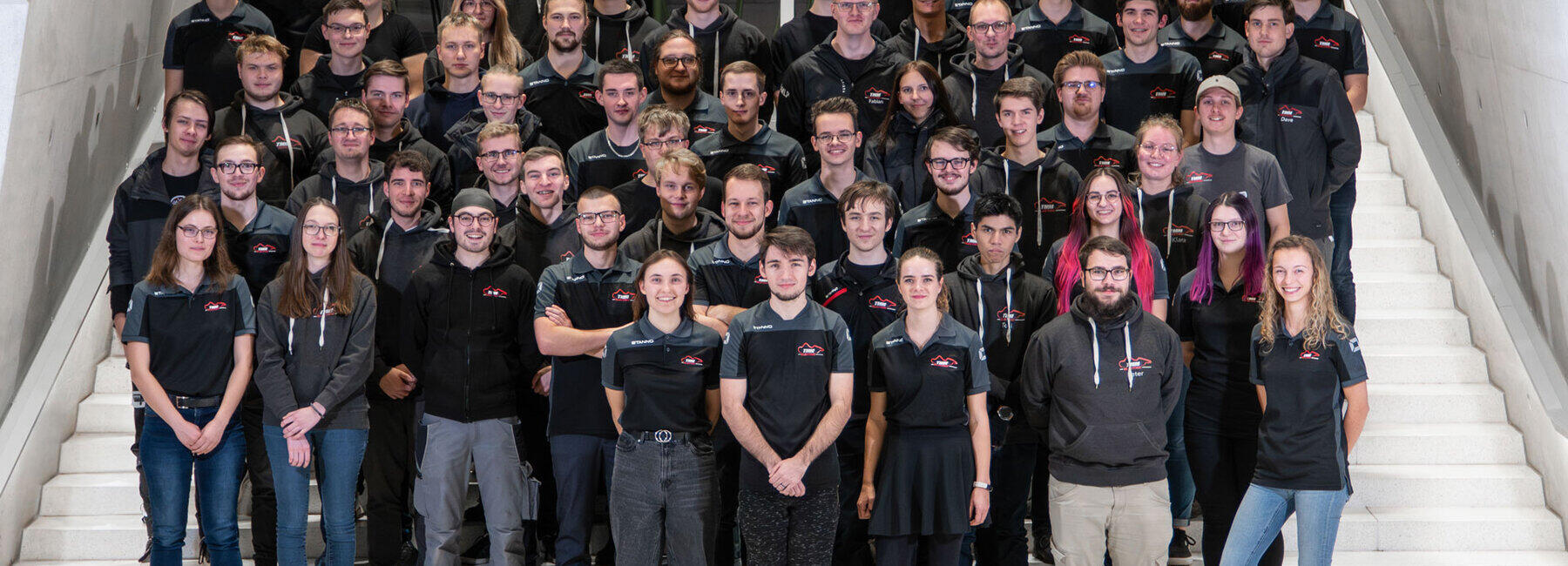
Technikum Mittweida Motorsport (TMM) is one of 500 teams competing in the international Formula Student, a challenging student design competition for racing cars. Since 2006, TMM has continued to develop, having now designed and built eight racing cars. The two most recent, El Cobra and Black Mamba, are electric. The electric racing car for the upcoming 2024 season – a further development based on the Black Mamba – is in the final stages of design and is being optimised for use at Formula Student events, which take place at renowned venues such as the Hockenheimring.
In terms of structure, TMM is no different from a professional racing team. This is because the Formula Student team’s responsibilities extend beyond the design, construction and manufacture of the vehicle to include financing, marketing and the planning of racing strategy. Consequently, there are commercial and technical departments with different roles for students from all faculties at Mittweida University of Applied Sciences. However, they all work towards a single goal: to succeed in the races. It is not just about the fastest lap. In addition to speed and acceleration, the assessment also takes into account efficiency, reliability, design and cost management.
The interplay between 5 and 462 volts
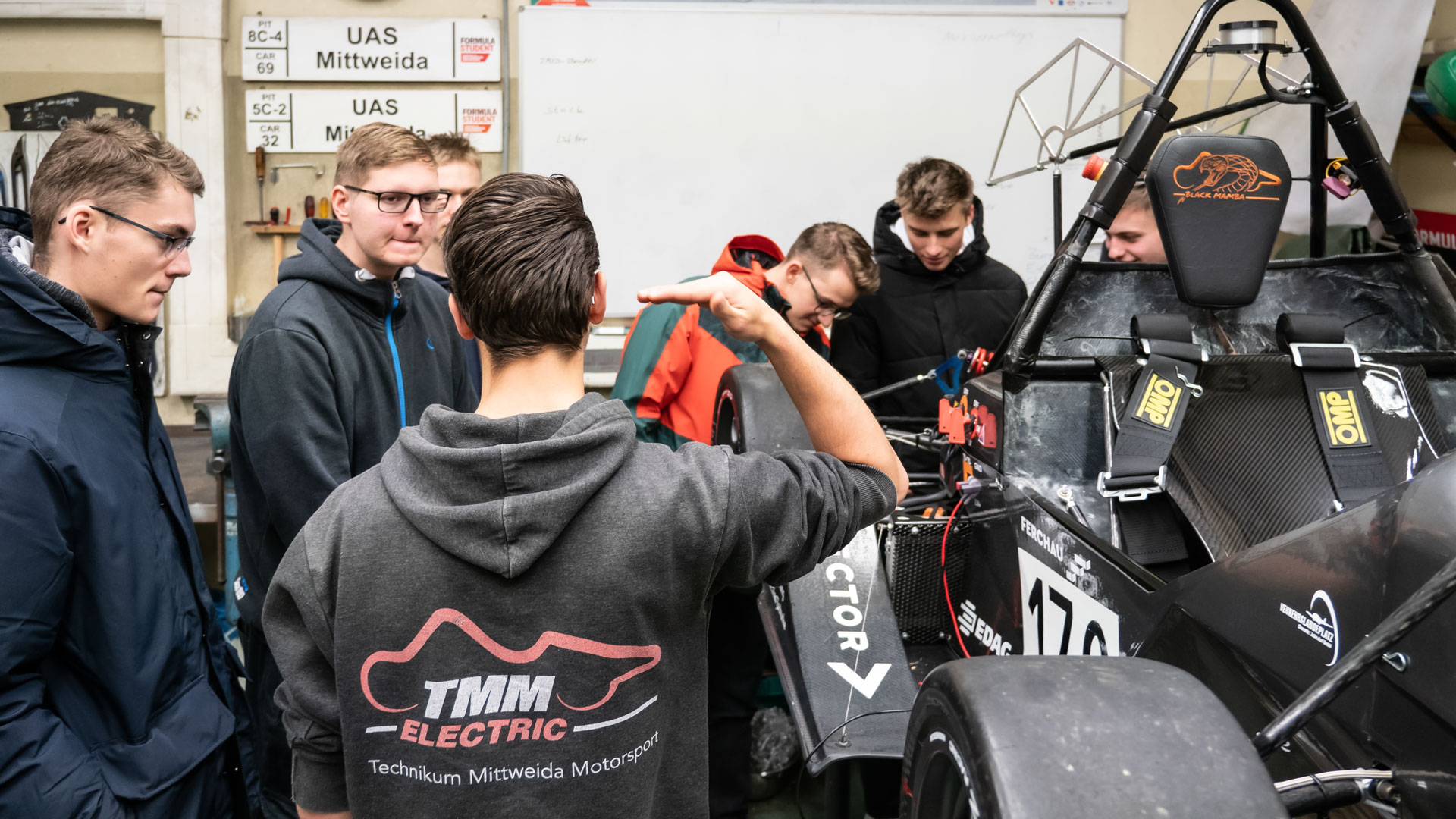
It stands to reason, given that this is an electric racing car: the Electrical Engineering department is one of TMM’s most important departments. Its head, Fabian Jugel, is in his fifth semester studying Electrical Engineering – Automation, specialising in Industry 4.0, and gives an insight into the work of his 23-strong team. “We play a key role, from the development of the high-voltage battery through to the manufacture of circuit boards and the assembly of the wiring harness. With an electric car, it’s all about how the components work together – from the chassis and frame right through to the fine-tuning of the motor. Ultimately, we have to create a system that is robust, safe and controllable in every respect.” The battery must always supply the racing car with sufficient energy during race events on the demanding 22-kilometre endurance circuit, despite fluctuating power demands. “If it’s too small, we’ll be too slow or come to a standstill. If it’s too big, the car will be too heavy,” says Fabian Jugel. Determining the exact capacity required is therefore crucial. And then it’s on to the design phase, because you can’t just buy a battery like that off the shelf.”
The high-voltage battery (462 volts) for the TMM racing car undergoes a demanding process, from the design of the aluminium casing, individual segments, the control compartment and the circuit boards, right through to the individual battery cells, which are painstakingly welded together. There is a dedicated team within the electrical engineering department responsible for the circuit boards in the high- and low-voltage ranges. Here, too, there are no off-the-shelf components. Everything is designed in Mittweida and then assembled by specialist firms that support TMM as sponsors. The wiring harness, which connects all the electrical components in the vehicle, is manufactured entirely in Mittweida.

The interaction between hardware and software
Having been part of the Electrical Engineering department until last year, the student software specialists now work closely with their colleagues from the Electrical Engineering department as a separate team. John Robin Pfeifer heads the team. The 21-year-old is in his third semester of Applied Computer Science, specialising in Software Development. “Due to the growing importance of software, we now operate independently and focus on battery management and vehicle control, as well as in-vehicle communication, which takes place via a CAN bus. In doing so, we continuously collect data on the status of all systems. This is essential for optimising the car and, of course, a necessary safety measure.”
It’s still a long way off for TMM this season, but the software department led by John Robin Pfeifer is also working on autonomous driving. ‘Driverless’ competitions are already being held as part of the Formula Student Driverless Cup. Cameras and sensors recognise predefined routes using coloured markings. A programme – developed in-house – interprets the data to safely navigate around obstacles.
Collaboration between students and sponsors
TMM relies not only on the dedicated students at Mittweida University of Applied Sciences, but also on numerous sponsors who help the team to overcome the challenges of the current season. Sponsors also provide valuable expertise and services, or contribute to the funding of, for example, travel costs and entry fees. A new financial supporter for the 2024 season is iGaming, a specialist agency for digital topics, online marketing and web development.