

This page was translated automatically using artificial intelligence (DeepL). The German version is binding. More information about automatic translation
News Intranet
This page was translated automatically using artificial intelligence (DeepL). The German version is binding. More information about automatic translation
Self-determined participation in social and professional life is a precious asset, but one which, unfortunately, not everyone enjoys to the same extent in their everyday lives. Improving opportunities for participation and active involvement is a key task of Social Work. Accordingly, it is important for future social workers to recognise and analyse people’s life situations and needs, and to draw conclusions from these that inform their professional practice. In the Bachelor’s degree programme in Social Work at Mittweida University of Applied Sciences, age and life situations play a major role throughout all semesters. In the module ‘Coping with Life Situations’, for example, students learn to recognise specific stressful situations in areas such as health, illness and disability, and to alleviate them using various approaches.
Learning and acquiring the skills needed to act professionally takes place at Mittweida not only in theory but also in a very practical way. This applies to all degree programmes, not just Social Work, where the focus is on people.
During the summer term, fifth-semester students collaborated with the Chemnitz City Mission, which, amongst other things, runs the ‘Club Heinrich’ day centre and the partner workshops for people with disabilities (WfbM). The aim was to gain an understanding of the opportunities for participation available to people with disabilities and to identify areas for improvement.
Working with clients
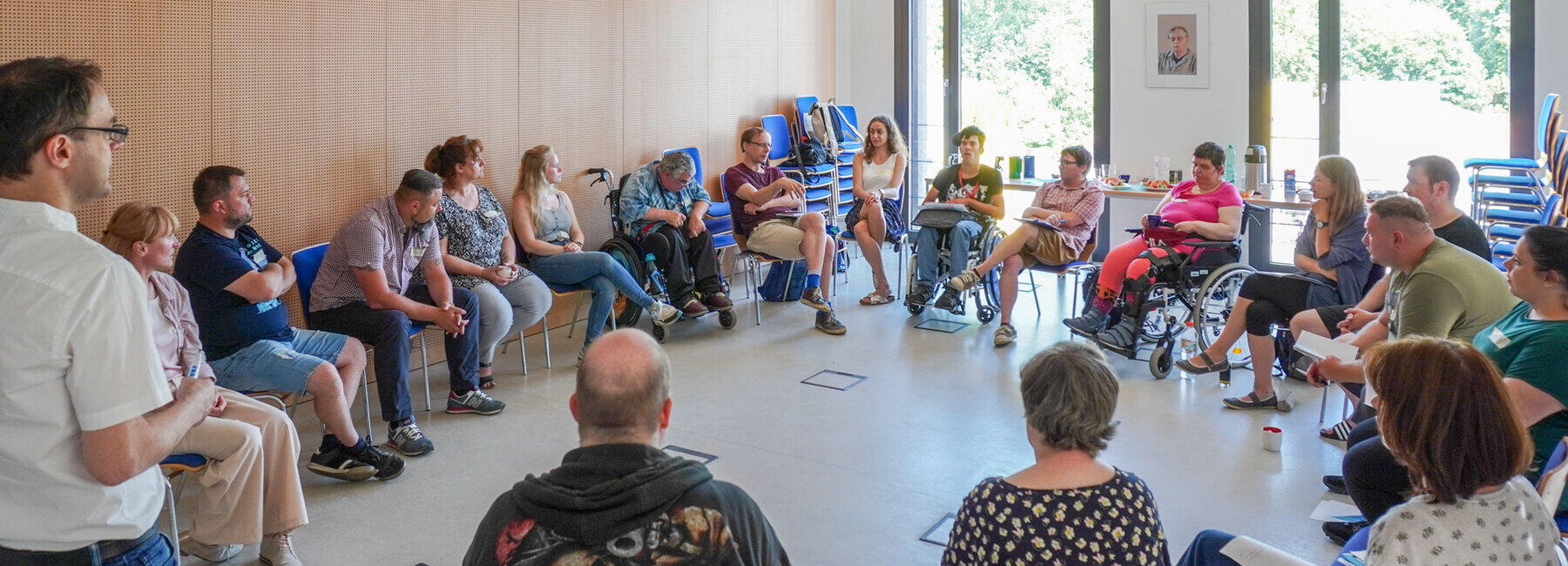
To this end, the students ran two workshops in Chemnitz with a group of employees with disabilities from the WfbM, focusing on the topics of leisure and work. In April, for example, they asked them about their shared leisure activities at the day centre and about their experiences and wishes regarding group trips. The second workshop, held at the end of May, focused on the topic of work and the conditions surrounding it. In group discussions, the people with disabilities described their opportunities for participation and their wishes for improvements.
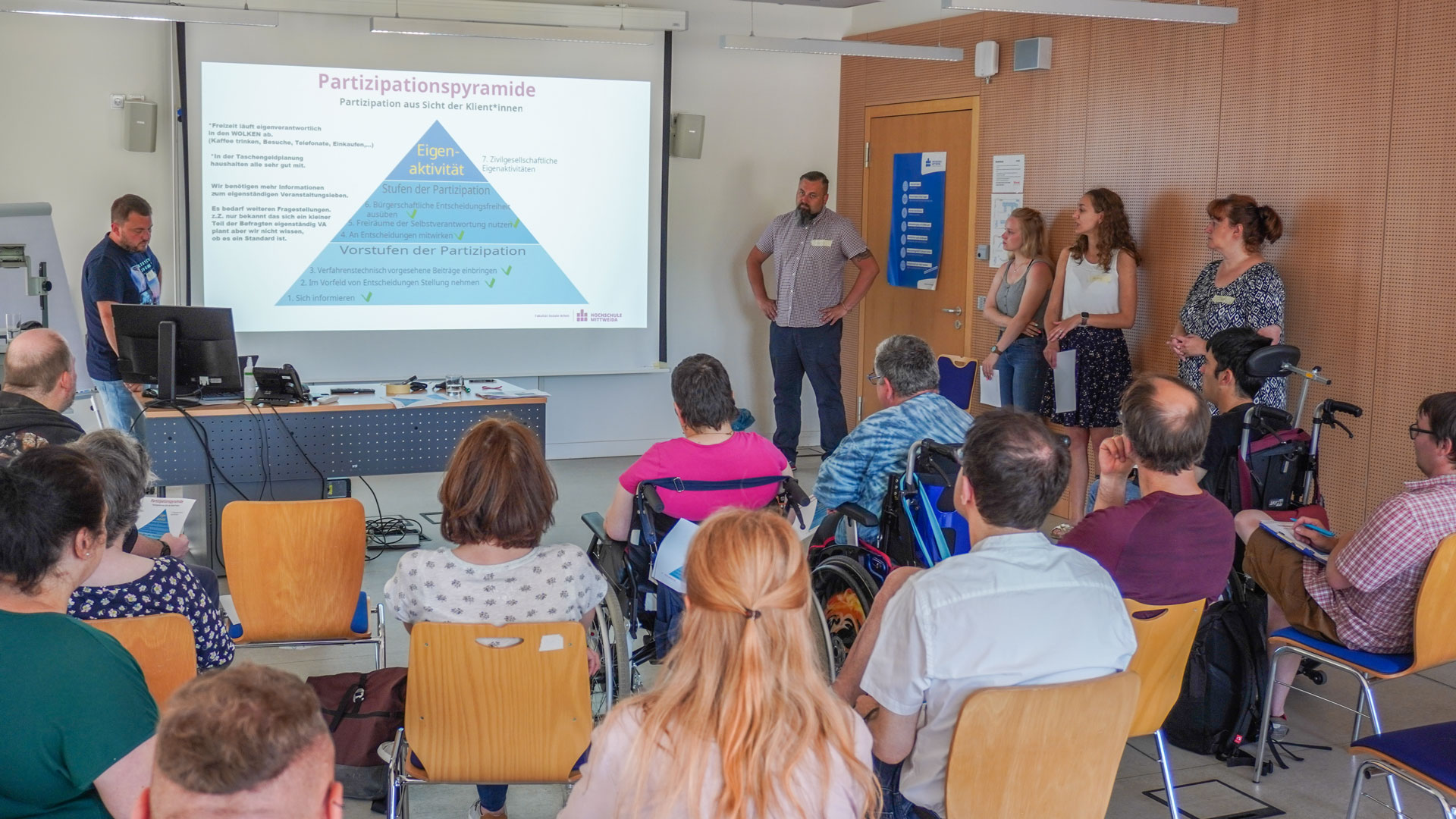
The students evaluated the workshops and categorised the existing opportunities for participation available to people with disabilities according to the individual levels of Straßburger/Rieger’s participation pyramid, which distinguishes between the preliminary stages of participation, levels of participation and self-directed activities in a differentiated and reasoned manner. The model helped the students to develop measures to promote greater participation, based on the workshop results and further research. They presented these measures to people with disabilities and their support workers at Mittweida University of Applied Sciences on 26 June 2023.
The proposals were subsequently the subject of lively discussion. The focus was, for example, on the workshop council, in which people with disabilities represent their interests within the workshop. To make it easier for new members to join this key participation body, the students proposed that, in line with the peer support approach, mentors with disabilities could support the newcomers. A taster period for those interested was also suggested as a suitable measure.
Proposals for greater participation were also drawn up for the WfbM: an information board featuring the social workers and other WfbM staff could make it easier for people with disabilities to get in touch. Regular surveys could help ensure that the dietary preferences of people with disabilities are taken into account more effectively in the canteen. Workshop manager Heiko Wünsche was delighted with the number of suggestions and gave many of them an immediate positive response.
A win-win situation
Prof. Dr Sebastian Noll, Professor of Social Management/Social Economy at the Faculty of Social Sciences at Mittweida University of Applied Sciences, supervised the students’ work during the summer term: “Our seminar is a win-win situation: On the one hand, we have drawn up proposals for improvements for the Chemnitz City Mission, and people with disabilities will be able to benefit in future from concrete improvements to their opportunities for participation. On the other hand, my students have gained practical insight into the issue of participation for people with disabilities through a real-world example. They designed the workshop concepts, organised and led the sessions, and engaged intensively with the actual on-the-ground practice in order to apply the methods and theories they had learnt and thus learn from the experience themselves.”
This is how the transfer of knowledge between academia and practice succeeds in both directions. There are many other examples of this at Mittweida University of Applied Sciences.
The Faculty of Social Sciences offers the degree programme of the same name at both Bachelor’s and Master’s level. For both, there is a variant that can be combined with full-time employment.