

This page was translated automatically using artificial intelligence (DeepL). The German version is binding. More information about automatic translation
News Intranet
This page was translated automatically using artificial intelligence (DeepL). The German version is binding. More information about automatic translation
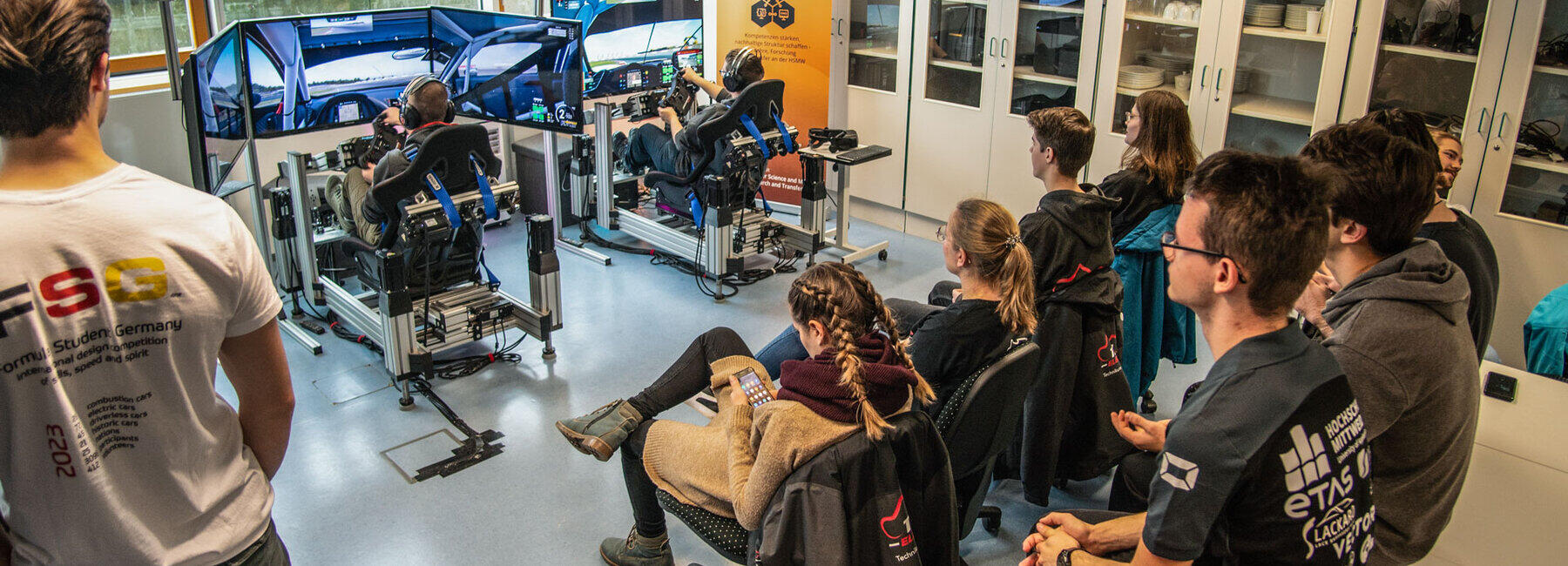
They’re doing it just like the pros at the major Formula racing teams: testing their driving skills on a simulator. The Formula Student team from Technikum Mittweida Motorsport (TMM) can draw on on-site resources for this: the university’s ‘Motion Simulation & Software Development’ Living Lab offers a range of driving simulators and expertise in the simulation-based optimisation of racing cars from various manufacturers.
During their most recent visit to the Living Lab on 25 November, however, the TMM team focused on having fun and enjoying some friendly competition; after all, even team members who had never driven a racing car in real life were given the chance to race around the Nürburgring’s Grand Prix circuit. “It was surprisingly dynamic and great fun. I’d definitely love to do it again,” says Klara Löffler, who is responsible for the wiring harness at TMM.

In a friendly yet competitive event, she had previously secured her starting position during qualifying on the driving simulators. The actual race then followed. For the final round involving the top five drivers, however, it was not simply the race position that counted, but the fastest valid lap time for each driver. A lap time was only considered valid if the virtual car did not leave the track at any point during the entire lap. Damage to the car also played a role, forcing some drivers into the pit lane, which cost them valuable lap time.
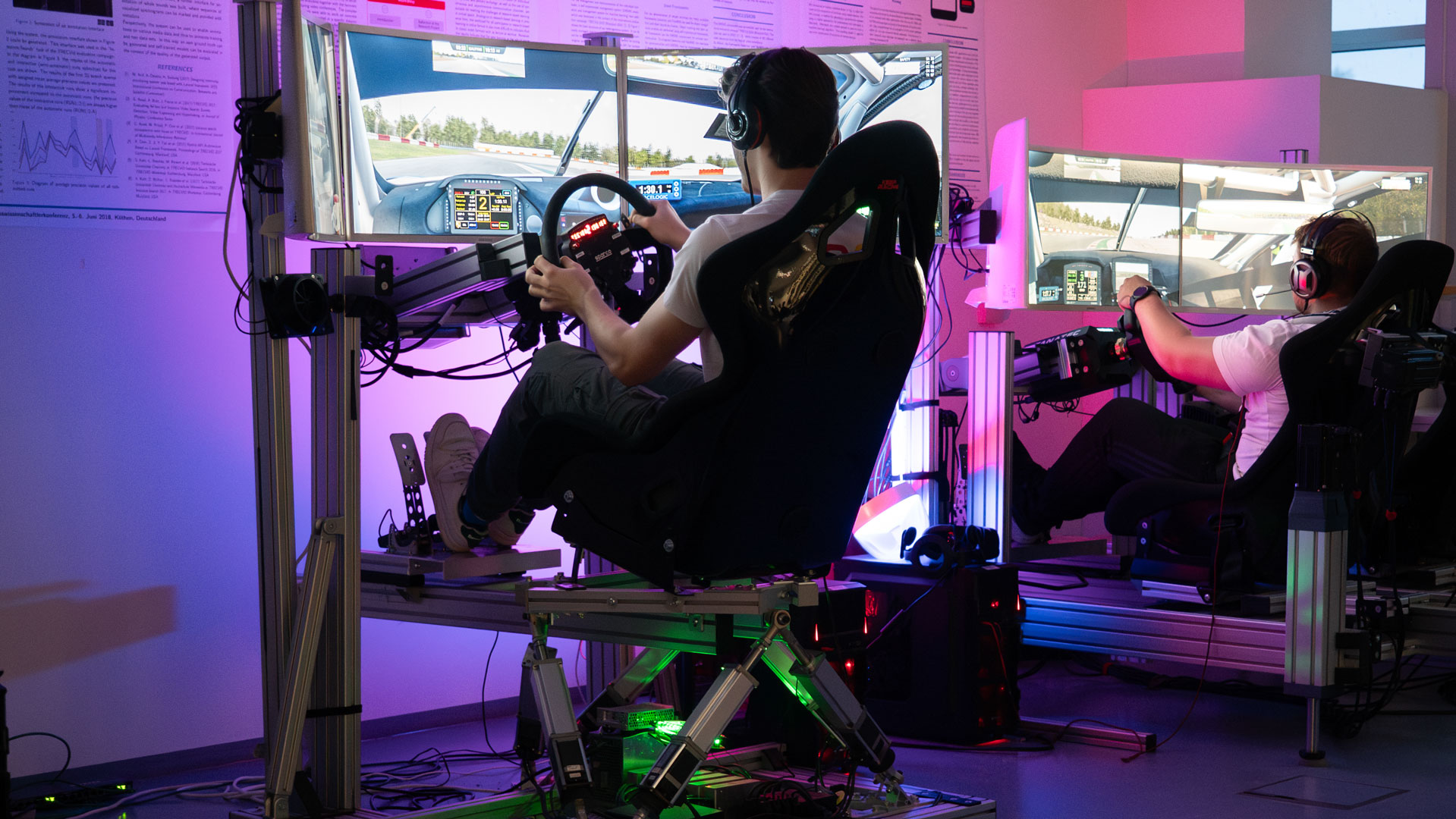
“For me, it was a really intense and immersive experience. It’s just as much fun as driving one of our racing cars – the only things missing are the real sounds, smells and the wind in your hair,” says Paul Reuther, who should know, as he is one of the drivers of the current electric TMM racing car.
The “Motion Simulation & Software Development” Living Lab at the university’s Institute for Computer Science and Media in Research and Transfer is, of course, not solely dedicated to the enjoyment of driving simulators. “In the lab, we aim to directly integrate research and teaching and to link real-world and virtual experiences more closely in the context of automotive simulations,” says Professor Matthias Vodel, head of the lab. “To do this, we use measurement data from real vehicles and adapt the characteristics of the virtual scenario on this basis. This involves, on the one hand, the direct configuration of the motion simulators, and on the other hand, the optimisation of the vehicle models within the simulation software.”
Typical of Mittweida University of Applied Sciences: studying with a practical focus
This enables students to gain an early insight into research at Mittweida University of Applied Sciences, whilst applying and deepening their fundamental knowledge.
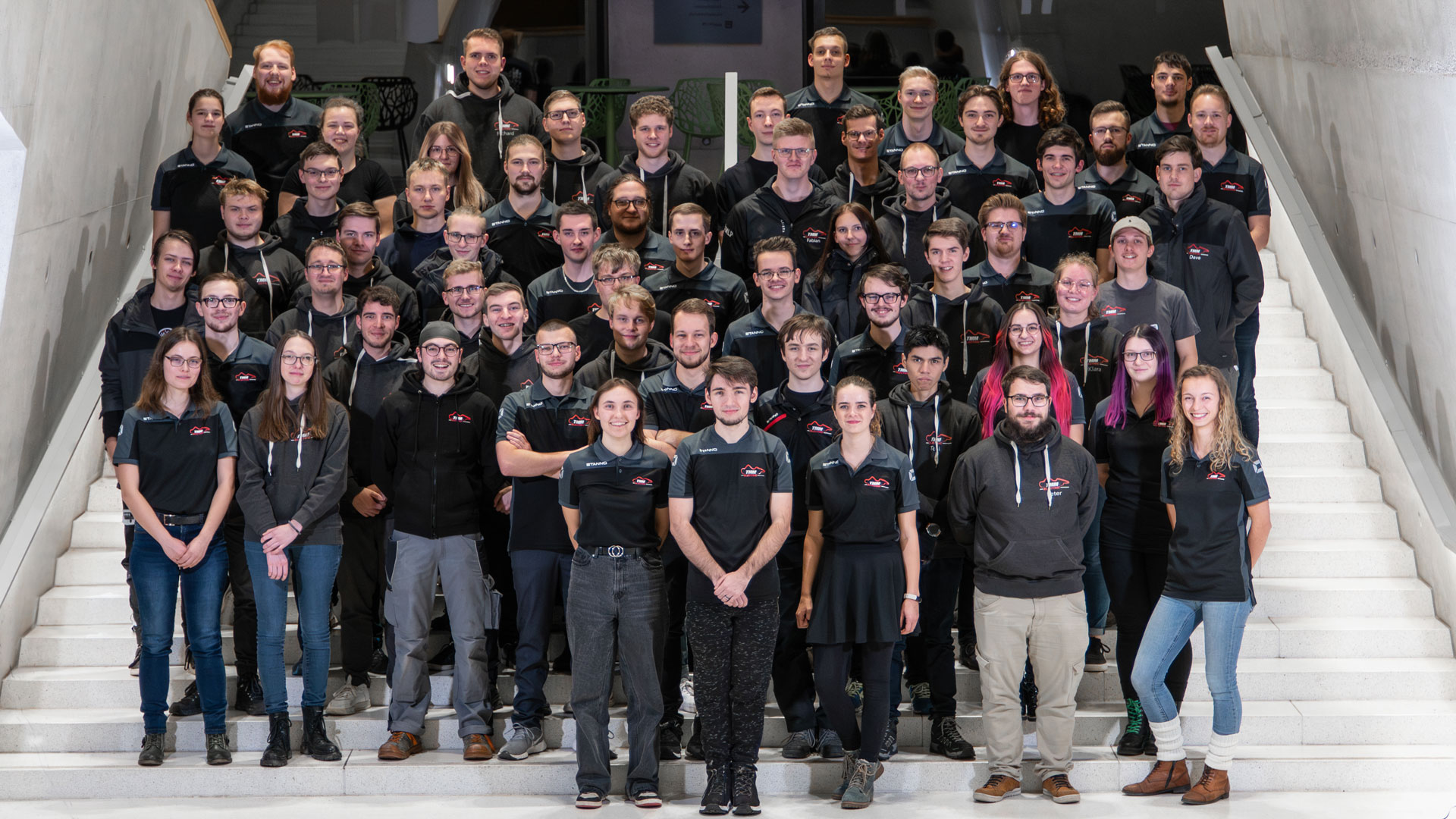
The same fundamental principle has also been at the heart of TMM for the past 17 years: students from various faculties put their theoretical knowledge to the test and deepen their understanding through practical application – whether in the design and construction of a Formula Student racing car, or in securing sponsors and organising events. “The experience gained from working together across faculty boundaries and with various institutions both within and outside the university – such as the Living Lab – is a crucial added value that students take with them into their future careers,” says Professor Frank Weidermann, one of TMM’s faculty advisers.
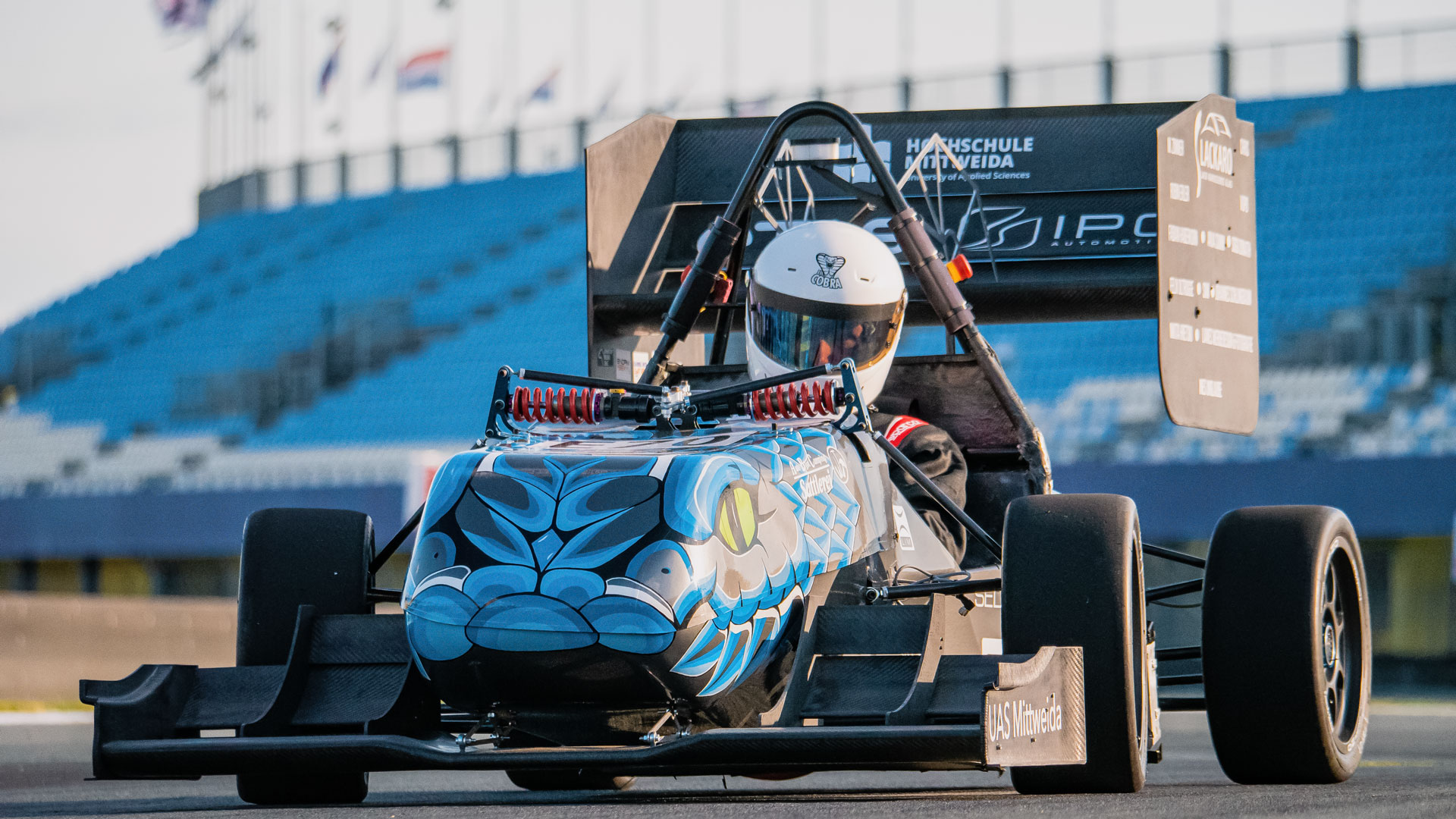
Looking ahead, the collaboration between TMM and the Living Lab could become even closer. Having already virtually modelled have already virtually implemented “El Cobra” – the predecessor to the current electric racing car “Black Mamba” – as a technology demonstrator to test and optimise chassis components, future implementations are also intended to help prepare drivers for the real race track.
Living Lab: Interdisciplinary study and research
Teaching and research in the ‘Motion Simulation & Software Development’ Living Lab are perfectly interlinked – and not just for success on the racetrack. The Living Lab offers more than that; it also gives other students at Mittweida University of Applied Sciences the chance to experience the practical benefits of the fundamental knowledge gained in lectures.
Knowledge gained from the Software Development specialisation within the Applied Computer Science degree programme can be excellently combined with the key areas of focus in the Living Lab; for example, in the software-based configuration of simulators, the integration of AI models, or interface programming for connected systems or components. Electrical Engineering – Automation students apply their knowledge to hardware-oriented programming, for example to ensure the correct control of actuators. They enable the simulators to move actively, thereby representing physical forces – such as when driving over kerbs or during brief forays into the virtual gravel trap – in a realistic and immersive manner. Finally, the knowledge gained from Mechanical Engineering enables the optimal mechanical design and dimensioning of the simulators. They must not be too heavy, yet must still be able to withstand high forces. In the Living Lab, students experience the interdisciplinary nature of their work, which they will also encounter later in their professional lives.

Both the Living Lab and TMM will be presenting at the Open Campus Day (Studieninformationstag) on 11 January at Mittweida University of Applied Sciences.