

This page was translated automatically using artificial intelligence (DeepL). The German version is binding. More information about automatic translation
News Intranet
This page was translated automatically using artificial intelligence (DeepL). The German version is binding. More information about automatic translation
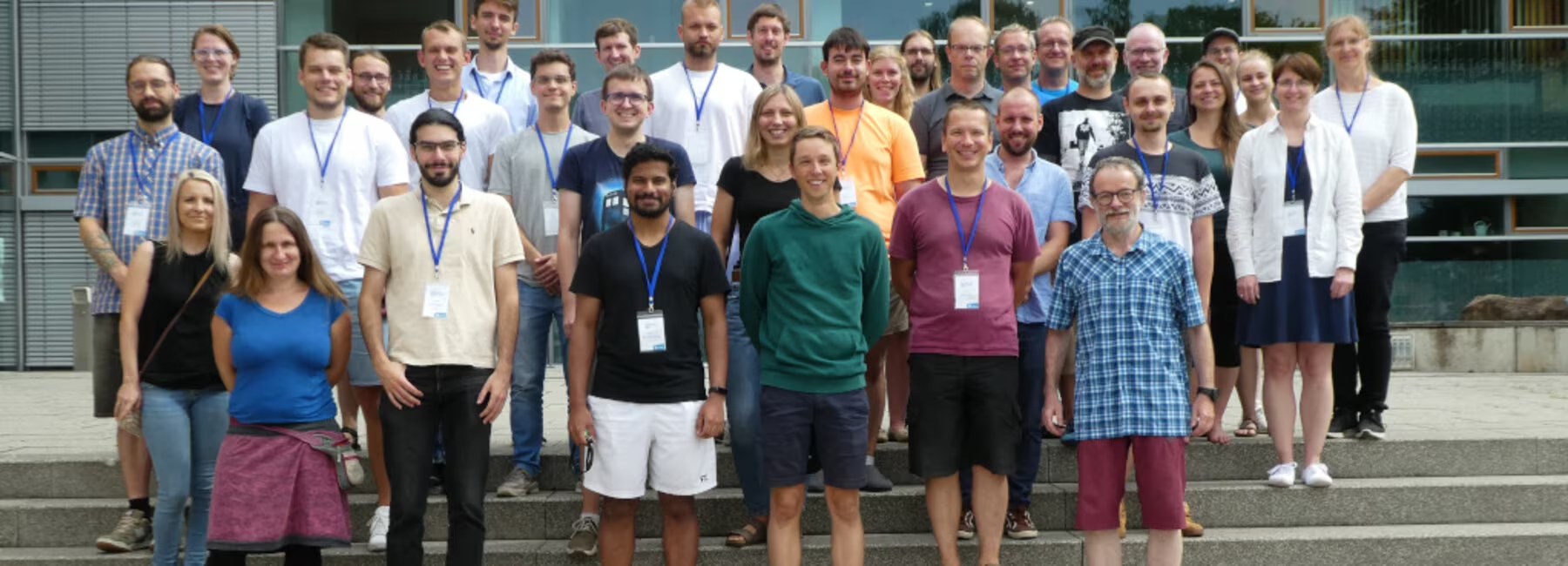
The Mittweida Workshop on Computational Intelligence (MiWoCI) has now reached its 15th edition. At the end of August (23–25 August 2023), the Saxon Institute for Computational Intelligence and Machine Learning (SICIM) at Mittweida University of Applied Sciences, in collaboration with the Institute for Computational Intelligence and Intelligent Data Analysis e.V. (CIID), organised this international knowledge exchange on current issues in AI development at Mittweida University of Applied Sciences. This year’s workshop, which was once again chaired by Professor Thomas Villmann and Dr Marika Kaden from SICIM, together with Professor Sven Hellbach from West Saxon University of Applied Sciences in Zwickau and Professor Frank-Michael Schleif from Würzburg University of Applied Sciences, took place, in keeping with established tradition, as a hybrid in-person and online event.
More than 40 academic talents and experts gathered at the university in summery temperatures or joined online to discuss the latest developments in research into artificial intelligence (AI) and machine learning. In keeping with tradition, MiWoCI is characterised by short, thought-provoking presentations by researchers, followed by in-depth discussions involving all participants. This conference format is particularly appealing to academic talent, as it promotes collaboration across different institutes and universities.
One key area of research was the issue of interpreting AI models and AI-generated results. For example, Professor Zühlke (Cologne University of Applied Sciences) gave a presentation on aspects of user-oriented assessment of AI interpretability and the resulting requirements for the development of such algorithms. She also highlighted potential problems regarding the vulnerability of such interpretable models to targeted attacks. Fabian Hinderer from Bielefeld University spoke about probabilistic aspects of training AI models. In particular, he highlighted mathematical constraints on model development that represent fundamental limitations in AI development. Roland Veen (University of Groningen, NL) reported on applications of AI models in medical research, as did Professor Michael Biehl from the same university.
Other AI application scenarios presented included autonomous driving (Robin Schwager, Porsche), sensor systems and object recognition in images (Jensun Ravichandran, Fusion Systems Chemnitz), blockchain technologies for software as a service (Dr Andreas Backhaus, Compolytics, Barleben) and feed analysis in agriculture (Lynn Reuss, SICIM).
Furthermore, Alexander Engelsberger from SICIM and Mittweida University of Applied Sciences presented new aspects relating to the topic of AI and quantum computing, amongst other things. Ronny Schubert analysed the mathematical structures in AI learning models with regard to cognitively motivated interpretations.
With a view to further collaboration in the field of AI interpretability and AI-based data representation for classification predictions, SICIM Director Professor Thomas Villmann agreed on further joint research with Professors Zühlke and Biehl.
In addition to the presentations, the academic work at the workshop was characterised by lively discussions and collaborative activities. Time slots were specifically set aside in the workshop schedule for these activities, and they were made full use of. The traditional and legendary MiWoCI social events – such as the climbing park, canoeing and the barbecue raft party on the Kriebstein Reservoir – were once again very well received and contributed to the open and inspiring atmosphere of MiWoCI.
The event drew to a close with a look ahead to next year’s 16th workshop, which will be held at the university in conjunction with the renowned international conference ‘Workshop on Self-Organising Maps, Learning Vector Quantisation & Beyond’ (WSOM+) (link to the conference website).
The next conferences at which SICIM’s findings will be presented are the European Symposium on Artificial Neural Networks and Machine Learning (ESANN, 4–6 October, Bruges, Belgium) and the Workshop on Hyperspectral Images and Signal Processing (WHISPERS) in Athens from 31 October to 2 November 2023.