

This page was translated automatically using artificial intelligence (DeepL). The German version is binding. More information about automatic translation
News Intranet
This page was translated automatically using artificial intelligence (DeepL). The German version is binding. More information about automatic translation
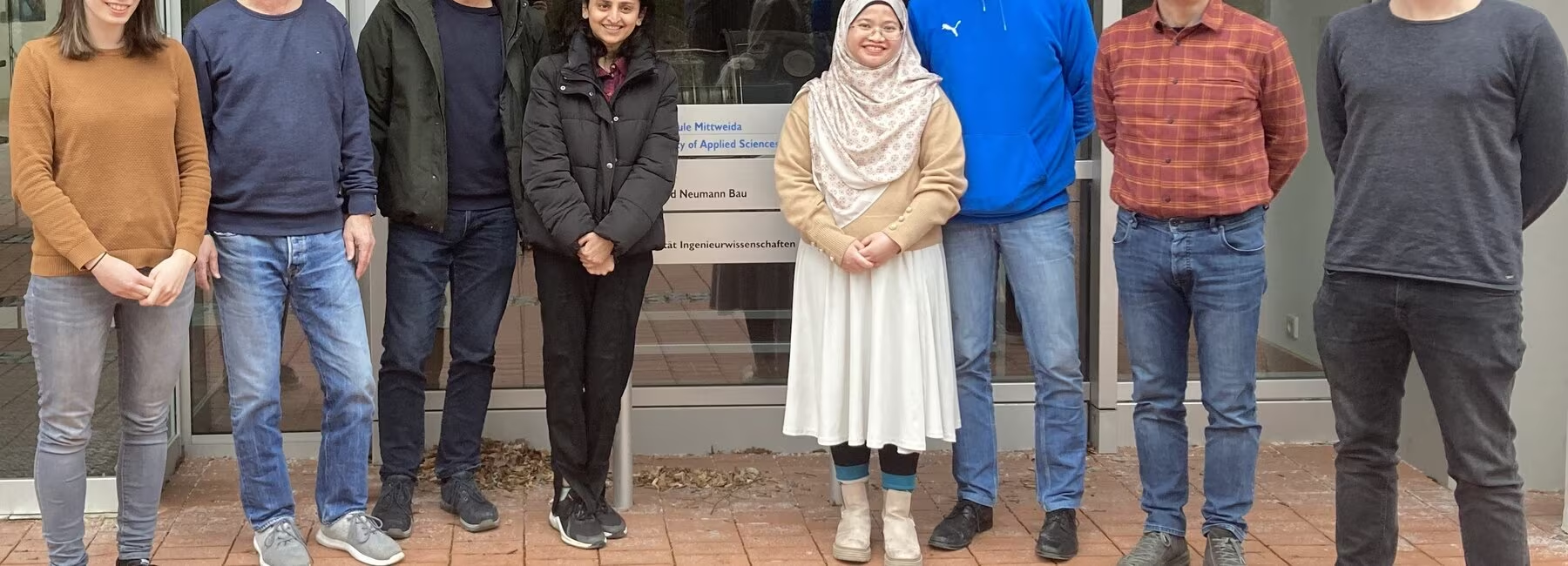
Sustainability, equal opportunities, interdisciplinarity, digitalisation and many other buzzwords can be associated with the newly launched early-career research group ‘KAP’ at Mittweida University of Applied Sciences. The eight-member group comprises four professors and their research staff from the Faculties of Engineering Sciences and Applied Computer Sciences and Biosciences. They are all working together on the project ‘Plastics metallisation using laser-induced activation and computer-aided process modelling’. The kick-off meeting took place in early February.
The aim of the early-career research group is to replace environmentally harmful, resource-intensive and technically complex coating processes for plastic metallisation with sustainable processes. In this project, various plastics are to be surface-modified in an initial process step using laser treatment in order to achieve sufficient conductivity for subsequent electroplating. This is to be achieved using the two laser techniques LIG and PLD. In the LIG (laser-induced graphene) process, a graphene layer is to be generated by transforming the plastic surface. In the PLD (pulse laser deposition) process, on the other hand, a thin metal layer is to be deposited onto the plastic.
In the subsequent process step, electrical conductivity is to be utilised to electroplate metal layers. For example, depending on the subsequent requirements, individual, pure layers (copper, nickel, tin), multi-layer coatings (copper-nickel-chromium, copper-nickel-gold), alloy layers (nickel-rhenium, nickel-tungsten), dispersion layers (nickel with corundum particles, copper with diamond particles) or combinations of these.
Another important aspect is the characterisation of the layers produced in the project. Testing methods such as Raman spectroscopy, SEM/EDX, the four-point method and materialography are used to gather information on layer composition, topography, electrical conductivity and layer thickness. This data can be used to derive optimisations for laser application and electroplating.
This research work is complemented by computer-aided modelling and visualisation of the processes. In future, these models are intended to save time and resources by enabling simulations of processes such as electroplating.
Metallised plastics are used in a wide variety of sectors and industries. The automotive industry, for example, uses them for vehicle emblems, trim strips and control buttons in vehicle interiors. They are also used in consumer goods and domestic appliances, such as ballpoint pens, coffee machines, dishwashers, furniture handles, hairdryers and telecommunications equipment (control buttons, casings). They are also used in the sanitary sector for bathroom fittings, valve knobs, hand-held shower heads and shower heads.