

This page was translated automatically using artificial intelligence (DeepL). The German version is binding. More information about automatic translation
News Intranet
This page was translated automatically using artificial intelligence (DeepL). The German version is binding. More information about automatic translation
Almost exactly 65 years ago, on 16 May 1960, Theodore H. Maiman switched on a flash lamp in Malibu, California, which was wound around a rod-shaped ruby. This marked the first time a laser – Light Amplification by Stimulated Emission of Radiation – had been activated, and the technology’s global triumph began. Today, laser beams have become indispensable both in industrial manufacturing and in everyday life.
A good 15 years later, the first research group to focus on this still relatively new technology was formed at what was then Mittweida University of Applied Sciences. And this triumphant advance, too, proved unstoppable. Today – 50 years on – this is evidenced by a new research building and an institute that ranks among the ten most successful laser research institutes in Germany.
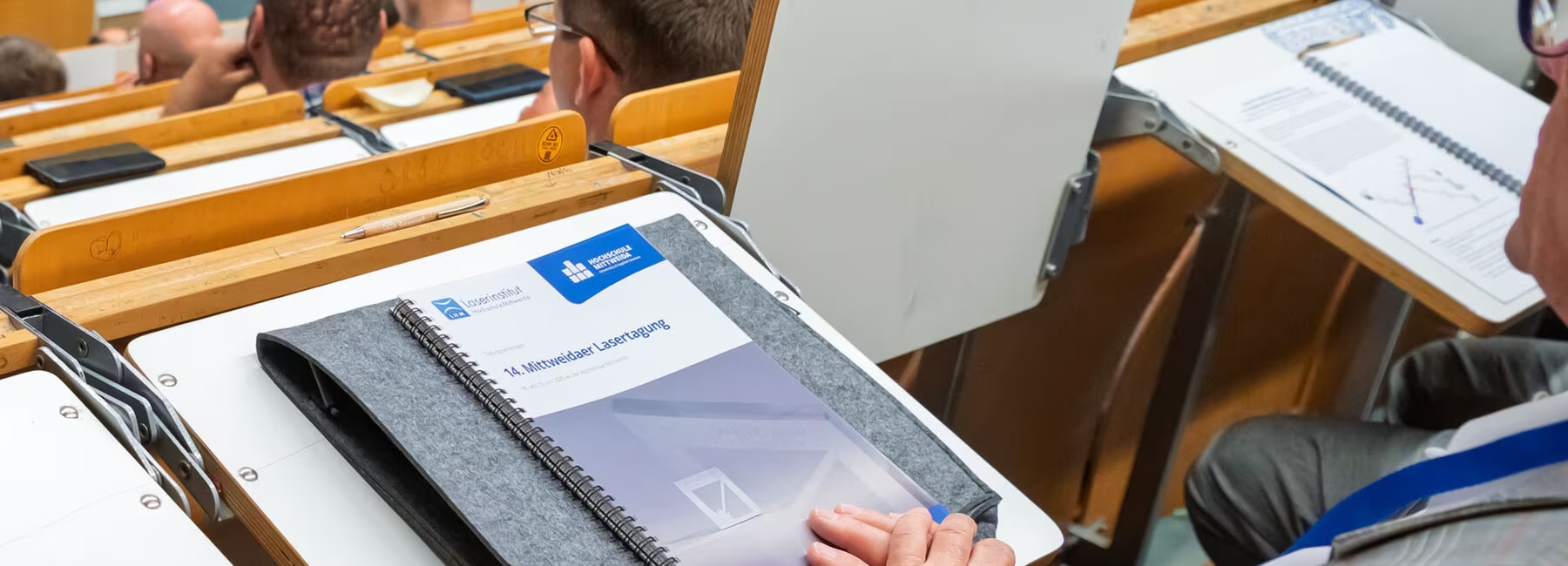
Part of the nature of science is to share knowledge. Thus, in November 1994, the first Mittweida Laser Conference took place – a success story that continues to this day. Today, in the Gerhard Neumann Building at Mittweida University of Applied Sciences, the 14th Mittweida Laser Conference was officially opened by the Vice-Chancellor for Research, Professor Uwe Mahn. In his opening address, Professor Uwe Mahn praised the conference as an indispensable forum for the exchange of knowledge and the promotion of collaboration in laser research. “From its humble beginnings to today’s state-of-the-art applications, this conference demonstrates just how far we have come. It is an honour to open this event and to present the latest research findings and innovations. The Mittweida Laser Conference once again underlines the importance of interdisciplinary collaboration and stands as a testament to the commitment and innovative strength of our research community.”
Today, Wednesday, and tomorrow, Thursday, the 120 participants will take part in six sessions focusing on the latest results and findings in the field of laser material processing. Twenty-eight presentations and 15 posters will showcase development projects, applications, trends and prospects relating to laser technology.
In his keynote speech today, Professor Markus Gräfe of TU Darmstadt will speak on the topic “Quantum imaging with undetected light – From fundamentals to holography with quantum light”. Tomorrow’s keynote address by Dr Anna Ziefuß from the University of Duisburg-Essen will focus on “Small particles, big impact. How laser-generated nanoparticles enhance 3D Printing”.
During the conference breaks, 15 companies will be presenting themselves and their portfolios. As well as professional discussions, there will be plenty of opportunity for participants to network on a personal level. There will be plenty of opportunities for this at the networking event taking place today, Wednesday, at the Laser Institute at Mittweida University of Applied Sciences, as well as at tomorrow’s gala event ‘50 Years of Laser Technology in Mittweida’ and the summer open-air event on Technikumplatz.
A glance at the conference programme, amongst other things, bears witness to over 30 years of successful conference and research history. At the 1st Mittweida Laser Conference, the programme of talks included a presentation entitled ‘Laser pulse deposition of oxide films’, delivered by Steffen Weißmantel. At the 14th Mittweida Laser Conference, Professor Steffen Weißmantel chaired the session on laser surface technology and was co-author of numerous papers, including one entitled ‘Ablation of metal matrix composites using ultrashort burst pulses’.