

This page was translated automatically using artificial intelligence (DeepL). The German version is binding. More information about automatic translation
News Intranet
This page was translated automatically using artificial intelligence (DeepL). The German version is binding. More information about automatic translation
The name says it all: UoAS – University of Applied Sciences. Applying scientific findings in a practical way – that is the cornerstone of applied research. But what if you need to dig deeper, that is, gain a fundamental understanding of a process, in order to solve a practical problem?
At the Laser Institute at Mittweida University of Applied Sciences (LHM), both approaches are taken. Research is conducted in collaboration with both industry and other research institutes to address issues that concern users. Sometimes, however, questions arise in practice that require more fundamental investigation.
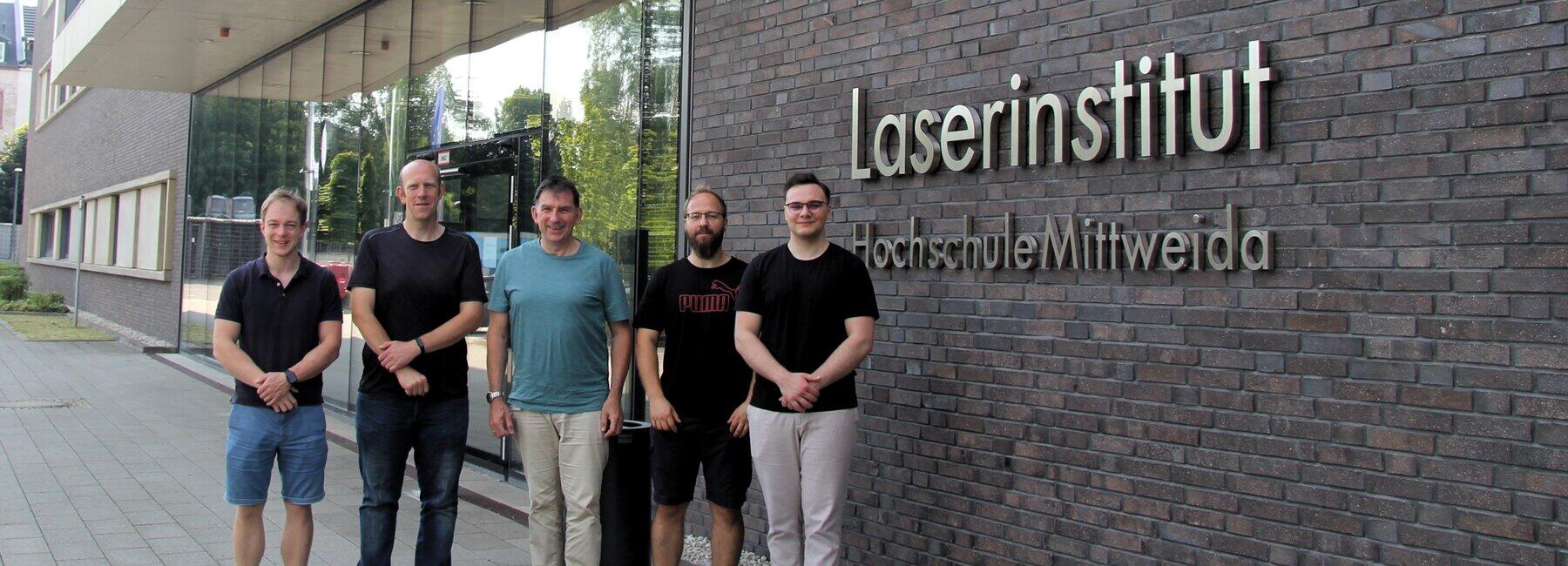
The research group ‘Dynamics of Ultrafast Selective Laser Processes’ (DUSL for short), led by Professor Alexander Horn at the LHM, has set itself the task of investigating the processes that take place when laser radiation interacts with matter. For over ten years, very fast processes in laser-excited solids have been analysed and observed, on timescales ranging from the femtosecond range – that is, one millionth of a billionth of a second – up to the millisecond range. This means that processes spanning nine orders of magnitude in time can be investigated.
When laser radiation ‘heats’ a metal, many complex processes take place, some sequentially and others simultaneously. Over the past decade, the research group has developed specialised measurement techniques to analyse these processes. These techniques enable, for example, the coupling of the laser radiation into the material and the subsequent reactions – such as heating, expansion, melting and material ablation – to be observed with resolution in wavelength, time and space. The measurement technique thus allows the interaction of the laser radiation with the material to be ‘filmed’ theoretically at more than 10¹³ FPS, i.e. 10 TFPS. (The abbreviation FPS stands for ‘frames per second’.) However, modelling is required to understand the measurement results. This enables the microscopic representation of the physical processes occurring during the interaction of laser radiation with matter and the calculation of the expected measurement values. By comparing theoretical calculation results with experimentally determined measurements, the interaction between laser radiation and matter can ultimately be physically interpreted and understood.
In recent years, numerous findings in this area have been published in prestigious journals such as *Advanced Functional Materials*, *Physical Review B*, *The Journal of Physical Chemistry C*, *Optical Materials Express* and *Scientific Reports*.
All of this can only work with colleagues who are passionate about research and committed to addressing scientific questions.
Phillip Börner, who is currently writing his Bachelor’s thesis, says: “Thanks to Professor Horn’s friendly and open-minded manner, I was fully integrated even during my time as a student assistant, which meant I became part of a great research group. I’m now writing my Bachelor’s thesis and am delighted with the direct supervision and the numerous opportunities to develop my skills.”
Markus Olbrich, a PhD student at the LHM, adds: “Thanks to the complex and wide-ranging research, we’re constantly coming across new questions, which means it never gets boring and you just want to keep going. In the areas of theory and programming, I can fully utilise my strengths and cannot imagine doing anything else.”
Dr Andy Engel has been a member of the LHM research team for some time and says: “In my previous research work at Mittweida University of Applied Sciences and the Laser Institute, I focused intensively on the interaction of ultrashort-pulsed laser radiation with various solid-state surfaces. Analysing the irradiated surface areas subsequently allowed me to characterise the laser-matter interaction, as well as the resulting topology of the interaction zones and any material changes. In short – I was able to answer the question ‘What happens?’. Working in Professor Horn’s group will enable me to expand my understanding of the processes involved. The new research question is: ‘When does what happen?’. Within the research group, this question can be investigated using spatially and temporally resolved pump-probe techniques. Supported by modelling and simulation calculations, which are validated by further experiments, it is possible to produce a comprehensive description of laser-matter interaction coupled with a better understanding of the process. I am looking forward to tackling further exciting research questions.”
The German Research Foundation (DFG) and its research community have recognised the expertise at the LHM in this field and have been funding it for several years now.
The ‘Project Quartet’ comprises the following research projects:
MULTIPULS
In collaboration with Professor Steffen Weißmantel’s research group, the interaction of rapid pulse trains of ultrashort-pulsed laser radiation in the GHz to MHz range with metals was investigated. The project was successfully completed in June 2024. An application for an extension has been submitted and is currently under review.
The project investigated the interaction of rapid pulse trains with metals as a function of the number of pulses in the train and their temporal spacing. In particular, the interaction of the successive pulses with the ablation cloud generated by the preceding pulses, and the resulting interaction of the additionally heated ablation cloud with the material that had not yet been ablated, were identified and described as key processes in the formation of the ablation structures.
CRYSTALLINITY
In collaboration with Professor David Rafaja (TU Bergakademie Freiberg) and Professor Stefan Sandfeld (RWTH Aachen, FZ Jülich), we are investigating the changes in the microstructure (primarily the size, shape and orientation of the crystallites, as well as the degree of mixing) of metallic single- and multi-layer systems resulting from irradiation with ultrashort-pulsed laser radiation. To this end, complementary in situ and ex situ analyses as well as multi-scale simulations are being carried out. At the LHM, the existing innovative measurement technology for in situ investigations is to be utilised in particular for this purpose. Furthermore, the simulation of ablation using hydrodynamic calculations is planned. In Freiberg, the crystallinity and the concentration of the elements are determined using high-resolution electron beam techniques and a range of other analytical methods. In Aachen, molecular dynamics simulations of ablation, recrystallisation and the diffusion of the elements are to be carried out.
SI SURFACE MODIFICATION
In collaboration with Professor Martin Garcia and his team from the University of Kassel, the research group is investigating the interaction of ultrashort-pulsed laser radiation with silicon.
The innovative measurement technology used by the research group in Mittweida enables the provision of experimentally determined input parameters for the theoretical simulations. These are also used to verify the model-based description of the interaction between the laser radiation and the material, and to simulate the induced ablation using molecular dynamics simulations carried out by the research group in Kassel.
LA PLALMA
In May 2024, the DFG awarded the research group a further project proposal to be carried out independently. The new project, LA PLALMA, will primarily investigate the interaction of a follow-up pulse with an existing ablation cloud consisting of vapour, particles and plasma. The follow-up pulse is not intended to strike the ablation cloud centrally, but rather at an offset angle. The resulting interaction between the follow-up pulse and the ablation cloud has a decisive influence on the final ablation pattern. The processes involved differ from those of central irradiation and are the subject of this research project.
Time is relative – this realisation has been driving science ever since Albert Einstein and is a source of motivation for the research group led by Professor Alexander Horn. “The shorter the interaction between laser radiation and matter, the more closely we want to examine it and try to understand what happens, when, where and why.”
Text: Prof. Alexander Horn
Images: Mittweida University of Applied Sciences