

This page was translated automatically using artificial intelligence (DeepL). The German version is binding. More information about automatic translation
News Intranet
This page was translated automatically using artificial intelligence (DeepL). The German version is binding. More information about automatic translation
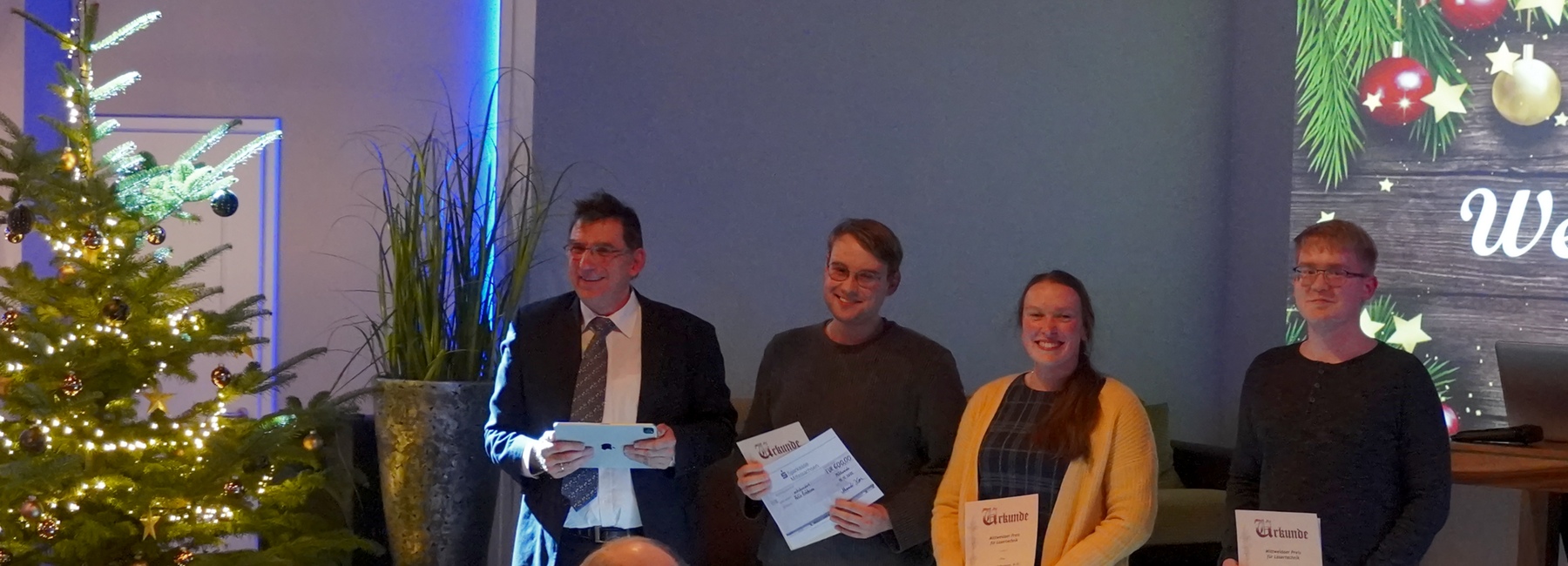
Every year, the Laserinstitut Mittelsachsen e.V. awards the Mittweida Laser Prize to the best final-year projects (Bachelor’s or Master’s) completed at the Laserinstitut at Mittweida University of Applied Sciences (LHM). In 2022, no fewer than three graduates were delighted to receive this award, which was presented to them in December by the Institute’s Director, Professor Alexander Horn.
Erik Thieme received the award for his outstanding Bachelor’s thesis on the topic of “Fabrication and characterisation of micro-spiral phase plates”, which was graded ‘very good’ by his supervisors, Professor Steffen Weißmantel and M.Sc. Sebastian Büttner. Erik Thieme demonstrated an excellent ability to analyse scientific and technical problems and to develop and apply solutions independently and creatively.
His thesis focused on the laser-based fabrication of micro-spiral phase plates using fluorine laser microstructuring and the characterisation of the optical effects of these micro-optics. Such micro-optics, which allow the manipulation of the orbital angular momentum of photons, are of great interest for future optical data transmission as well as quantum communication and quantum cryptography.
Erik Thieme is currently undertaking a work placement.
Vanessa Schumann was awarded the Laser Prize for her outstanding Master’s thesis entitled ‘From plasmid design to in vitro spectroscopy: Establishment of a production line for RNA and RNA fluorescent labelling’, which was jointly assessed by Professor Richard Börner and Professor Röbbe Wünschiers and awarded the grade ‘very good’.
In her thesis, Vanessa Schumann focused on establishing a biotechnological production line for fluorescently labelled RNA. In particular, she concentrated on plasmid design for template-based in vitro RNA transcription. She succeeded in establishing RNA production at Mittweida University of Applied Sciences (HSMW).
Vanessa Schumann studied Genomic Biotechnology at bachelor’s and master’s level at Mittweida University of Applied Sciences and joined Richard Börner’s Biophotonics group in September 2020, starting with a research placement followed by her master’s thesis. She will continue to be employed at Mittweida University of Applied Sciences and will work on her joint PhD programme with the University of Lübeck. Professor Richard Börner, who delivered the laudatory speech, expressed his gratitude for her great commitment to establishing and expanding Biophotonics at the LHM and to the further development of biomolecular laboratory capabilities in the chemistry laboratory.
Felix Erichson was awarded the Laser Prize for his outstanding Master’s thesis entitled ‘Simulation of experimental photophysical parameters using de novo models of ribosomal RNA tertiary contacts’, which was also awarded the grade ‘very good’.
In his thesis, Felix Erichson focused on the simulation of Biophotonics parameters (FRET, anisotropy). He investigated ribosomal RNA as a model system and compared his results with existing experimental data. His work lays the groundwork for the integrative modelling of RNA biomolecules and their interaction partners (proteins, etc.) and is intended to be applied in future in the field of computer-aided drug design (CADD).
Felix Erichson also studied Genomic Biotechnology at bachelor’s and master’s level at Mittweida University of Applied Sciences and has been involved in the LEGO Sequencer project at the LHM since March 2020. He will remain employed at Mittweida University of Applied Sciences and will commence his joint PhD programme with the University of Lübeck.