

This page was translated automatically using artificial intelligence (DeepL). The German version is binding. More information about automatic translation
News Intranet
This page was translated automatically using artificial intelligence (DeepL). The German version is binding. More information about automatic translation
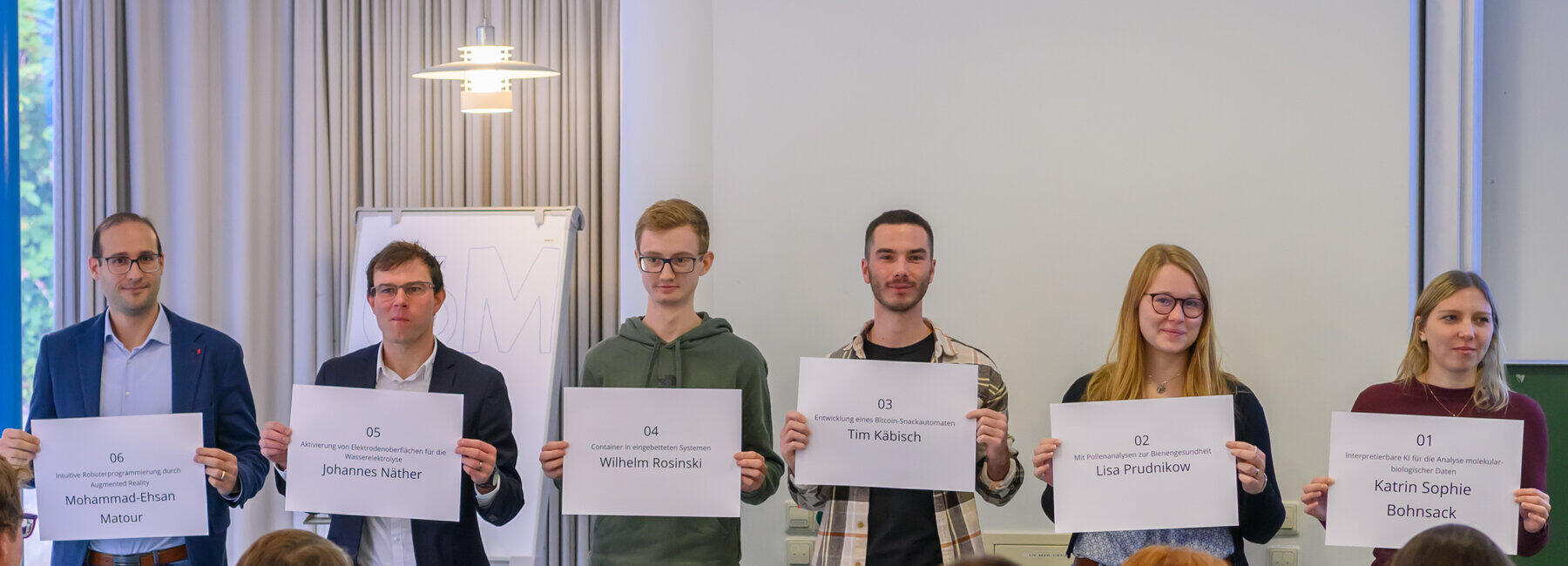
What do AI, bees, Bitcoin, containers, electrodes and robots have in common? These are all topics that academic talent at the university is working on, and on which they submitted entries for the 2023 Science Prize.
A total of six candidates from the CB and INW faculties had qualified for the final of the 2023 Science Prize and went before the public for a vote during Research Day in October. Each of them had exactly four minutes to win over the audience with their pitch.
Katrin Sophie Bohnsack submitted a proposal on the topic ‘Interpretable AI for the analysis of molecular biology data’. In her pitch, she presented a method for efficiently processing complex biomolecular structures as data objects for AI algorithms. This research into bioinformatic AI was carried out at SICIM within Prof. Villmann’s theoretical working group.
“Using pollen analysis to assess bee health” is the title of the project for which Lisa Prudnikow applied. In Saxony’s apple orchards, she is taking a close look at the foraging behaviour of mason bees. To do this, she will analyse the DNA information contained in the pollen grains stored by the pollinators.
Tim Käbisch gave a talk on the “Development of a Bitcoin snack machine” and demonstrated how Bitcoin can be used as an alternative payment method, alongside cash and credit cards, at snack machines. This research project highlights Bitcoin’s potential for everyday use, which interested members of the public can now see and experience for themselves in Mittweida.
Wilhelm Rosinski presented his project ‘Containers in Embedded Systems’. Backed by a new measurement methodology and the results obtained from it, he demonstrated that, contrary to many preconceptions, containers can not only be used in server environments and as cloud technology, but can also demonstrate their strengths on embedded systems.
Johannes Näther spoke about the “activation of electrode surfaces for water electrolysis”. In the context of green hydrogen production, this process forms an important basis for… the anode reaction. Optimised catalyst deposition enables cell potentials to be reduced and hydrogen to be produced more cost-effectively.
Mohammad-Ehsan Matour gave an introduction to ‘Intuitive Robot Programming through Augmented Reality’ and demonstrated how a robot can be controlled or programmed using AR glasses such as the HoloLens, and what benefits this brings.
The results of the public vote were combined with the marks awarded by the assessors based on the written applications, on a percentage basis.
In the end, the Vice-Chancellor for Research, Professor Uwe Mahn, announced the following rankings:
- 1st place: Katrin Sophie Bohnsack
- 2nd place: Johannes Näther
- 3rd place: Lisa Prudnikow
We offer our warmest congratulations and wish them every success in their future research work.
Further information on the Science Prize is available via the following link: https://www.forschung.hs-mittweida.de/foerderprogramme-stipendien-preise/wissenschaftspreis/wissenschaftspreis-2023/
Text: Annett Kober and the nominees.
Images: Mittweida University of Applied Sciences