

This page was translated automatically using artificial intelligence (DeepL). The German version is binding. More information about automatic translation
News Intranet
This page was translated automatically using artificial intelligence (DeepL). The German version is binding. More information about automatic translation
As part of the BMBF joint project ‘PerspektiveArbeit Lausitz (PAL) – Centre of Excellence for the Future of Work in Saxony and Brandenburg’, new solutions are being developed collaboratively for people involved in the production process.
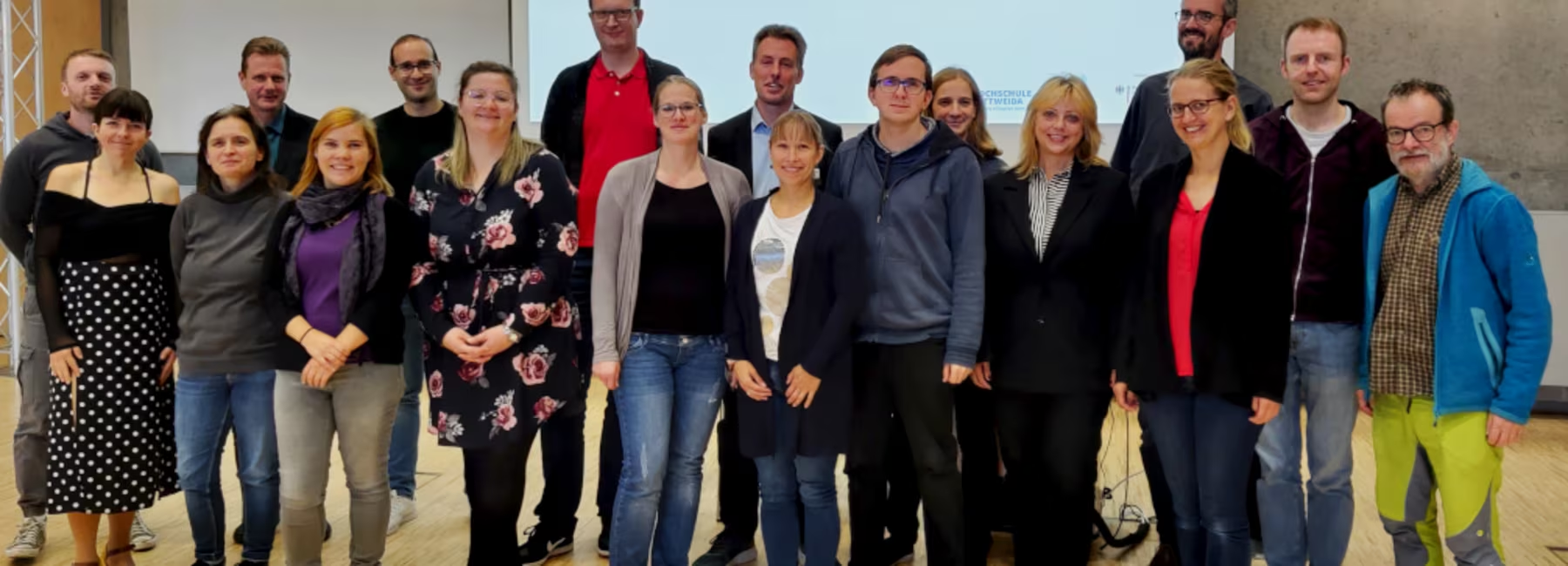
Over the past few months, the PAL project consortium has expanded to include a number of notable project partners. These exciting collaborations will undoubtedly support their vision of driving forward structural change in the Lausitz region and take the project to a new level.
The new partners are:
- HGS GmbH, Hirschfelde
- SOBAtec GmbH
- Oberlausitz OL Skilled Workers’ Network gGmbH
- Mittweida University of Applied Sciences
- Chair of Automated Joining Processes and Simulation
- Institute for SME Cooperation (MIKOMI)
- Chair of Human Resources Management and Business Psychology
- Zittau/Görlitz University of Applied Sciences
- Chair of Business Administration
- Chair of Work and Organisational Psychology
PAL is convinced that these partnerships not only support their project objectives but also underline their ability to develop innovative solutions and their commitment to shared missions.
A very specific collaboration was already underway at the end of October.
Cetex Institut gGmbH visited Mittweida University of Applied Sciences to find out about the use of mobile manipulators (MoMa), automated guided vehicles and collaborative robots at the university’s Faculty of Engineering Sciences. In the ‘Mobile Robotics’ section of the ‘Living Lab for Hybrid Work Systems’, the company learnt how these technologies work. During the discussion, the desired application scenario for the textile industry was then developed.
MoMa stands for ‘mobile manipulator’ and describes the combination of a collaborative robot with a mobile transport robot. This innovative system offers a wide range of industrial applications. The handling of objects of varying shapes and sizes at different workstations boosts productivity in handling tasks, even in small and medium-sized enterprises. The automated guided vehicle (AGV) system enables technical systems to move autonomously between different locations by continuously scanning the surroundings using LiDAR (Light Detection and Ranging). As soon as objects or people block the path, the MoMa stops and searches for alternative routes.
Compared with other mobile manipulators in research institutions, the MoMa at Mittweida University of Applied Sciences was designed, on the one hand, with open interfaces for research tasks in mind. On the other hand, its sensor technology, control system and risk assessment also enable the entire system to carry the CE mark. The MoMa was designed and developed for real-world industrial applications. This meets the demand for practical, innovative solutions that are tested in the Living Lab, continuously discussed with researchers and industry representatives, and further developed.
The ‘Hybrid Work Systems’ Living Lab at Mittweida University of Applied Sciences also encompasses the areas of ‘Adaptive Manual Assembly’ and ‘Virtual Reality’. It will be fascinating to see how these technologies and applications, introduced through a participatory approach, revolutionise industry and, above all, the way humans and machines work together.