

This page was translated automatically using artificial intelligence (DeepL). The German version is binding. More information about automatic translation
News Intranet
This page was translated automatically using artificial intelligence (DeepL). The German version is binding. More information about automatic translation
Germany and the Czech Republic intend to work more closely together in investigating cross-border crime, particularly in the digital sphere. To this end, the DiForPol project will, over the next three years, improve networking between the participating police authorities in both countries and provide joint training. DiForPol stands for ‘Training in Digital Forensics for the Police’. Academic institutions and police forces in both countries are working closely together on this project.
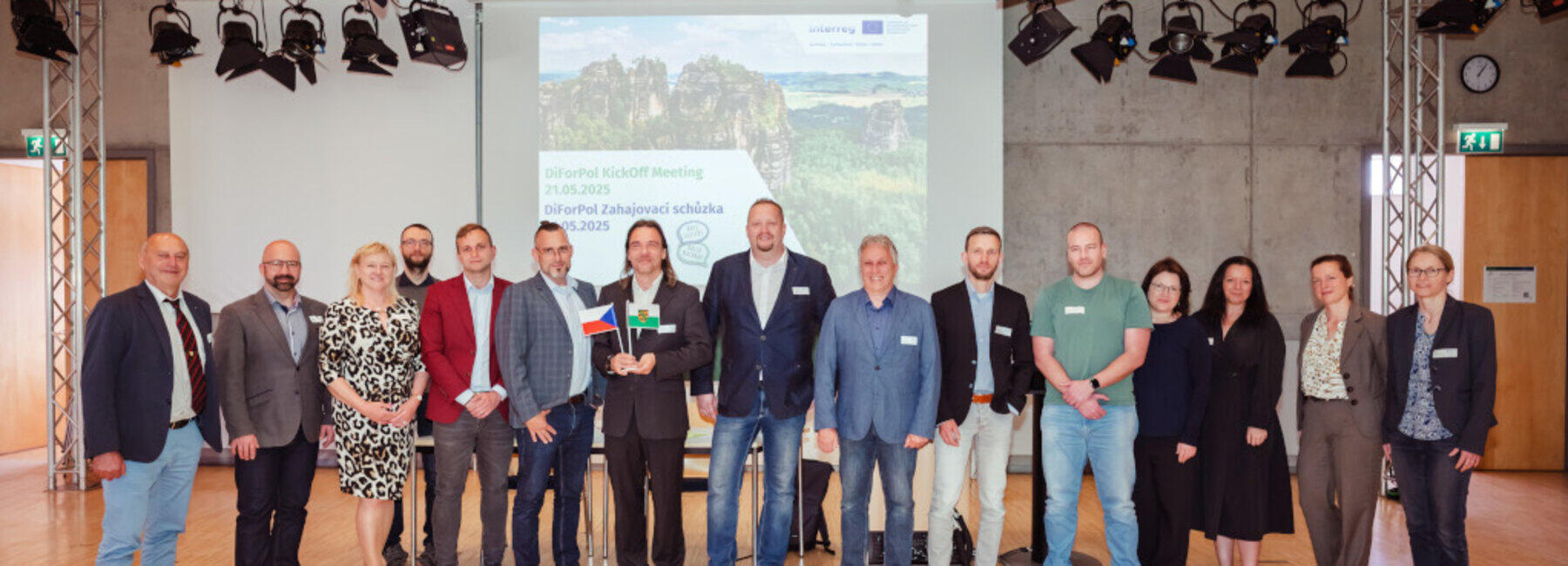
On 21 May 2025, the project partners met for the kick-off meeting at Mittweida University of Applied Sciences (HSMW). Representatives of the Saxon police and the police of the Czech Republic, as well as experts from the fields of digital forensics and security research, attended the project’s official launch.
Professors Dirk Pawlaszczyk and Ronny Bodach from HSMW are leading the project. They and their team are experts in the field of digital forensics and have been training staff from investigative authorities and security companies for many years. The academic project partner on the Czech side is the private AMBIS University in Prague, led by Priv.-Doz. Dr Irena Tušer and Priv.-Doz. Dr Jan Kolouch.
New powers to secure digital evidence
The increasing changes in the scope of police investigations are also affecting the traditionally very good cooperation between higher-level police authorities and regional police stations on both the Czech and German sides. Alongside traditional forms of evidence such as files, photographs and weapons, digital evidence is playing an ever-greater role in criminal investigations. In particular, the analysis of mobile phones is becoming increasingly important. Technological advances in digital communication make it necessary to provide police officers on both sides of the border with ongoing training and professional development. Many of the challenges facing the border region can only be tackled through joint efforts.
Professor Dirk Pawlaszczyk describes the project: “In DiForPol, we are working with our Czech partners to develop a bilingual training programme on digital literacy in police investigations. It will deepen the specialist knowledge of the authorities and improve police cooperation in the border region. The aim is to further strengthen the digital forensic chain of investigation. This will enable information gathered during case work to be passed on to neighbouring police forces with less effort.”
The researchers are working closely with the Czech police and the Saxon State Police on their project.
The project will initially run for three years, from April 2025 to March 2028. In the first phase of the project, which will run until spring 2026, the partners will define the framework for the joint training programme in consultation with the Saxon and Czech police forces. To this end, the partners will jointly assess the current needs and expectations of the Czech police units regarding the planned training. They will then develop the training materials, taking into account the legal and professional context in the Czech Republic, and carry out a trial run. In addition to tried-and-tested teaching methods, digital group learning methods and case simulations will be used.
Lieutenant Dr Lukáš Hřibňák, representative of the Police of the Czech Republic: “Digital forensics is now an indispensable part of modern criminal investigation and a key tool in solving crimes. Whilst methods for collecting, securing and analysing digital data are evolving rapidly, there remains an urgent need for systematic training and standardisation in the practical application of these tools within law enforcement agencies.”
The project team will focus in particular on developing training scenarios based on real-life cases from the Czech and Saxon contexts. In the final phase, running until March 2028, the optimised training programmes will be incorporated into police training in both countries. Both AMBIS University and Mittweida University of Applied Sciences will deliver the training to police cadets.
AMBIS representative, Priv.-Doz. Dr Irena Tušer: “As part of the project, AMBIS University, a.s. will play a central role for the Czech Republic. In this area, the university will also work closely with the National Cyber and Information Security Agency, the National Centre for Combating Organised Crime and the Department for Police Education and Training.”
The project is designed to be sustainable: in the long term, the Saxon and Czech police training programmes are to be expanded to include the material developed. The two universities in Mittweida University of Applied Sciences and Prague also intend to collaborate on this beyond the project period. The project is part of the Interreg Saxony–Czech Republic 2021–2027 regional programme, which forms part of the European Structural Funds for the promotion of cross-border cooperation.
Further information:
Prof. Dr. rer. Pol. Dirk Pawlaszczyk, Project Leader, DiForPol
; Interreg website for the DiForPol project
Brief profiles of the two universities, focusing on the disciplines concerned here
AMBIS University, the largest private university in the Czech Republic, offers a wide range of degree programmes in the fields of law, social sciences and security studies. With a comprehensive range of 17 accredited degree programmes and over 8,000 students, AMBIS has firmly established itself as a key player in the Czech higher education landscape over the past twenty years. Its success is based on the proven combination of high-quality specialist training with a strong practical focus in teaching and research. AMBIS University is part of the renowned Carl Remigius Fresenius Education Group, one of the largest private and independent educational institutions in Germany. The ‘Security Management’ degree programme offers a unique specialisation in cyber security as well as key forensic disciplines such as criminalistics and criminology. Students acquire comprehensive and practically applicable skills in the protection of networks and data, in the analysis of digital and physical evidence, and in effective crime prevention. Particular emphasis is placed on mastering modern criminological methods, which graduates can immediately apply in the public sector, within security agencies or in consultancy firms, thereby contributing to the strengthening of national and international security in the digital age.
Mittweida University of Applied Sciences was founded in 1840 and is a leading centre for research and knowledge transfer in Central Saxony, with around 7,000 students across five faculties. The many facets of its industry-oriented research and development include externally funded research, collaborative PhD projects and independently organised development work, as well as projects within institutes and research consortia. For several years now, Mittweida University of Applied Sciences has been offering various degree programmes and continuing professional development courses in the fields of IT forensics and cybersecurity. For instance, the university launched Germany’s first Bachelor’s degree programme in Digital Forensics, which remains unique in the higher education landscape to this day. Six professors are active in teaching and research. In addition, around 500 police officers receive further training each year in cooperation with the Federal Police and the state police forces. Research is seen as a fundamental driving force for teaching and is therefore integrated into the design of the curriculum. The capabilities of the Mittweida Forensic Investigation Laboratory have been continuously expanded in recent years. The university has two forensic laboratories used for teaching and research, including facilities for analysing digital evidence, as well as two in-house institutes for research into blockchain technology and computational intelligence and machine learning. The main areas of focus are the development of innovative AI technologies in the fields of digital forensics – including Forensic Science in Business – cyber security and Industry 4.0.
Czech version / česká verze
Strengthening cross-border police cooperation – DiForPol supports digital investigations
A Saxony-Czech university collaboration project is developing bilingual training for police forces in both countries in the field of mobile phone forensic analysis.
Germany and the Czech Republic wish to cooperate more closely in investigating cross-border crime, particularly in the digital sphere. Over the next three years, the DiForPol project will improve coordination and joint training for the participating police forces in both countries. DiForPol stands for ‘Training in Digital Forensics for the Police’. The scientific community and the police in both countries are working closely together.
On 21 May 2025, the project partners gathered for a kick-off meeting at the Mittweida University of Applied Sciences (HSMW). The official launch of the project was attended by representatives of the Saxon police and the Czech Republic’s police force, as well as experts in the fields of digital criminology and security research.
The project is led by Professors Dirk Pawlaszczyk and Ronny Bodach from HSMW. Together with their team, they are experts in the field of digital forensics and have been training staff from investigative bodies and security companies for many years. The project’s scientific partner on the Czech side is the private AMBIS University in Prague, led by Assoc. Prof. Irena Tušer, Ph.D., and Assoc. Prof. Jan Kolouch, Ph.D.
New skills for securing digital evidence
The increasing changes in the field of police investigations are also affecting the traditionally very good cooperation between senior police authorities and regional police departments on both the Czech and German sides. Alongside traditional forms of evidence, such as case files, visual material or weapons, digital evidence is playing an increasingly important role in investigative proceedings. In particular, the analysis of mobile phones is becoming increasingly important. Technical advances in the field of digital communication require ongoing training and education for police officers on both sides of the border. Many of the upcoming challenges in the border region can only be tackled jointly.
Professor Dirk Pawlaszczyk describes the project: “As part of the DiForPol project, we are working with Czech partners to develop a bilingual training programme on digital skills for police investigations. This will deepen the specialist knowledge of the authorities and improve police cooperation in the border region. The aim is also to further strengthen the digital forensic investigation chain. Information obtained whilst working on a case will thus be able to be passed on to neighbouring police forces with less effort.”
The researchers are working closely with the Czech police and the Saxon State Police on their project.
The project will initially run for three years, from April 2025 to March 2028. In the first phase of the project, running until spring 2026, the partners will, following consultation with the Saxon and Czech police, define the framework conditions for the joint training programme. To this end, the partners will jointly assess the current needs and expectations of Czech police units regarding the planned training. They will then develop training materials, taking into account the legal and technical environment in the Czech Republic, and carry out a trial run. In addition to tried-and-tested teaching methods, group-based digital learning and case simulations will be used.
Bc. Mgr. Vladimír Táborský, member of the research team: “Digital forensics is now an indispensable part of modern criminal investigation and a key tool in the investigation of criminal offences. Although methods for collecting, securing and analysing digital data are developing rapidly, there remains an urgent need for systematic training and standardisation of the practical use of these tools within law enforcement agencies.”
The project team will focus in particular on developing training scenarios based on real-life cases from the Czech and Saxon contexts. In the final phase, running until March 2028, the optimised training courses will be integrated into the practical training programmes of the police forces in both countries. Training for police cadets will be organised by both AMBIS University of Applied Sciences and Mittweida University of Applied Sciences.
AMBIS representative, Associate Professor Irena Tušer: “Within the project, AMBIS University, a.s. will play a central role for the Czech Republic. In this area, the university will also work closely with the National Cyber and Information Security Agency, the National Organised Crime Agency and the Police Education and Training Department.”
The project is designed to be sustainable: in future, it is planned to expand Saxon and Czech police training programmes to include the materials developed. Both universities, in Mittweida and Prague, intend to continue their collaboration even after the project has ended.
The project forms part of the regional Interreg Saxony–Czech Republic 2021–2027 programme, which is funded by the European Structural Fund for cross-border cooperation.
Further information:
- Interreg website: https://www.sn-cz2027.eu/cz/projekty/priorita-3-vzdelavani-celozivotni-vzdelavani-kultura-a-cestovni-ruch/100704162_diforpol
- DiForPol
Brief profiles of both universities, focusing on their respective fields of study
AMBIS University is the largest private university in the Czech Republic. It offers courses in law, social sciences and security studies. It has 17 accredited degree programmes, attended by a total of 8,000 students. For more than twenty years, its existence has demonstrated that the combination of high-quality specialist education with practical experience and research has a firm place within the Czech higher education landscape. AMBIS University is owned by the renowned Carl Remigius Fresenius Education Group, which is one of the largest private and independent education companies in Germany. The Security Management degree programme offers specialisation in cyber security and forensic disciplines, such as criminalistics and criminology. Students will acquire the skills to protect networks and data, analyse evidence and prevent crime. They will learn criminological methods for practical application in the public sector, security services and consultancy.
Mittweida University of Applied Sciences was founded in 1840 and is a major centre for research and knowledge transfer in Central Saxony, with approximately 7,000 students across five faculties. Many aspects of its business-related research and development involve externally funded studies, collaborative doctoral projects and independently organised development work, as well as projects within institutes and research consortia. For several years now, Mittweida University of Applied Sciences has been offering various degree programmes and continuing education courses in the fields of IT forensics and cyber security. For example, Mittweida University of Applied Sciences launched Germany’s first bachelor’s degree programme in digital forensics, which remains unique in the university sector to this day. Six professors are involved in teaching and research. In addition, approximately 500 police officers are trained each year in collaboration with the federal and state police forces. Research is regarded as a fundamental source of inspiration for teaching and is therefore integrated into the organisation of teaching. The capabilities of the forensic laboratory in Mittweida have been steadily expanding in recent years. The university has two forensic laboratories, which are used for teaching and research, including facilities for the analysis of digital evidence, as well as two in-house institutes for research into blockchain technology and computational intelligence and machine learning. It focuses on the development of innovative artificial intelligence technologies in the field of digital forensics, including economic forensics, cyber security and Industry 4.0.