

This page was translated automatically using artificial intelligence (DeepL). The German version is binding. More information about automatic translation
News Intranet
This page was translated automatically using artificial intelligence (DeepL). The German version is binding. More information about automatic translation
#OT24Leipzig
The event kicked off on Wednesday evening with a short journey to the Congress Hall at Leipzig Zoo. The opening address by ZVO Chairman Jörg Püttbach was followed by award ceremonies, welcoming remarks from the DGO (German Society for Electroplating and Surface Technology), and a keynote speech by Prof. Dr Michael Hüther, Director of the German Economic Institute in Cologne.
In up to six sessions, research institutes and companies reported on the latest innovations. Industry exhibitors also invited visitors to their stands for discussions and networking outside of the presentation times. Future technologies were another key focus. For instance, alternatives and substitutes were highlighted in light of potential regulation of chromium(VI) compounds. This issue has been a major concern for the industry for several years now.
Coatings for hydrogen production were recurring themes, as were topics relating to sustainability initiatives, automation, digitalisation and management.
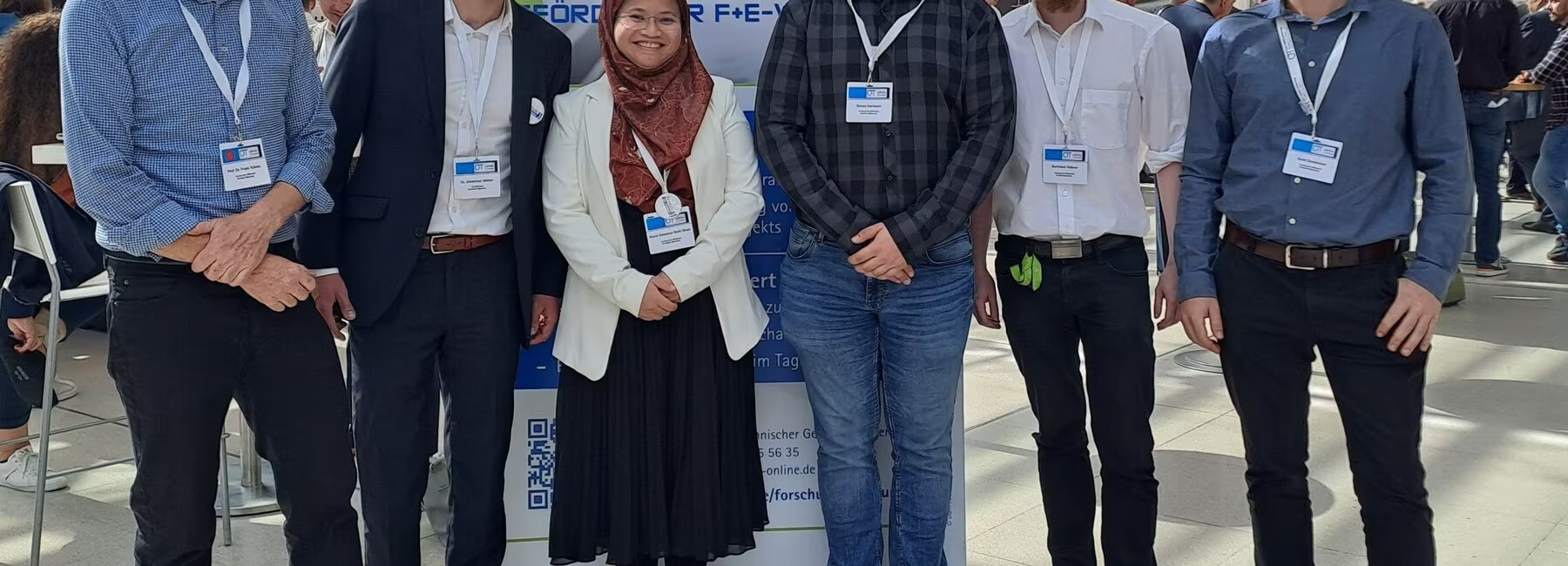
Young colleagues were given the opportunity to present their latest research findings in a dedicated session. Mittweida University of Applied Sciences contributed no fewer than three presentation topics:
Ms Nurul Amanina Binti Omar presented her corrosion studies on chemical nickel-phosphorus coatings with boron dispersion. These coatings are intended for use in wear and corrosion protection. Her experimental methods include the salt spray test – a standardised and widely used procedure – and electrochemical corrosion studies, such as those involving impedance measurements. Heat-treated coatings subjected to various temperature regimes were also examined and compared. These offer the potential for harder, more wear-resistant surfaces.
Mr Scott Dombrowe gave a presentation on his electroplated nickel-rhenium alloy coating produced from an aqueous solution. In his ‘NiWRe-Alloys’ project, these coatings are intended for use in medical technology and component testing in computed tomography scanners. The high-density alloy coatings exhibit X-ray-absorbing properties. Research is specifically focused on the electrolyte components and coating parameters in terms of their influence on coating formation. The demonstrator is a wafer onto which a lattice structure, fabricated using the LIGA process, has been applied; this structure has a height of 200 µm and a gap width of 8 µm. The alloy layer is intended to replace gold, which is far more expensive and poses significant toxicological risks during electrochemical processing.
Johannes Näther outlined the fundamentals of water electrolysis and presented galvanic pulse deposition of catalyst particles as a potential method for the direct coating of electrodes, which could be used for both PEM and AEM. In particular, he discussed the effects of pulse sequence and electrolyte composition on the deposition of iridium-ruthenium nanoparticles. These nanoparticles can be used to extend the service life of electrolysers.