

This page was translated automatically using artificial intelligence (DeepL). The German version is binding. More information about automatic translation
News Intranet
This page was translated automatically using artificial intelligence (DeepL). The German version is binding. More information about automatic translation
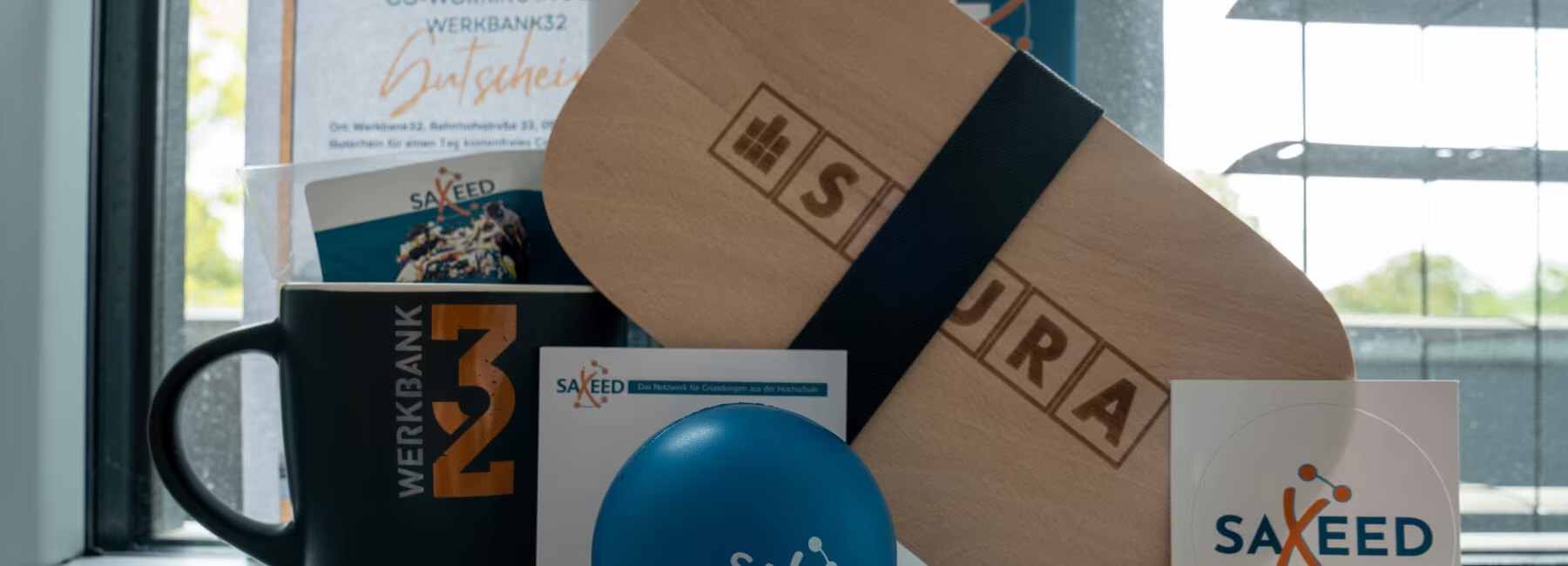
“At a time when start-ups and business start-ups are playing an increasingly central role in our economy, Mittweida University of Applied Sciences has recognised how important it is to promote entrepreneurship and self-employment. However, until now it has been difficult to collect accurate data and statistics on start-up activity at the university,” said the project leader, Professor Frank Schumann. SAXEED, Mittweida University of Applied Sciences’ start-up network, has responded to this by developing an innovative solution to make start-up activity more transparent. Together with various partners, both within and outside the university, a start-up box has been put together for all the university’s founders who launched their businesses in the 2022/23 academic year.
The start-up boxes contain not only useful everyday items, such as a lunchbox from the Students’ Union (StuRa), a coffee mug from Werkbank32 and a voucher for a free day at the co-working space of the same name run by TeleskopEffekt GmbH in Mittweida, but also a USB stick, a stress ball and some snacks to keep you going. These gifts are not only practical, but are also intended to symbolise the launch of a successful business and to serve as a small token of appreciation for taking the courageous step towards self-employment.
In its efforts to foster an entrepreneurial spirit, Mittweida University of Applied Sciences draws on the findings of the Start-up Monitor. Around 18 per cent of start-ups in Germany are university spin-offs. This means that almost one in five start-ups originates from the academic sector. In 72 per cent of university spin-offs, the founders are students or graduates, whilst professors and research assistants are less likely to set up businesses. Overall, women are proportionally slightly less likely to set up businesses than men; however, in university spin-offs, the proportion of women is comparatively high at 25 per cent. It is therefore particularly encouraging that almost half of the start-up kits were awarded to female founders. To ensure this trend continues to be supported, Mittweida University of Applied Sciences, in collaboration with SAXEED, has submitted an application for the EXIST-Women funding scheme. Through this programme, women at the university who are interested in starting a business and becoming self-employed are given the opportunity to familiarise themselves with these topics at an early stage.
Most university start-ups are in the fields of IT, software and analytical tools, as well as the life sciences, whilst there are fewer start-ups in areas such as Mechanical Engineering and nanotechnology. We are also seeing this trend at Mittweida University of Applied Sciences, as Dirk Liebers, the project’s site manager, reports.
The findings of the Start-up Monitor highlight the importance of initiatives such as SAXEED and the start-up kits provided. Bureaucracy, funding difficulties and a lack of entrepreneurial skills are cited as the biggest hurdles to university start-ups. Over 50 per cent of university start-up founders make use of services such as start-up advice, incubators, etc. at their universities.
The story of Esra Pötter, a media informatics student and keen freelancer, offers an insight into the success stories of Gründungsbox recipients. As a solo entrepreneur, he has made a name for himself in the creative sector and specialises in content creation. Esra conceives, edits and publishes videos and creates graphics for social media. He also runs a game design club at a school. Just like Esra Pötter, Christofer von Collas, a fourth-semester Media Management student, was delighted to receive a Gründungsbox. He set up a small business whilst studying and now produces, amongst other things, promotional videos and explanatory videos.
According to Lucas Naummann of SAXEED, who put together the start-up kit and organised its distribution, a total of 27 founders responded to the call to receive the kit and took part in a survey. Among the participating founders, apart from a few graduates, the majority are students. The students have set up their start-ups across a wide variety of sectors. As well as freelance photographers and social media marketing managers, there are also founders from the gaming and fashion industries.
The survey revealed that, in 2022 and 2023, students were mainly setting up businesses on their own. In the case of team start-ups, in most instances two students joined forces to set up a business. Freelance start-ups often play a role, particularly in the Faculty of Media Sciences. Almost all founders finance their self-employment through self-funding. This means that they draw on savings, gifts, etc. to make investments intended to help them build up their own business or self-employment.
The survey results show that the start-up network SAXEED is already well known amongst the participants. Eleven out of 27 start-up founders stated that they had first become aware of SAXEED mainly through lectures, seminars and workshops at Mittweida University of Applied Sciences, as well as via social media channels such as LinkedIn and Instagram. The start-up network offers support, resources and events to guide aspiring entrepreneurs on their path to self-employment. It works closely with partners to develop innovative solutions for evaluating and promoting start-up activity at the university. Through initiatives such as the ‘Start-up Boxes’, SAXEED actively contributes to promoting business start-ups at Mittweida University of Applied Sciences and making the process more transparent. Furthermore, the BMWK’s EXIST initiative offers funding opportunities for students and researchers pursuing their own start-up ideas. Through the EXIST start-up grant and the EXIST Research Transfer scheme, funding and advice can be applied for to support the start-up phase. Participation in specialised start-up seminars and workshops is also supported. EXIST thus helps to strengthen the transfer of knowledge and technology between universities and industry. SAXEED actively supports students and researchers at Mittweida University of Applied Sciences in applying for funding from the EXIST initiative.