

This page was translated automatically using artificial intelligence (DeepL). The German version is binding. More information about automatic translation
News Intranet
This page was translated automatically using artificial intelligence (DeepL). The German version is binding. More information about automatic translation
What does applied communication research involve? What exactly is ‘datafication’? What new research methods do big data and the use of AI open up for communication studies, media studies and journalism?
Answers to these and other questions were the focus of the joint annual conference held in September at the University of Hamburg by the ‘Digital Communication’ and ‘Methods of Journalism and Communication Studies’ sections of the German Society for Journalism and Communication Studies (DGPuK).
The Faculty Media Sciences was represented at this conference with three peer-reviewed presentations, thereby impressively showcasing applied communication research in the field of digital and data journalism at Mittweida to other experts.
Public service broadcaster feature reports
Presenter-led reports are formats in which the journalist takes centre stage, guides the audience through the report they have researched themselves and, so to speak, takes on the leading role.
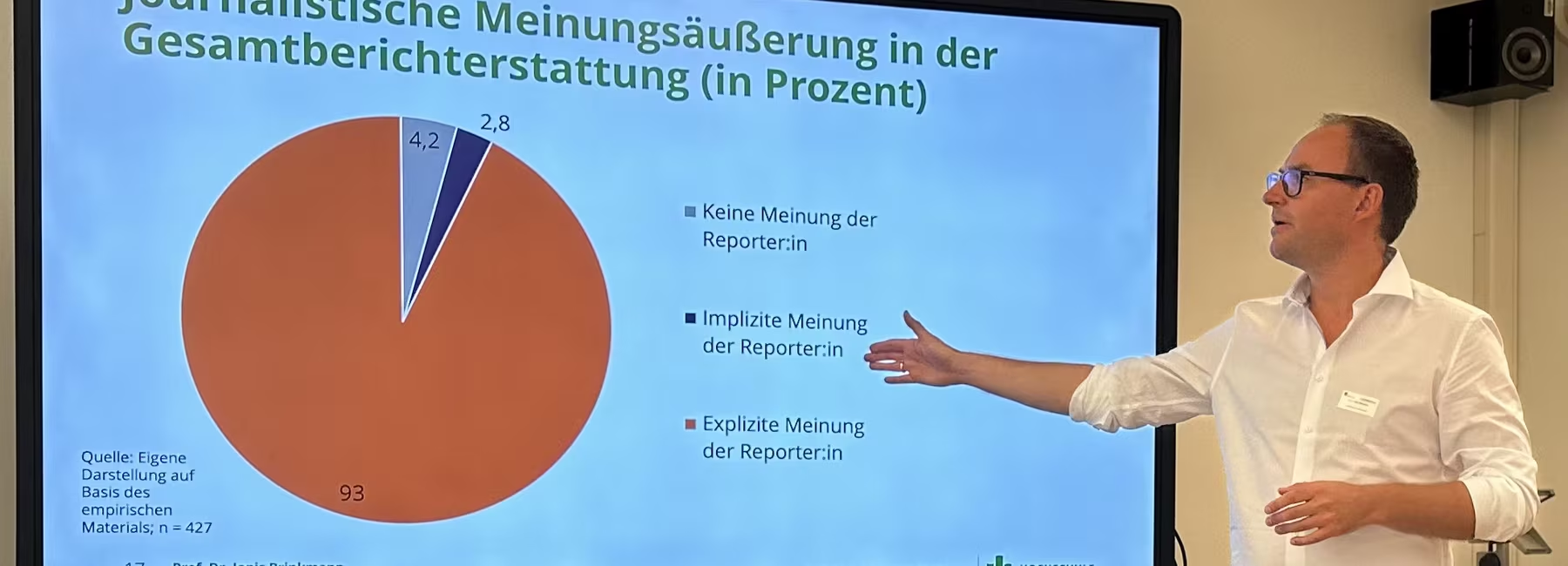
The extent to which topics, sources, key figures, opinions, assessments and quality criteria are defined in such programmes, and what kind of media-constructed reality this creates for young target audiences (aged 14 to 29), was the subject of the lecture ‘Journalistic avant-garde or more of the same? The ‘new generation’ of public service presenter-led reports as formats of target-group- and data-driven social journalism’, presented by Professor Janis Brinkmann.
He presented initial findings from a joint research project with Professor Christof Amrhein and Dr Anna Pröhle (both also from the Faculty Media Sciences). The focus was on the formats launched since 2021 as examples of target-group and data-driven portfolio management by the public service content network funk, as well as ARD and ZDF. The presentation explored the extent to which this ‘new generation’ of presenter-led reports delivers journalistic added value – particularly in contrast to their predecessor formats, such as Y-Kollektiv or STRG_F, which have been criticised by media journalists.
An interdisciplinary methodological framework for virtual assistance
What do journalists expect from virtual assistants? This is precisely what Anna Gorksi is investigating in her ongoing PhD research. The title of her presentation was: “Identifying and utilising journalistic expectations: Development of an interdisciplinary methodological framework for requirements analysis for virtual assistants in East German newsrooms”. In order to derive dimensional requirements for virtual assistants, a planned, structured and verifiable process was required to synthesise, structure and preserve replicable requirements. Accordingly, a methodological approach was developed and applied that can be used for further planned research. This was presented in the talk with a view to the conference’s focus on new methods in interdisciplinary communication and media research.
Data journalism in conjunction with journalistic practice
The lecture “Data Journalism in Eastern Germany – A Practical and Theoretical Analysis of Action and Structure in Data-Driven Information Communication” analysed, from a practical and structural-theoretical perspective, the recursive interplay between journalistic practice and structures within the practical context of data journalism. To this end, drawing on a qualitative survey of experts, it focused on the rules and resources to which data journalists in Eastern Germany refer, thereby contributing to the questions and issues raised in the call for papers. The presentation is based on a joint research project by Professor Linda Rath and Professor Janis Brinkmann, with the collaboration of Leoni Kipka.
The Faculty Media Sciences thus virtually single-handedly organised the conference panel on “Journalism & Datafication”, an absolute first and a testament to how innovative approaches to researching the datafied society, the media industry and journalism are being developed at the Faculty Media Sciences in Mittweida and fed back into the scientific community.
Further information on the conference is available via the following link: https://www.wiso.uni-hamburg.de/fachbereich-sowi/ueber-den-fachbereich/fachgebiete/fachgebiet-journalistik/tagung-digikomm