

This page was translated automatically using artificial intelligence (DeepL). The German version is binding. More information about automatic translation
News Intranet
This page was translated automatically using artificial intelligence (DeepL). The German version is binding. More information about automatic translation
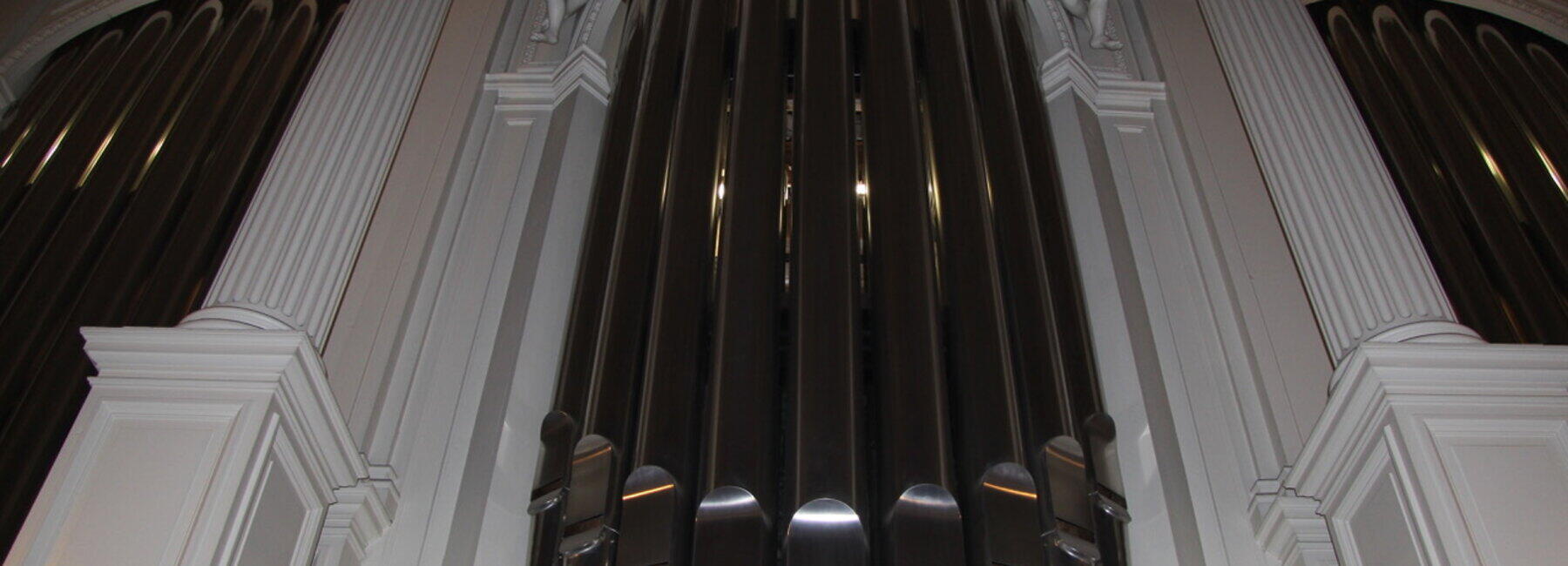
The ‘Porsche organ’ – as the Ladegast-Eule organ at St Nikola’s Church in Leipzig is popularly known – is indeed a name that fits both the car and the instrument, as they are both top-of-the-range in their respective categories. This article explains why a piece from Mittweida also belongs in this category and how it all fits together.
Friedrich Ladegast and the organ workshop
Friedrich Ladegast of Weißenfels built the organ at St Nicholas’ Church in Leipzig in 1862. It was his greatest work and was – and is once again – the largest organ in the Free State of Saxony. Originally built with 84 stops, the organ now has a total of 106 stops following various alterations and restorations.
Once highly acclaimed for its distinctive sound, this was lost at the beginning of the 20th century due to supposed technical progress. The major alterations at the start of the 20th century were carried out by the firm Sauer. In 2004, following an extensive restoration by the firm Orgelwerkstatt Hermann Eule from Bautzen, the Ladegast organ was restored to its former glory. The addition of an extra manual has further enhanced the range of sounds it produces.
Porsche AG and organ building
Porsche AG contributed a total of just under 2 million euros towards the restoration of the organ. However, the car manufacturer’s connection to the organ is not merely financial; there are also similarities in the design of the console. As the original Ladegast console no longer existed, the organ builders and car manufacturers developed what is probably a unique console to control the instrument, which was awarded the ‘red dot award’. In typical Porsche style, the organ is started from the left-hand side of the console, and the swell indicators feature Porsche’s characteristic speedometer-style design. The console also features heated seats and a rear-view camera for monitoring the chancel.
Christian Schulz and the organ control system
Professor Dr.-Ing. Christian Schulz held the Chair of Automation Technology at Mittweida University of Applied Sciences until February 2024. As part of a research project, he has been working since 2006 with the company Orgelwerkstatt Hermann Eule to develop an electronic system for controlling the tone and stop valves (action) of an organ, based on a distributed microcontroller control system. This system is now manufactured in series by the electronics service provider IMM and, under the name ‘Orgelelektronik System Eule’ (OSE), has already been installed in over 50 organs worldwide.
The impetus for the system’s development came from the former Rector of Mittweida University of Applied Sciences and Honorary Citizen of the town of Mittweida, Prof. Dr.-Ing. habil. Reinhard Schmidt, a qualified organ builder.
In technical terms, an organ functions as follows: a note, produced by one or more pipes, sounds precisely when the corresponding manual or pedal key is pressed at the console and the associated stop (a row of pipes of the same design) is drawn out.
The control of the tone and stop valves has evolved from a purely mechanical mechanism to electronic control. To resolve the contact problems that frequently arise in the console as a result, Christian Schulz, together with Dr Jörg Krupke (Faculty CB) a solution conceived as an ‘electronic bypass’, comprising a modular system of just under twenty different printed circuit boards for the flexible construction of an electronic tone and stop action. The microcontroller in the console captures the input pattern of the key assignments, calculates the output pattern from this and transmits it to the organ via a CAN bus.
Adventure: Register Rescue
Whilst installing the new organ electronics in Leipzig, a problem arose which none of the restorers or scientists had anticipated. To make the organ largely immune to cyber-attacks and viruses, it does not have a USB port accessible from the outside. However, every organist saves the stops required for their performance to the organ’s microcontroller so that they can access them when needed. How, then, were these to be transferred to the new playing electronics? Years of work seemed to have gone to waste. Christian Schulz came up with the solution. First, 4,000 different stop combinations (and 126 different stop-pull positions) had to be photographed. Using AI, the position of the stop pulls – whether pulled or not – was then recorded and converted into programming code. Via remote diagnosis, Prof. Schulz accessed the CAN bus and transferred the stops directly to the microcontroller; the organists’ work was saved.
Markus Kaufmann and the ‘Orgel in Vollendung’ festival week in October
Markus Kaufmann has been the cantor at St Nicholas’ Church since 2021. He raves about ‘his’ organ: ‘Dynamism, exclusivity and a sense of tradition come together in Saxony’s largest organ. Being able to play this instrument is indescribable: the elegant console, the warmth of the timbres and the attention to detail inspire and fascinate me anew every day. It is a true masterpiece. An instrument whose sound also extends an invitation: everyone is welcome at St Nicholas’ Church. As part of the work to complete the instrument in 2024, its technical capabilities have now been further expanded: As a parish, we are grateful that, through the collaboration between traditional organ-building craftsmanship and the innovative spirit of Mittweida University of Applied Sciences, we have succeeded in installing a modern storage system for the organists’ registrations, and to transfer the previously existing combinations to the new setter system without any loss of data. Prof. Schulz’s inventiveness will also be audible in the future: we are currently planning the first dynamically variable pipe glockenspiel in an organ. With the ‘Macan’ stop, the Ladegast-Eule organ gains yet another touch of exclusivity and elegance.”
The ‘Queen of Instruments’, as the organ is also known, was expanded in 2024 – to mark the 20th anniversary of its restoration – to include three additional stops and the OSE system. Two of the new stops are named ‘Macan’ and ‘Panamera’, after the Porsche models manufactured in Leipzig. The third stop is named ‘Vox Populi’ – the voice of the people – and thus commemorates the Peaceful Revolution in Leipzig.
The organ rang out in all its splendour for the very first time during a festival week at the end of October. HSMW Rector Professor Volker Tolkmitt said after attending the opening concert: “Today, to mark the start of the organ festival week, I had the pleasure of attending a wonderful concert at St Nicholas’ Church in Leipzig. The Central Saxony Symphony Orchestra filled St Nicholas’ Church with sound, alternating between solo passages and ensemble pieces alongside the famous organ, played by Markus Kaufmann. The fact that, amongst the many notes – from loud to soft, from high to low – which created a unique auditory experience in this beautiful church, there was always a touch of ‘Mittweida University of Applied Sciences’ made me enjoy the concert all the more. Thank you to everyone who made this new sound of the organ possible, and thank you for making our university part of it.”