

This page was translated automatically using artificial intelligence (DeepL). The German version is binding. More information about automatic translation
News Intranet
This page was translated automatically using artificial intelligence (DeepL). The German version is binding. More information about automatic translation
“AutoPoDMobile” is a simulation tool that populates and configures mobile phones with sample data in order to recreate “real” investigative cases for police authorities. It was developed as part of the FORMOBILE project. The tool can be used to simulate communication between (suspected) individuals across multiple channels (phone calls, email, messaging apps), and the mobile devices can be automatically populated with additional data. This is required, for example, for training purposes, to prepare the devices so that they contain calls and chat messages, but also so that both case-relevant and non-case-relevant data can be found on the devices. Backups of the devices can then be created and examined by the training participants.
Until now, the tool consisted of a collection of command-line programmes that had to be run in a specific order. Configuration was carried out manually by placing files in specific folders and making adjustments to configuration files. Furthermore, the tool has so far only supported Android-based devices.
The team, led by Professor Dirk Pawlaszczyk, has enhanced the tool with a user interface that assists with configuration and makes the tool easier to use. Support for messaging apps has also been expanded. Whilst previously only WhatsApp was supported, the tool now also allows messages to be sent via Threema, Telegram and Signal. A key feature of the tool is the extension for iOS devices. This means that data can now also be automatically transferred to Apple devices. During development and testing, the research group was supported by Bachelor’s and Master’s students specialising in forensics.
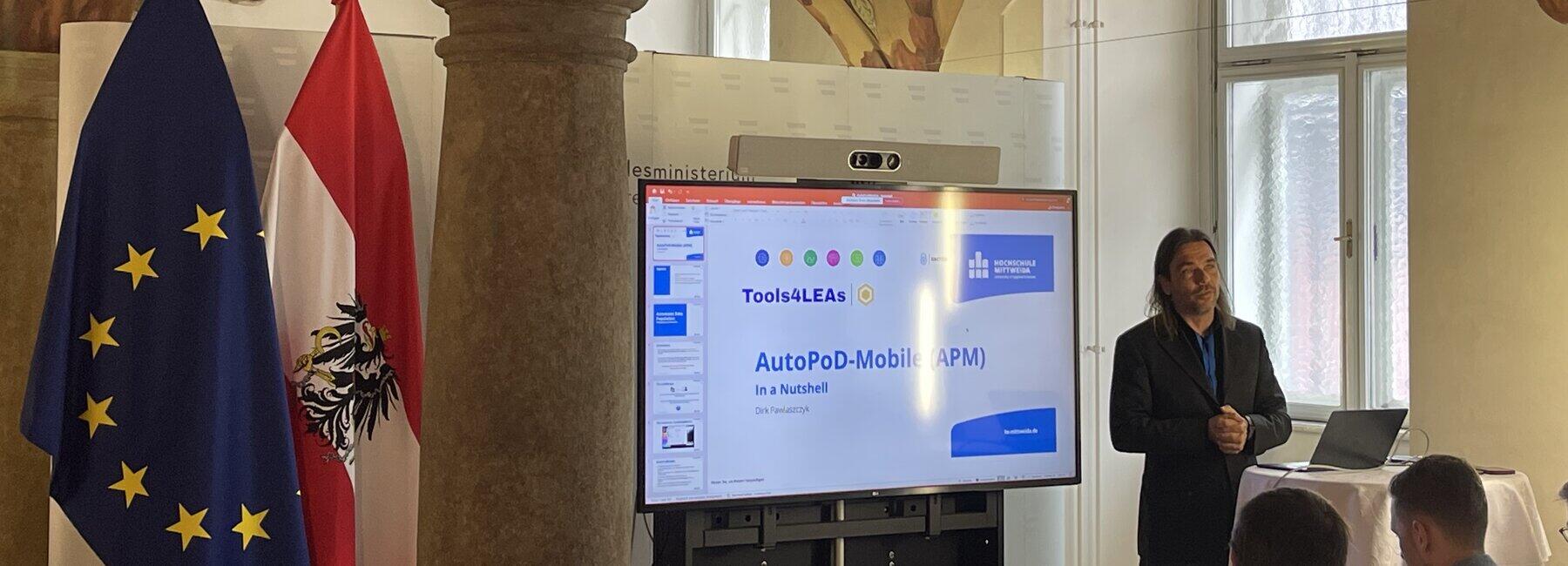
Professor Pawlaszczyk and Philipp Engler presented the results of this implementation in early April at the Tool4LEAs event in Vienna. Tool4LEAs provides instruments and tools that can be used free of charge by European security authorities to investigate criminal cases, particularly in the digital environment. During the subsequent Q&A session, participants highlighted the urgent need for such a tool to be made available.
Professor Pawlaszczyk is currently planning the next enhancement to the tool: a storyboard function will be implemented, thereby simplifying the creation of data – and, if desired, even automating the process with the help of a locally operating, pre-trained AI. Furthermore, the tool will be expanded so that it can also be used to validate the results of forensic investigation tools.
Further information on the tool, topics for final-year projects and opportunities to get involved is available from Philipp Engler.
Text and image: Prof. Dirk Pawlaszczyk, Philipp Engler