

This page was translated automatically using artificial intelligence (DeepL). The German version is binding. More information about automatic translation
News Intranet
This page was translated automatically using artificial intelligence (DeepL). The German version is binding. More information about automatic translation
Fatigue – anyone who paid attention in French lessons will know that this means ‘fatigue’. The more than 160 participants from over 20 countries who met in Cambridge in mid-June were certainly not tired, however. Fatigue 2024 is the 9th Engineering Integrity Society International Conference on Durability & Fatigue – loosely translated as the Engineering Integrity Society’s conference on the durability and fatigue (of materials).
The conference offers companies the opportunity to keep up to date with the latest developments in the field of material durability and structural analysis methods, and provides researchers with an excellent forum to present their work, serving as a platform for its industrial application. A total of 29 individual sessions provided ample opportunity for exchange, discussion and collaboration.
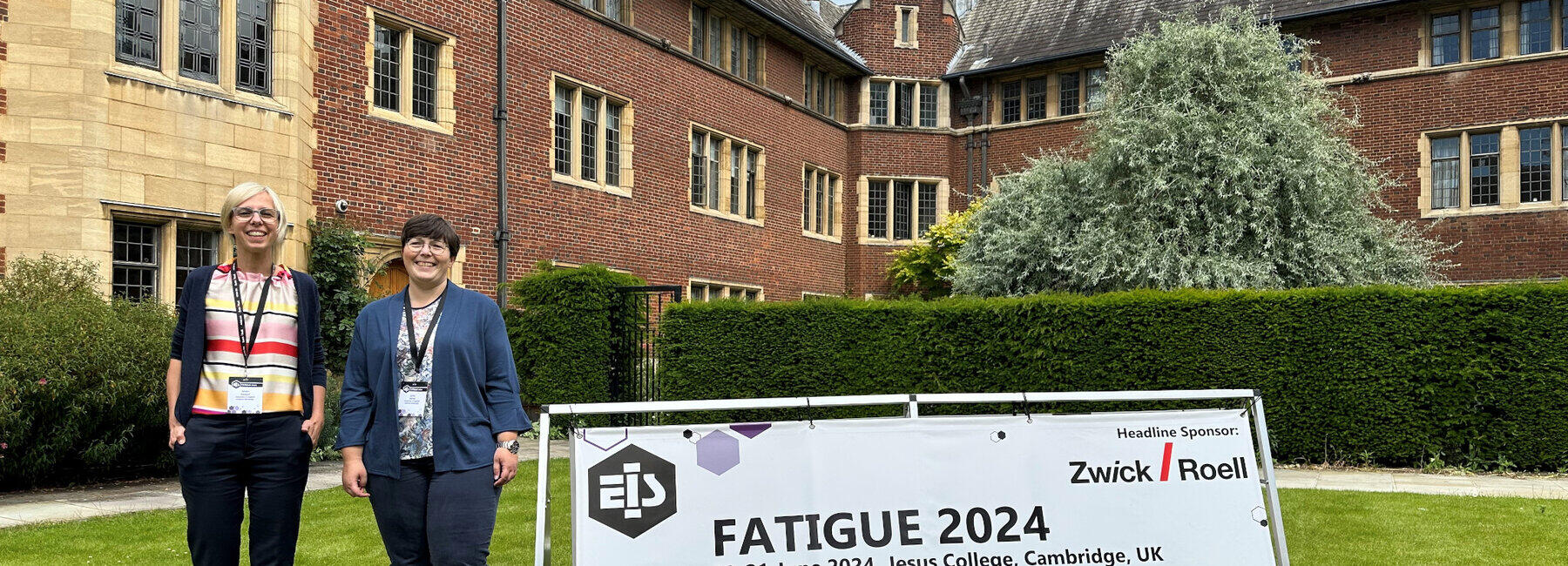
Amongst the participants were PhD student Ulrike Hähnel and Professor Kristin Hockauf from the HSMW, who were, on the one hand, impressed by the time-honoured historical setting and, on the other, delighted by the lively professional exchange with their international colleagues.
Jesus College, Cambridge, the venue for the conference, is set amongst 24 hectares of gardens in the heart of Cambridge and was founded in 1496 on the site of the 12th-century Benedictine convent of St Mary and St Radegund.
In the packed Frankopan Hall, during the ‘Surface Conditions’ session, Ulrike Hähnel presented her findings on the stability of compressive residual stresses in ADI cast iron under cyclic loading – one aspect of her doctoral thesis. The influence of induced compressive residual stresses on the fatigue behaviour of ADI, a high-strength yet ductile cast iron material, was investigated here. The distribution of residual stresses near the surface was determined following hard rolling and cyclic loading of the cast samples using a method of X-ray diffraction that is not yet widely used: the cosα method.
Kristin Hockauf presented the crack propagation and damage behaviour in PZT piezoceramics. The presentation included findings from a collaborative project funded by the SMWK (2020–2023), on which she had worked alongside colleague Frank Poschmann and Professor René Pleul. They investigated the failure behaviour of the piezoceramic as a function of pre-existing damage under cyclic electrical loading. Her presentation in the ‘Non-metallic materials’ session at the Webb Library was received with interest and discussed by the community.
Both are returning from this trip with a wealth of positive feedback, exciting ideas and fresh inspiration, and would like to thank everyone who supported them in the run-up to the trip and held the fort at home whilst they were away.
Further information on the conference can be found at the following link: https://fatigue2024.com/
Text: Prof. Kristin Hockauf
Photos: private