

This page was translated automatically using artificial intelligence (DeepL). The German version is binding. More information about automatic translation
News Intranet
This page was translated automatically using artificial intelligence (DeepL). The German version is binding. More information about automatic translation
“Technologies for sustainable point-of-care diagnostics – shaping the future of diagnostics” – that is the aim of the WIR! DIANA alliance. WIR! stands for ‘Change through Innovation in the Region’ as part of the BMBF’s ‘Innovation & Structural Change’ pilot programme and is aimed at broad-based regional alliances comprising a wide variety of stakeholders who are jointly conducting research into innovative approaches.
The WIR!-DIANA Alliance aims to bring together the regional technological potential in the fields of micromechanical manufacturing, laser processing and plant engineering, as well as that of diagnostics companies, medical institutions and academic partners in the Central Saxony region between Chemnitz and Leipzig, and to use this to establish sustainable structures. This collaboration across these fields is intended to create a high-quality value chain, culminating in innovative point-of-care diagnostic systems that can be used close to the patient in doctors’ surgeries, emergency medicine and in the home.
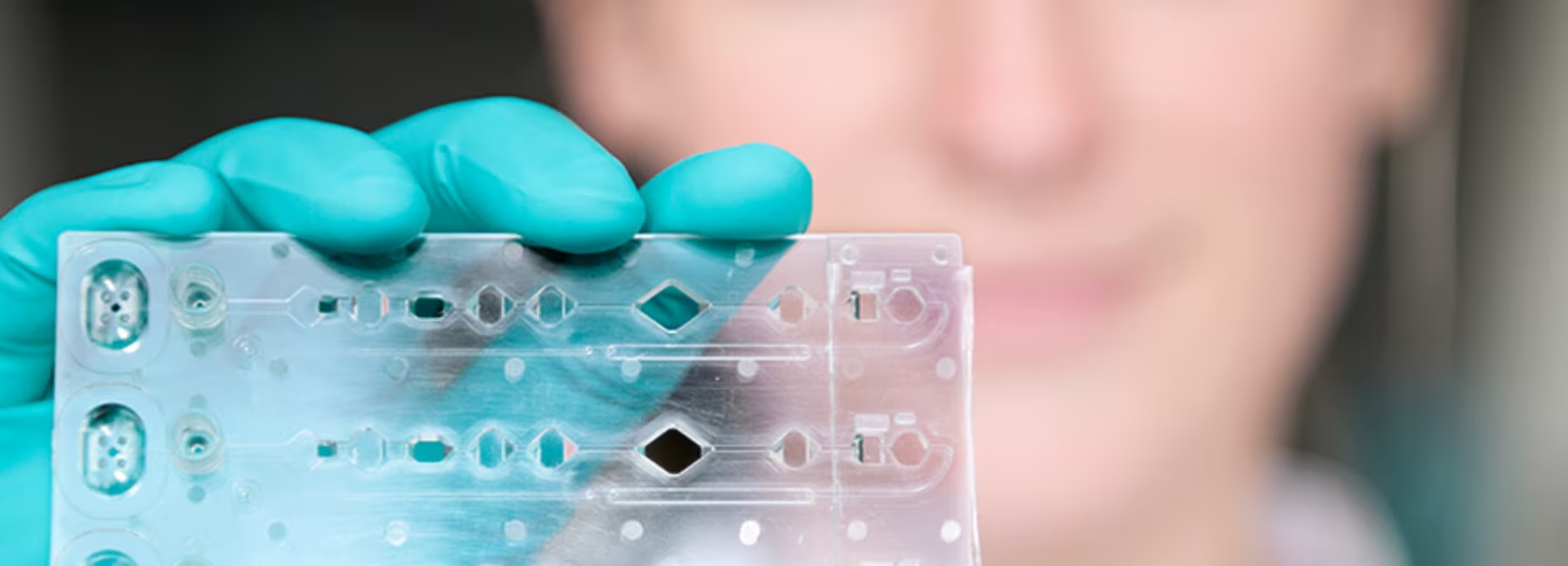
Professor Udo Löschner from the Laser Institute at Mittweida University of Applied Sciences (LHM) is an active partner in the WIR! alliance and, since early August 2023, has been conducting research with his research group alongside the industry partners Senslab GmbH, SITEC Industrietechnologie GmbH, C-Marx GmbH and d-opt GmbH as part of a project funded under the WIR!-DIANA programme. The aim of the research is to develop a novel process for “laser welding for the mass-production-ready manufacture of lab-on-a-chip applications and AI-based quality control procedures – LasOC”, which will also open up further areas of application for laser technology in medical engineering for the research group in the future
It was therefore both a privilege and a duty for him to organise the third DIANA Forum – which this time focused on manufacturing technologies for point-of-care diagnostics – at the Laserinstitut Mittweida University of Applied Sciences (LHM) at the end of June. Prior to the event, the LHM opened the doors to its laboratories for around 40 participants as part of a guided DIANAvisit tour, demonstrating the possibilities offered by laser technology. The tour provided the perfect introduction to the topic and highlighted that laser technology offers a whole range of very different applications for the medical technology sector.
The forum, which was very well attended with more than 70 participants, was opened by Dr Dirk Kuhlmeier, alliance coordinator for WIR! sind DIANA (Fraunhofer IZI), and Dr Uwe Lienig (Wirtschaftsförderung Sachsen GmbH). This was followed by a video message from the patron, Thomas Schmidt, Saxony’s Minister of State for Regional Development. Udo Eckart (Fraunhofer IWU) acted as moderator. The host, Professor Udo Löschner, brought the opening proceedings to a close with an engaging presentation on the Laser Institute.
The chairpersons of the DIANA Advisory Board, Professor Klaus Stefan Drese and Professor Paula Prenzel, then provided an update on the current status of the DIANA projects and offered an insight into the work of the Advisory Board. This was followed by a series of engaging keynote presentations covering a wide range of areas within the value chain for point-of-care diagnostics. Guests learnt interesting details about the “potential of 3D Printing for POCT” from Sophia Röder (Rapidobject GmbH), “Toolmaking for microfluidics” by Dr Andreas Ebert (WESKO GmbH) and Eric Gärtner (Fraunhofer IWU), “Device development for in-vitro diagnostics” by Dr Jens Trepte (IMK Health Intelligence), “Laser technologies for bionic applications” by Professor Udo Löschner (Laser Institute, Mittweida University of Applied Sciences) and “Functional surfaces for POC” by Professor Lutz Engisch (Partner – WIR! Alliance GRAVOmer).
Following the keynote presentations, existing and new partners gave short pitches to the DIANA network to showcase their expertise or project ideas.
The concluding panel discussion, featuring guests Andreas Persch (RKT Rodinger Kunststoff-Technik GmbH), Dr Peter Miethe (Posanova GmbH) and Dr Wilhelm Gerdes (Cell.Copedia GmbH) covered a wide range of topics, from the market opportunities offered by point-of-care technologies to the challenges currently facing production. The discussion once again highlighted how important networks are for the development of innovative technologies and the future of the economy in Central Germany.
The forum was a resounding success and has raised the profile of the LHM and Mittweida University of Applied Sciences within the field of medical technology applications. Through active participation in the WIR!-DIANA consortium and its network, momentum has been created to further develop the synergistic potential of laser technologies and medical technology, to utilise them sustainably, and to translate them into innovative applications through exciting research projects.