

This page was translated automatically using artificial intelligence (DeepL). The German version is binding. More information about automatic translation
News Intranet
This page was translated automatically using artificial intelligence (DeepL). The German version is binding. More information about automatic translation
How can engineers use artificial intelligence responsibly? What ethical and legal frameworks need to be taken into account when developing technical systems? Fourth-semester students on the Mechanical Engineering degree programme at Mittweida University of Applied Sciences explored these and other questions as part of the seminar ‘Ethics in the Engineering Profession’. The seminar took place as part of Professor Leif Goldhahn’s ‘Fundamentals of Production Operations’ module and placed particular emphasis on the ethical use of AI technologies. In addition to covering key ethical principles such as transparency, fairness, data protection and human oversight, the legal foundations – in particular the risk-based approach of the European AI Act – were also discussed.
Practical learning with the PAL project
A key element of the seminar was the presentation of a real-world application example from the PAL project – PerspektiveArbeit Lausitz (www.pal-lausitz.de) – by research assistant Christina Pietschman. In a PAL sub-project, Mittweida’s Institute for Labour Research (InnArbeit) and Institute for Artificial Intelligence (SICIM), a network of companies and an industrial firm are jointly developing an assistance system to improve ergonomics at assembly workstations. The system uses cameras and mini-PCs to analyse employees’ movements and postures. Based on established standards and ergonomic methods, it provides real-time feedback whenever postures that pose a health risk are detected. The aim is to protect employees’ health in the long term – whilst adhering to clear ethical guidelines for AI: the system can be used offline, is activated on a voluntary basis and can be switched off at any time.
Students discuss ethical challenges
The students then engaged in a lively discussion on four key questions relating to this AI application:
1. How should the risk posed by AI be assessed?
2. What ethical principles need to be taken into account during development and deployment?
3. What does this mean in practical terms for system development?
4. What needs to be taken into account when using AI in a business context?
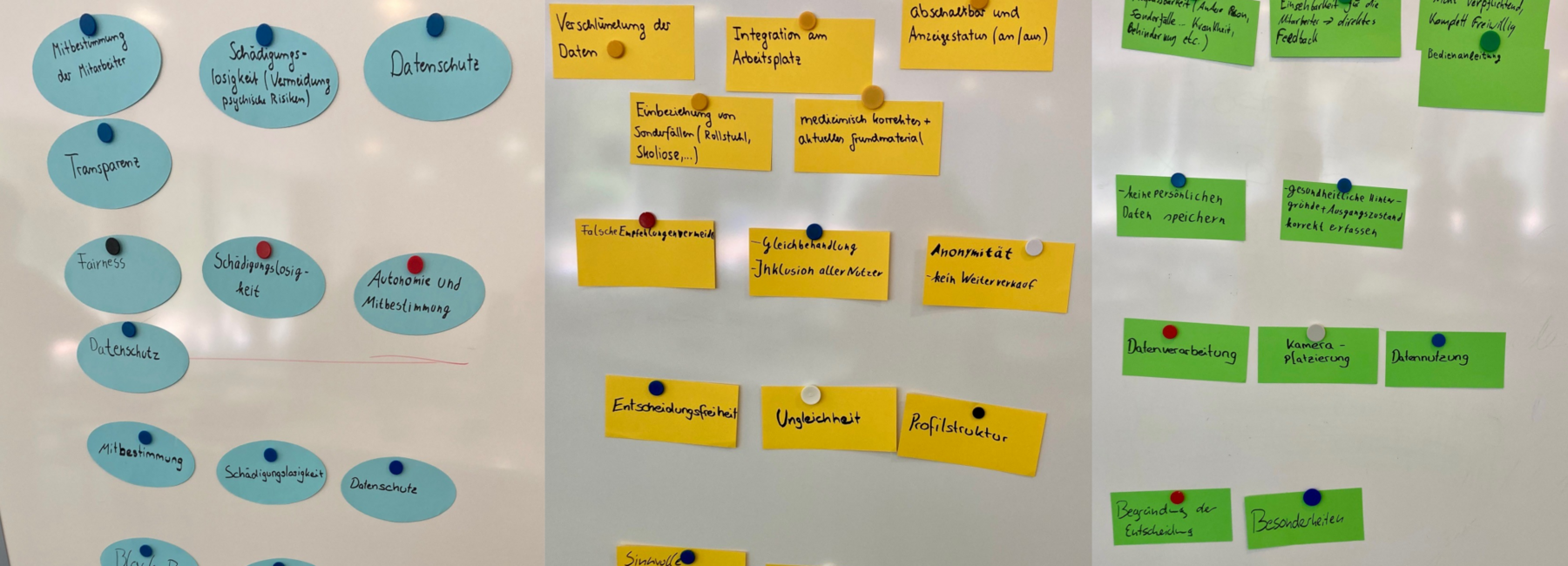
The students summarised the results using the Metaplan technique. This revealed a high degree of reflection and a strong sense of responsibility. Among other things, the students emphasised the importance of data protection, transparency, voluntary participation and the involvement of users in the development process. Occasionally, some light-hearted suggestions emerged – such as appointing a ‘seating officer’ within the company – which encouraged further reflection.
A seminar with a forward-looking perspective
The ethics seminar impressively demonstrated how important it is to combine technological innovation with social responsibility – a skill that is of central importance for aspiring engineers.
Text: Prof. Leif Goldhahn, Christina Pietschmann
Photos: Christina Pietschmann (1), Prof. Leif Goldhahn