

This page was translated automatically using artificial intelligence (DeepL). The German version is binding. More information about automatic translation
News Intranet
This page was translated automatically using artificial intelligence (DeepL). The German version is binding. More information about automatic translation
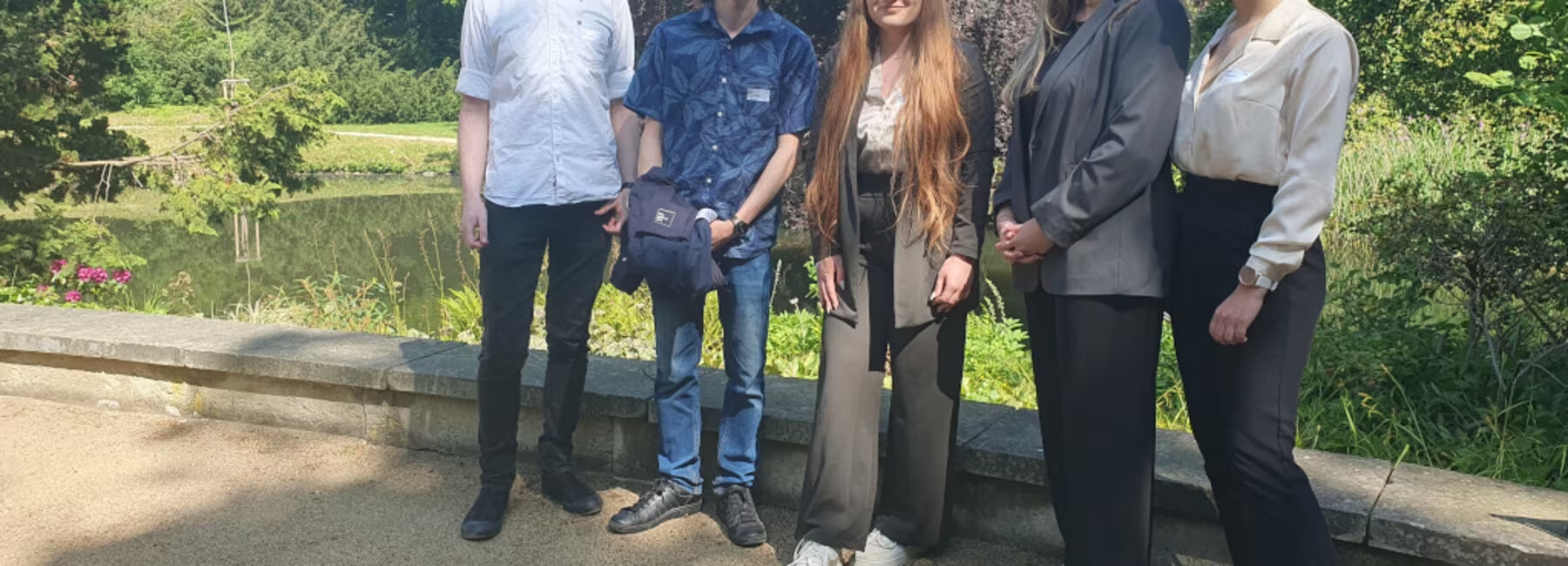
Several Media Informatics students, who presented the findings of their academic work at this year’s Young Researchers’ Conference at Harz University of Applied Sciences in Wernigerode, demonstrated that it is not always necessary for a research project to be carried out entirely independently in order to be successful.
As part of the ‘Science and Business’ module series, students on the ‘Media Informatics and Interactive Entertainment’ degree programme worked on a project over three semesters in groups of 5–10 people, within the broader context of ‘Interactive Software Applications’. In each project, a partner from outside the degree programme acted as a stakeholder, whose objectives and requirements the students were tasked with implementing with the technical support of the module supervisors. Based on the award-winning teaching concept “Digital Skills and Products” (previously reported on via this link), this led to the development of software products which were scientifically evaluated towards the end of the module series. Together with the conclusions drawn from this, the results were published at various conferences, including NWK2023.
Publication: Exploratory study on health assessment and monitoring using multimodal sensor technology (represented at the NWK by Michelle Becher and Serena Clausnitzer)
During the pandemic, many people have started exercising at home. The aim is to improve their health through exercises that are usually provided digitally. Particularly in the case of exercise programmes as part of a course of therapy, ensuring long-term benefits is essential, but a review of these requires a resource-intensive visit to a (physiotherapy) therapist. The students developed a smartphone app which uses photos and short questionnaires to record a participant’s physical condition before and after exercising on a vibration platform, and analyses the data using various algorithms to automatically provide an assessment of actual improvements.
Publication: Automated detection of bug reports in customer support within the banking sector (represented at the NWK by Annie Simon)
If a user of a website or app encounters a problem, many companies now offer rapid support via chat. Many of the questions asked there can be answered quickly and automatically by bots, or – in more complex cases – manually by a human member of staff. A text analysis algorithm handles the classification. Using the Sparkassen app as an example, the student group was able to improve this algorithm and the data used in conjunction with it to such an extent that user enquiries regarding software errors (so-called ‘bugs’) can be distinguished with a high degree of certainty from general errors (e.g. forgotten passwords). This enables bugs to be identified specifically and rectified by the app developers. This topic was worked on by a group led by Annie Simon in collaboration with Fingentia GmbH.
Publication: Realistic reproduction of environments for interactive real-time simulations, using the offices of the Data Science Research Group (represented at the NWK by Martin Weber and Jannik Büge) as an example
Artificial intelligence has been an indispensable part of AI-supported assistance systems for years, particularly in the field of (semi-)automated control of vehicles and robots of all kinds. However, as is necessary for many AI processes, these systems must first learn how to behave in the desired environment. To ensure that this time-consuming and error-prone process does not consume too many resources or even cause physical damage (e.g. by a robot crashing into walls), the team of students digitally recreated both the office spaces required as the experimental environment and the Double 3 robot with all its technical sensors, in order to generate data for AI-based control within this virtual world. This publication was produced at the Artificial Intelligence Co-Creation Lab as part of the Saxony 5 university consortium project, a collaboration between Mittweida University of Applied Sciences and Professor Espig from West Saxon University of Applied Sciences, Zwickau.