

This page was translated automatically using artificial intelligence (DeepL). The German version is binding. More information about automatic translation
News Intranet
This page was translated automatically using artificial intelligence (DeepL). The German version is binding. More information about automatic translation
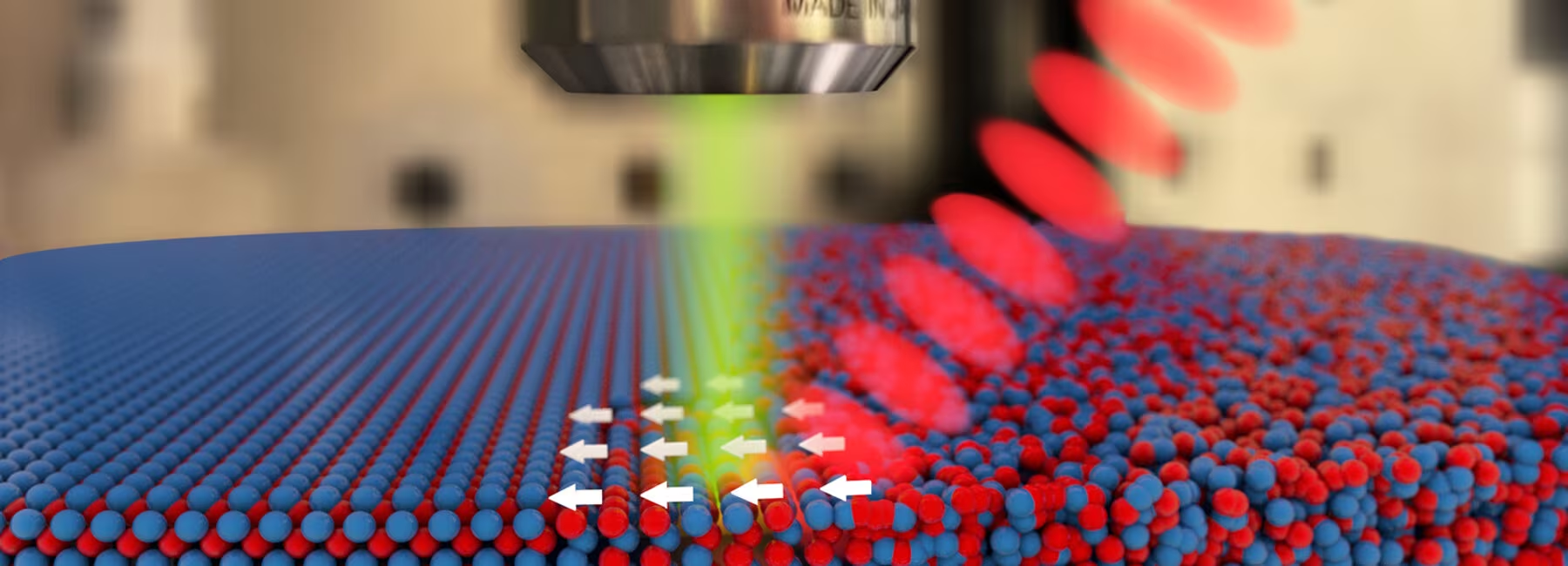
If you want to magnetise an iron nail, you simply need to pass a bar magnet over its surface several times. However, there is also a much more unusual method: some time ago, a team led by the Helmholtz Centre Dresden-Rossendorf (HZDR) discovered that a specific iron alloy can be magnetised using ultrashort laser pulses. The researchers have now investigated this process in greater detail, in collaboration with the Laserinstitut at Mittweida University of Applied Sciences (LHM), and found that the phenomenon also occurs in another class of materials – which significantly broadens the prospects for potential applications. The research group presents its findings in the journal *Advanced Functional Materials* (DOI: 10.1002/adfm.202311951).
The unexpected discovery had already been made in 2018. When the HZDR team irradiated a thin layer of an iron-aluminium alloy with ultrashort laser pulses, the non-magnetic material suddenly became magnetic. The explanation: the laser pulses rearrange the atoms in the crystal in such a way that the iron atoms move closer together, thereby forming a magnet. The researchers were then able to demagnetise the layer again using a series of weaker laser pulses. In doing so, they had discovered a way to selectively create and remove tiny ‘magnetic spots’ on a surface.
However, the pilot experiment left some questions unanswered. “It was unclear whether the effect occurred only with the iron-aluminium alloy or also with other materials,” explains Dr Rantej Bali, a physicist at the HZDR’s Institute of Ion Beam Physics and Materials Research. “We also wanted to try to track the process over time.” To investigate this, he teamed up with Prof. Alexander Horn and Dr Theo Pflug from the LHM, as well as colleagues from the University of Zaragoza in Spain.
A flipbook with laser pulses
Specifically, the experts focused on an alloy of iron and vanadium. Unlike in the iron-aluminium alloy, the atoms are not arranged in a regular crystal lattice, but are arranged in a more chaotic manner. They form an amorphous, glass-like structure. To observe what happens after laser irradiation, the physicists used a specialised method: the pump-probe technique. “First, we fire a strong laser pulse at the alloy, which magnetises the material,” explains Theo Pflug. “Then we send a weaker pulse after it, which is reflected by the material’s surface.”
Analysis of the laser reflections provides insights into the material’s physical properties. The process is then repeated several times, with the time interval between the first ‘pump’ pulse and the subsequent ‘probe’ pulse being gradually increased. The result is a time series of reflection data from which it is possible to reconstruct the processes triggered by the exciting laser pulse. “The method is similar to a flipbook,” says Pflug. “There, too, a series of individual images is used to create a sort of animated film.”
Rapid melting
The result: although it has a different basic structure to the iron-aluminium compound, the iron-vanadium alloy can also be magnetised using a laser. “In both cases, the material melts briefly at the point where it is irradiated,” explains Rantej Bali. “As a result, the laser erases the previous structure, allowing a small magnetic region to form in both alloys.” This is an encouraging result: apparently, the phenomenon is not limited to a specific material structure, but occurs in various atomic arrangements.
The team is also investigating the temporal sequence of the process: “At the very least, we now know in which time scales something happens,” explains Theo Pflug. “Within femtoseconds, the laser pulse excites the electrons in the material. Later, after several picoseconds, the excited electrons transfer their energy to the atomic nuclei.” This energy transfer then causes the atoms to rearrange themselves into a magnetic structure, which is fixed in place by the subsequent rapid cooling. The researchers aim to observe exactly how the atoms rearrange themselves in follow-up experiments by using intense X-rays to probe the magnetisation process.
A look at better magnets
Even this early-stage research is already yielding initial ideas for potential applications: for example, it is conceivable that a laser could be used to place tiny magnets precisely on the surface of a chip. “This could be useful for the production of sensitive magnetic sensors, for example in vehicles,” speculates Rantej Bali. “It could also be a possibility for magnetic data storage.” Furthermore, the phenomenon appears to hold promise for a new branch of electronics known as spintronics. Here, rather than routing electrons through transistors as is customary, magnetic signals are to be used for digital computing processes – a potential approach for the computers of the future.
Publication
T. Pflug, J. Pablo-Navarro, S. Anwar, M. Olbrich, C. Magén, M. R. Ibarra, K. Potzger, J. Faßbender, J. Lindner, A. Horn, R. Bali: Laser-Induced Positional and Chemical Lattice Reordering Generating Ferromagnetism, Advanced Functional Materials, 2023, (DOI: 10.1002/adfm.202311951)
Link: https://onlinelibrary.wiley.com/doi/10.1002/adfm.202311951