

This page was translated automatically using artificial intelligence (DeepL). The German version is binding. More information about automatic translation
News Intranet
This page was translated automatically using artificial intelligence (DeepL). The German version is binding. More information about automatic translation
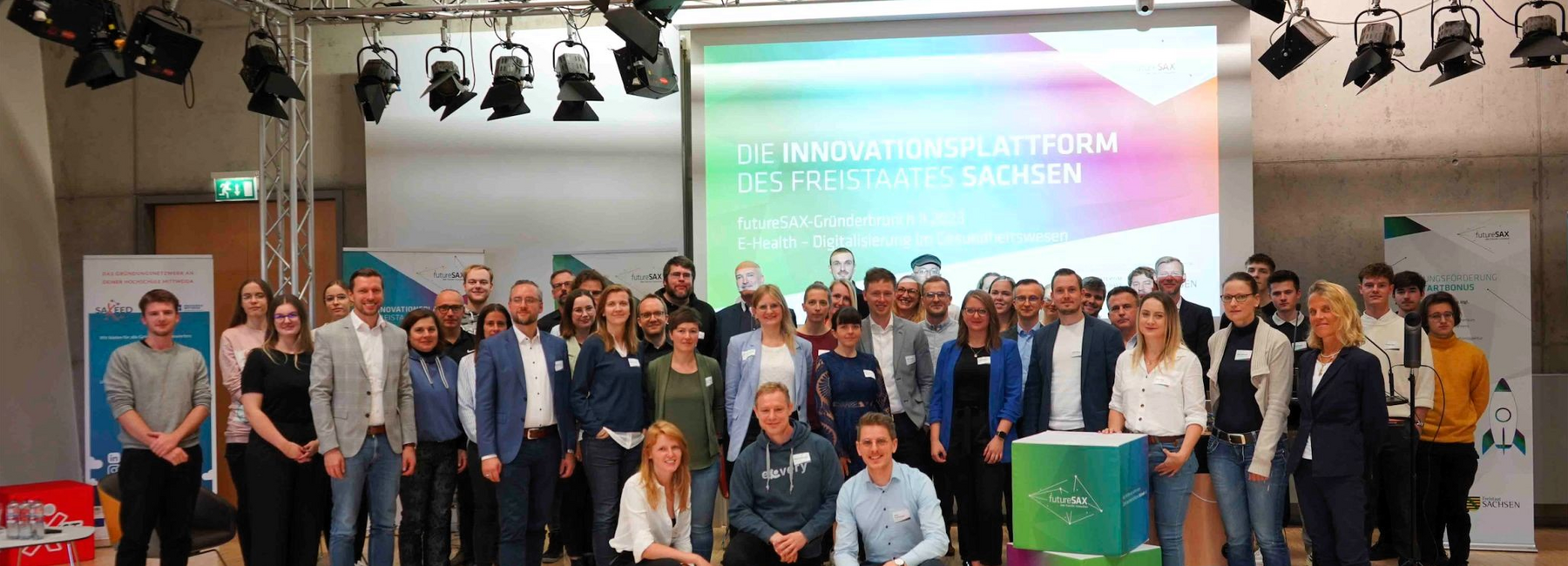
On 24 October 2023, Mittweida University of Applied Sciences became a meeting place for innovators and visionaries in the field of e-health. In collaboration with SAXEED, the university’s start-up network, the Free State of Saxony’s innovation platform – futureSAX – organised the Start-up Brunch. More than 50 participants from across Germany came together to exchange ideas, network and explore new opportunities for collaboration. Mittweida University of Applied Sciences, renowned for its strong research focus and practice-oriented approach, provided the ideal setting for this event. As the organiser, SAXEED – under the leadership of Professor Frank Schumann – once again proved itself to be a platform that serves as a crossroads between many different specialist fields, contacts and experiences. Given his background as a qualified psychologist, it quickly became clear that for Professor Frank Schumann, as project leader of the SAXEED site in Mittweida, “[...] this is not just a normal networking event, but a personal commitment to driving innovation and progress in the healthcare sector.”
Mittweida University of Applied Sciences has established itself within Saxony’s start-up ecosystem through successful projects and the resulting business start-ups, and offers a wealth of expertise and potential through its various projects. For example, Dr Florian Kaiser, co-founder of PharmAI – a start-up that uses artificial intelligence to accelerate pharmaceutical research – studied bioinformatics and molecular biology at Mittweida University of Applied Sciences and completed his PhD as part of a collaborative programme.
In his opening speech at the Start-up Brunch, Dirk Liebers, Site Manager at SAXEED in Mittweida, emphasised a key message that was enthusiastically taken up by those present: Ongoing digitalisation presents a unique opportunity to make the healthcare system more preventative and personalised – a goal that is not only desirable but also essential for the future of healthcare.
During the panel discussion, moderated by Heinz Truckenbrodt and Charlotte Bienhaus (start-up project manager at futureSAX), the wide-ranging opportunities and challenges facing Saxony’s e-health sector were examined in detail. Mittweida University of Applied Sciences, as a hub for exchange and innovation, provided the ideal platform for this fruitful dialogue. Florian Claus from Landkreis Mittweida Krankenhaus gGmbH, Dr Madlen Scheibe from the Centre for Evidence-Based Healthcare at TU Dresden, and Marion Mattern from Teleskop Effekt contributed their respective expertise and discussed the current and future challenges as well as the opportunities presented by digital medical devices. Their insights from clinical practice, scientific research and start-up consultancy complemented one another perfectly and shed light on the topic from various perspectives. A key consensus that emerged from the discussions was the need to adapt the legal framework in order to drive forward the development of the e-health sector. It became clear that, on the one hand, there is a lack of clear regulation, whilst, on the other hand, existing data protection regulations significantly complicate the implementation of digital medical devices. The experts agreed that legislators must strike a careful balance between data protection concerns and the requirements of effective preventive healthcare. Furthermore, the slow pace of digitalisation at federal level was identified as a significant obstacle for the sector, a point that was clearly raised during the discussion at Mittweida University of Applied Sciences.
Following the stimulating discussions, four start-ups from Saxony had the opportunity to present their innovative business models in brief, three-minute presentations, after which they fielded questions from the interested audience. These presentations, a demonstration of the dynamic entrepreneurial spirit in Saxony, were also followed with great interest by Mittweida University of Applied Sciences.
Sciendis GmbH from Leipzig presented its revolutionary app, WUNDERA, which redefines digital wound documentation. Was hab’ ich gGmbH offered insights into its work on improving communication in the healthcare sector through its unique ‘patient letter’. BWS Education GmbH demonstrated how digital learning platforms can enrich medical training with over 4,000 pieces of multimedia content. scanacs GmbH from Dresden presented its innovative software solution, which simplifies prescription billing between pharmacies and health insurance providers. The importance of cooperation and collaboration was highlighted by the joint presentation by Florian Bontrup (DOCYET GmbH) and Benedict Rehbein (eCovery GmbH), who demonstrated how strategic partnerships can open up new avenues in the e-health sector.
Following a brief networking break, the second panel focused on market positioning and growth opportunities for start-ups in the e-health sector. Representatives from leading organisations such as AOK Plus, Techniker Krankenkasse, Medical Forge e. V., biosaxony and DiA42 GmbH expressed their willingness to support and collaborate with start-ups. They emphasised the importance of clear objectives and appropriate regulation by the legislature to drive the sector forward.
The start-up brunch concluded with presentations from three promising start-ups, some of which are still in the crucial pre-launch phase. They were given the opportunity to present their innovative business ideas in concise, three-minute pitches. Participants included Maria Schächer from vimum GmbH, Sebastian Driesnack, and the founding duo Clara Rosebrock and Max Tettenborn with their Therapease project.
The Start-up Brunch in Studio B at Mittweida University of Applied Sciences was a resounding success. It brought together key players from Saxony’s e-health sector, fostered dialogue and collaboration, and demonstrated the sector’s promising future. Despite existing challenges and hurdles, the participants demonstrated a strong commitment to driving forward digitalisation in the healthcare sector and promoting innovation.
Text and photos: SAXEED Mittweida Start-up Network