

This page was translated automatically using artificial intelligence (DeepL). The German version is binding. More information about automatic translation
News Intranet
This page was translated automatically using artificial intelligence (DeepL). The German version is binding. More information about automatic translation
Mendel’s cross-breeding experiments can be carried out in the classroom – well, it does take a bit of time. The same goes for the inheritance of traits in fruit flies – they reproduce more quickly, as we all know. However, it requires dedicated teachers, as conducting an experiment with pupils is always a challenge – especially as not everyone chooses to study biology out of a love for the subject. Particularly dedicated teachers, though, want to pass on their passion for experimentation to their pupils. A few years ago, the WUN (Science in the Classroom) teachers’ network (Figure 1) approached Professor Röbbe Wünschiers from the CB Faculty because they’d learnt about the ‘ease’ of modern DNA sequencing during one of his lectures. ‘To be honest, can we actually do that at school?’ asked Dr Jürgen Braun, a sixth-form teacher and head of the network. ‘Of course,’ was the decisive reply – though it did underestimate a few aspects.
The aim of the experiment was quickly defined: the in vitro synthesis of a guide RNA which, when mixed with Cas9 protein, cuts a circular DNA molecule (a plasmid) and thus linearises it. By sequencing the linearised molecule, the cleavage site can then be precisely determined (Figure 2). The specialist is amazed, the expert is puzzled: “It’s not rocket science, and we’re shooting water balloons at flies, but it’s still an instructive experiment that can be completed in a day and easily adapted,” says Professor Wünschiers, adding: “The main aim is, of course, the application and consolidation of curriculum content and its relevance to cutting-edge science. After all, both DNA sequencing and the CRISPR/Cas9 gene-editing tool represent the cutting edge of science.” Together with his then PhD student Robert Leidenfrost and the teachers’ network, they set about developing the project.
It was clear from the outset that the experiment had to be carried out within the context of a school laboratory. The process involves cutting isolated DNA. This means that, legally speaking, the experiment does not constitute genetic engineering and can therefore be carried out in all schools. “The biggest challenge initially was avoiding the need for expensive basic equipment,” says Professor Wünschiers, describing the development of the experiment. “Any teacher can apply to the Chemical Industry Fund for 2,500 euros to support teaching,” says Professor Wünschiers, adding: “They are familiar with our experiment and support it, and the money is enough to cover the cost of the sequencer and the consumables.”
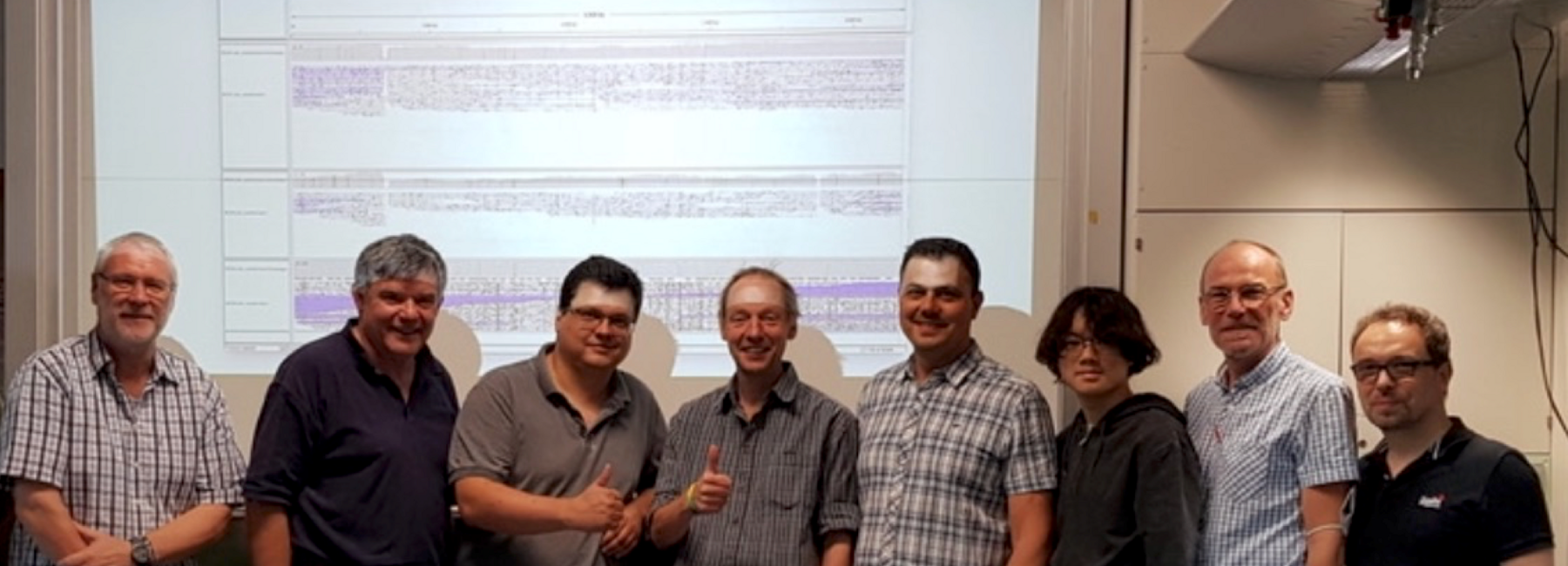
The pilot project was first rolled out during teacher training sessions in Bruchsal, Esslingen, Ulm and Villingen-Schwenningen (Figures 3 and 4). “This is where a second hurdle became apparent: the bioinformatic analysis of the data,” says Professor Wünschiers, describing his experiences. And so the small-scale project turned into a research and development project: how could the many bioinformatics steps involved in data analysis be organised in such a way that teachers would have to install and tinker with as little as possible on their own computers? The solution was to run the software on a computer in Mittweida and handle data input and output via a website. After some time spent on development, this led to the creation of the DNAlesen website (https://dnalesen.hs-mittweida.de), which handles the entire analysis and visualisation process once the raw data has been uploaded (Figure 5).
“The experiment is now ‘chief physician-approved’,” says Dr Jürgen Braun, head of the Baden-Württemberg network. The entire experimental procedure, including its didactic context, was accepted by the Journal of Microbiology and Biology Education in May 2024 and, thanks to the university’s support, is freely accessible via the following link: doi.org/10.1128/jmbe.00187-23. The experiment has also already been successfully used by teachers in other European countries, including Athens, Istanbul and Vilnius. Furthermore, the collaboration continues. This year, for example, a student experiment was developed to identify individual bacteria in mixtures using DNA sequencing.
Text and illustrations: Röbbe Wünschiers.