

This page was translated automatically using artificial intelligence (DeepL). The German version is binding. More information about automatic translation
News Intranet
This page was translated automatically using artificial intelligence (DeepL). The German version is binding. More information about automatic translation
Tuesdays evenings are all about AI: from 22 October to 3 December, the AI colloquia will take place every Tuesday from 5.30 pm to 7.00 pm in Lecture Theatre 39-001. Anyone interested in AI and its applications is welcome to attend.
Under the theme ‘Generative AI’, the sessions will cover topics such as
- text generation: Beyond Transformers – Is attention really all you need?
- The path to your own chatbot
- The EU AI Act and its implications
- The art of image, video and audio generation
- AI copyright or how to protect your images
- IAV self-driving cars and image generation
Further information on the topics and speakers can be found in the HSMW events calendar and via the following link: AI Colloquium 2024/25
The programme kicks off on 22 October with a very special opening session: alongside Jörg Scharfe’s overview of generative AI, Professor Thomas Villmann will give a brief overview of this year’s Nobel Prize in Physics, which was awarded to the AI pioneers John Hopfield and Geoffrey Hinton.
The talks, most of which will be delivered by HSMW students, were developed during this year’s AI Summer School, which took place in late August/early September in the spa town of Rathen in Saxon Switzerland.
This marked the third time that students and lecturers had gathered there to explore the latest developments in AI together in a relaxed atmosphere.
A total of 23 students from the INW and CB faculties, who are studying STEM subjects from the fourth semester of their bachelor’s degree onwards, took part. The presentations and practical exercises had been prepared in advance by the students with the support of tutors.
To introduce the topic, the historical development of generative AI and its ecosystem was outlined, including market trends, key players, career profiles and use cases.
Over the next two days, the focus was on chatbots and AI agents, their algorithmic principles – such as Transformer networks and database searches – as well as the workflows and APIs used. Practical examples were used to deepen understanding and illustrate how chatbots work and are implemented. The subsequent Maker Sessions enabled the students to create their own chatbot using a ChatGPT-based LLM under guidance.
Following the text generation session, a wide variety of image generation frameworks and their underlying algorithms were presented, along with methods for generating video and music using tools such as SORA, SingSong and Suno.ai. These tools could be tested and applied independently in the subsequent practical exercises to explore the possibilities and limitations of, for example, music generation. The creation of plasma crystal images was explained as a potential scientific application of generative AI, and a quality assessment was carried out using a quiz.
A particular highlight was the trip to Jahnsdorf Airfield for test drives in the IAV test vehicle for autonomous driving. Here, the students developed and tested real-time applications to analyse the data provided by the test vehicle and presented their findings following the autonomous test drives. We would like to extend our sincere thanks to IAV Chemnitz, as well as Professors Falk Langer and Daniel Kriesten, for organising and making this eventful day possible.
The legal framework for generative AI, as set out in the EU AI Act, was discussed in a lecture by guest lecturer Dr Maryam Alipour from the Federal Institute for Occupational Safety and Health.
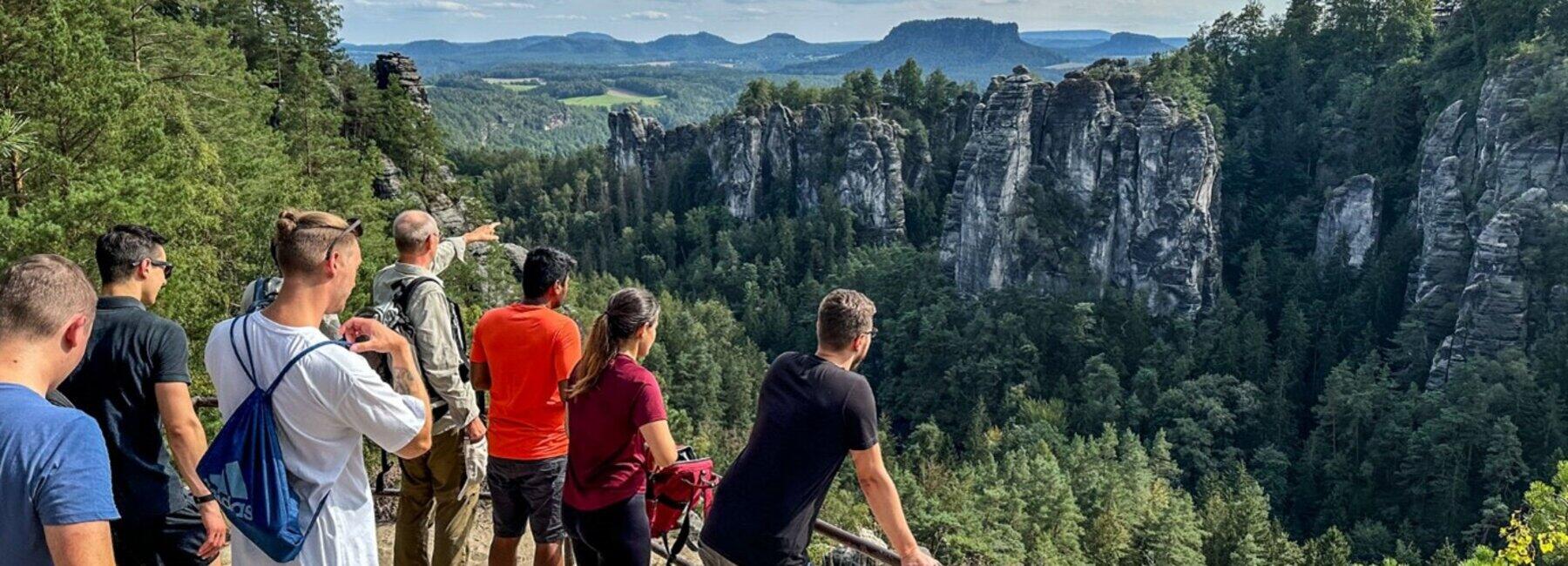
As well as the academic programme, the summer school offered a wide range of leisure activities. A guided climbing course with various levels of difficulty was held at the Papststein. Other excursions took participants to places of interest such as the Bastei, the Prebischtor, the Carolafelsen, the Lilienstein and Königstein Fortress.
The summer school enabled students to link theoretical knowledge with practical application, whilst gaining hands-on experience of new technologies. The combination of academic discussion and collaborative activities contributed to an intensive learning environment. The positive feedback from participants demonstrates the success of the event and underlines the importance of such formats for training in the field of artificial intelligence. The third AI Summer School has shown how important interdisciplinary collaboration and practical training are for the future generation of AI experts
Special thanks are due to Siemens and IAV in Chemnitz for their once again generous financial support, as well as to the university, the INW and CB faculties, the Student Union (Stura) and the student councils of the INW and CB faculties.
Students studying engineering, computer science, mathematics or related subjects who are interested in artificial intelligence are warmly invited to take part in future summer schools. The next opportunity will be in summer 2025, when a maximum of 20 students will have the chance to explore the subject in greater depth. The combination of lectures, practical applications and leisure activities in a beautiful setting makes the summer school a special experience. Further information is available via the following link: AI Summer School 2025