

This page was translated automatically using artificial intelligence (DeepL). The German version is binding. More information about automatic translation
News Intranet
This page was translated automatically using artificial intelligence (DeepL). The German version is binding. More information about automatic translation
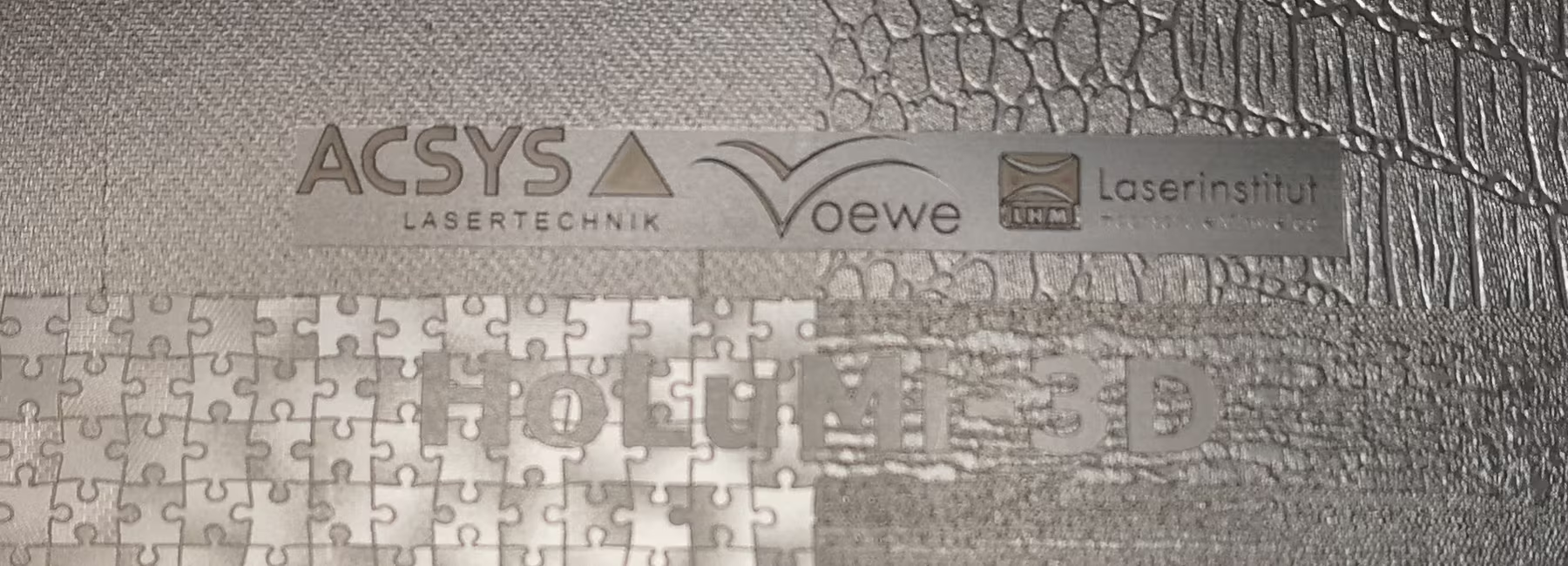
Through a collaboration between the Laserinstitut of Mittweida University of Applied Sciences (LHM) and the Mittweida-based companies ACSYS Laser Technology GmbH and MOEWE Optical Solutions GmbH, high-speed laser micro-engraving using a polygon scanner was carried out in an industrial setting for the first time anywhere in the world. This will enable higher laser power to be utilised in future and further accelerate the engraving process. This is not so much a factor in small-area engravings – such as those for coin dies, where ACSYS is already very successful on the market – but is particularly important for structuring large surfaces. One area of application for the new technology is, for example, the micro-engraving of printing cylinders, such as those required by the Frankenberg-based company Sächsische Walzengravur GmbH.
This collaboration was made possible by the “Holumi 3D” project within the cross-sector network GRAVOmer, of which the LHM and all participating companies are members. GRAVOmer combines the expertise of technology and materials developers with the application potential of product developers, with the aim of developing functional surfaces with smart features for virtually all sectors.
For high-precision micro-engraving, laser sources with ultra-short pulses in the femtosecond (fs) or picosecond (ps) range are primarily used. This allows material to be ablated with minimal melting. Scientists in Professor André Streek’s research group have identified optimal parameters, enabling a high power of 60 W – which is high for an ultrashort-pulse laser – to be applied at a high scanning speed of 40 m/s for the creation of microstructures. This scanning speed can only be achieved with a polygon scanner, such as the one developed in-house. Through collaboration on the project, the team succeeded in resolving complex control issues and integrating the scanner into a laser engraving machine for large surfaces, thereby ensuring that the high scanning speed can be utilised precisely.
Previously, as part of the Inno Teams project (funded by the ESF and SAB) entitled ‘High-rate material removal from tool steel using ultrashort laser pulses’, researchers in Professor Steffen Weißmantel’s research group, in collaboration with the company ACSYS, had already developed a technology for polishing such microstructures (Pulse Forging). In this process, the ultra-short-pulse laser is utilised in an unusual way so that a melt is actually produced, thereby smoothing the surface. Pulse Forging was patented by Mittweida University of Applied Sciences and is used under licence by ACSYS Laser Technology GmbH.
By combining the two technologies, it is now possible for the first time to carry out laser micro-engraving at high speed and to a high standard, thereby enabling new market shares to be tapped or existing ones to be expanded. A key advantage in developing this combination of technologies was the close collaboration between the companies involved, stemming on the one hand from their geographical proximity and, on the other, from their close links with and support from Mittweida University of Applied Sciences. Both companies employ graduates who were trained at the university and the Laser Institute.
The LHM plays a leading role worldwide in research into ultra-fast, high-rate laser processes. Professors André Streek, Udo Löschner and Steffen Weißmantel are working alongside their colleagues in their respective research groups to harness and optimise the new possibilities offered by Laser Technology.
Text: Robby Ebert
Photos: ACSYS Laser Technology GmbH