

This page was translated automatically using artificial intelligence (DeepL). The German version is binding. More information about automatic translation
News Intranet
This page was translated automatically using artificial intelligence (DeepL). The German version is binding. More information about automatic translation
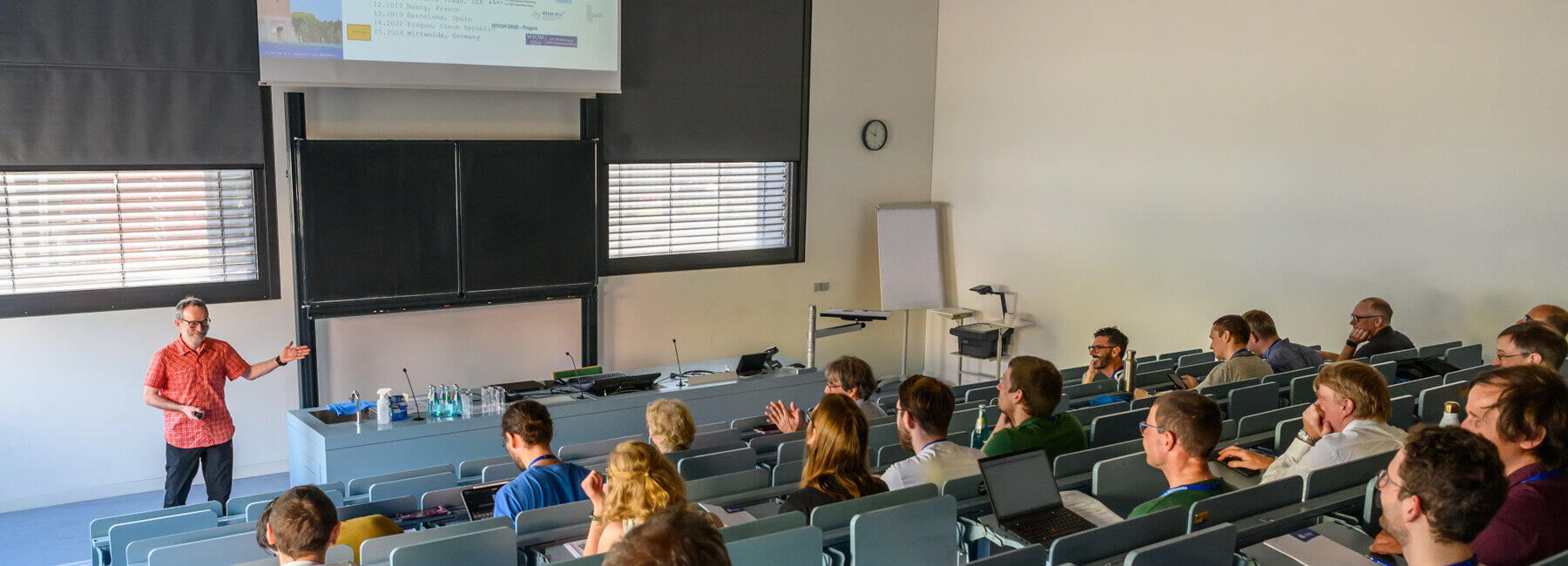
Last week, Mittweida University of Applied Sciences hosted the 15th Workshop on Self-Organising Maps, Learning Vector Quantisation, and Beyond (WSOM+) – an international conference on artificial intelligence. This series of conferences has been running since 1997, with venues including Helsinki, Paris, Houston, Santiago de Chile and Prague. Having previously hosted the 10th workshop in Mittweida back in 2014, Mittweida was once again entrusted with organising the event. This reflects the high regard in which AI research is held at our university, particularly at the Saxon Institute for Computational Intelligence and Machine Learning (SICIM) under the leadership of Professor Thomas Villmann (Faculty CB) and his team.
This year, more than 50 researchers from 10 countries and three continents made their way to Mittweida to discuss the latest issues in AI and present their research findings. The workshop was characterised by interesting presentations and in-depth discussions, all taking place in an exceptionally friendly and cheerful atmosphere. One key focus was on so-called interpretable and explainable AI models. These do not operate as so-called ‘black-box’ algorithms but provide users with explanations for AI decisions, making them more transparent and offering users relevant justifications. Another focus was the topic of AI safety – that is, assessing how certain the AI is of its decision (self-confidence). Mathematical verifications regarding the robustness of AI safety were discussed in this context.
The highlights of the conference were the plenary talks given by the three invited speakers:
Professor Barbara Hammer (University of Bielefeld) explained how intricate and complex AI models can be made explainable – that is, how they can be transformed into interpretable models through the use of various model evaluation techniques
Professor John Aldo Lee (Université Catholique de Louvain, Belgium) presented AI-supported visualisation methods that can be used to analyse highly complex data, such as that encountered in bioinformatics or medicine.
Professor Peter Tino (University of Birmingham, UK) gave a talk on a specific class of AI models that exhibit particularly robust learning behaviour and are also intuitively interpretable, without having to compromise on the fundamental functional power of AI.
In addition, the best paper was honoured at the conference: the prize was awarded to Joshua Jordan Taylor and Stella Offner (The University of Texas at Austin, Texas, USA) for their work on data visualisation and clustering using AI models based on sensory data processing in the brain.
Overall, the high standard of the papers was impressive, particularly the mathematical verifications of the AI tools developed that were presented. This theoretical validation of the correctness of AI models is also a key focus of research at SICIM. The team led by Professor Thomas Villmann was therefore represented at the conference with several papers on this topic.
Participants also highlighted both the outstanding scientific and technical organisation and the excellent general on-site organisation, which were primarily managed by Dr Marika Kaden (SICIM, Faculty CB) and by Annett Kober and Ines Lange (Research Department).
Last but not least, the excursion to Rochlitz Castle – including a guided tour of the castle followed by a conference dinner in the historic ballroom – was also highly praised by the participants.
The conference proceedings, containing all conference papers, will be published by Springer Nature (title: ‘Advances in Self-Organising Maps, Learning Vector Quantisation, Interpretable Machine Learning, and Beyond’, Lecture Notes in Networks and Systems (LNNS, volume 1087), ISBN 978-3-031-67158-6, expected publication date 29 July 2024).
Text: Prof. Thomas Villmann
Photos: Helmut Hammer (1), Prof. Thomas Villmann (2)