

This page was translated automatically using artificial intelligence (DeepL). The German version is binding. More information about automatic translation
News Intranet
This page was translated automatically using artificial intelligence (DeepL). The German version is binding. More information about automatic translation
Year after year, Mittweida University of Applied Sciences honours the outstanding research achievements of its staff and students with the Science Prize. Year after year, young and young-at-heart researchers apply for this award. Following a written application, which is assessed by a jury comprising professors from the five faculties, the top candidates must then convince the audience with a pitch.
This year, on Research Day last Wednesday, five candidates took part and each presented their topic to the audience in exactly five minutes. The participants were (in order of presentation):
Julius Voigt:
Biological knowledge integration into AI models for the analysis of gene expression data in cancer classification
Mona Wiebke Urban
Semi-automated creation and validation of historical event databases using prompt engineering and interactive cartographic information display
Max Schlosser:
Development of a semi-automated prompt generation method to improve readability in the context of text generation
Felix Erichson:
Development of a Python-based software pipeline for FRET-assisted integrative structure modelling of ribonucleic acids
Julia Köhler
Events as drivers of regional economic and tourism impacts – an empirical study using the QUARTERBACK Immobilien ARENA in Leipzig as a case study
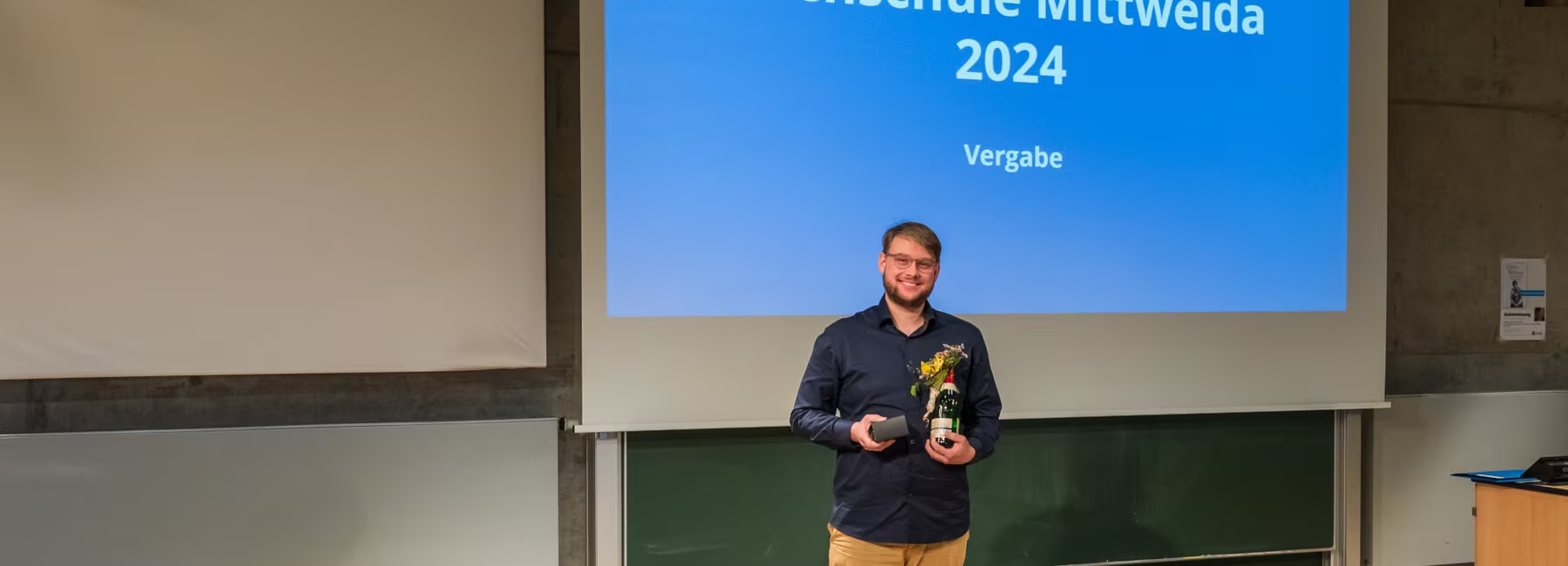
Once the public votes had been counted, the 2024 Science Prize was awarded. First place, and thus the 2024 Science Prize, went to
Felix Erichson
from the Vice-Chancellor for Research, Professor Uwe Mahn. Second
place went to Julius Voigt. Max Schlosser was delighted to take third place.
Felix Erichson: How to bring a biomolecule to life from a jumble of letters – or, to put it scientifically: What is integrative structural modelling of RNA?
My research in the Mittweida Biophotonics Group focuses on the computer-aided structural characterisation of ribonucleic acids (RNA), utilising experimental data from fluorescence microscopy and spectroscopy.
RNA plays a central role in the translation of genetic information into proteins, but in addition to its role as a messenger or mRNA, it has many other essential functions, such as catalytic activity (ribozymes). In nature, the structure and function of biomolecules are closely interlinked. To understand the diverse functions of RNA molecules, it is therefore helpful to know their structure. We aim to predict the structure of an RNA molecule based solely on its sequence; to do this, we not only use existing software such as Rosetta, RNAComposer or Google’s AlphaFold, but also combine known structural motifs using a sort of ‘RNA LEGO’ principle. Using molecular dynamics (MD) simulations, we simulate molecular motion and thus create a highly realistic, atomically accurate model of the RNA structure.
To ensure that the model created on the computer accurately reflects the actual 3D RNA structure, we use experimental data to validate these models. In this process, Förster resonance energy transfer (FRET) is used as a molecular ruler. In this process, the RNA sequences are labelled with two fluorescent dyes, e.g. green (donor) and red (acceptor), and the distance between them is measured by observing shifts in colour intensity depending on the distance between the dyes. Comparing the experimental results (FRET) with the simulation (computer model) allows us to selectively choose the most suitable computer model – or, to put it another way: we find the needle in the haystack.
This method is known as integrative structural modelling and combines bioinformatics, biophysics and molecular biology. What is new is that we bring together many existing methods in such a way that they run almost entirely automatically on various operating systems (Windows, macOS, Linux) and are optimised for FRET-based integrative RNA structure prediction.
The Biophotonics team at the LHM provides an ideal environment for this, as we can generate the experimental data required to evaluate the computer models ourselves at our Mittweida site, thereby further improving both the speed and the quality of 3D structure prediction. The group works in an interdisciplinary manner and examines questions relating to dynamic RNA structural biology from various perspectives. Depending on the research question, the RNA structure may then be the target of a drug, or the functional RNA structure itself may become the drug. Our method offers the possibility of creating a detailed picture of the respective RNA molecule and utilising it in the future for computer-aided drug development.
Further information is available on the Biophotonics Research Group’s project website via the following link: https://www.inw.hs-mittweida.de/webs/boerner/
Julius Voigt: Data jumble or scientifically sound: the use of AI in the analysis of medical data
I studied Biotechnology at Mittweida, completing both my Bachelor’s and Master’s degrees, specialising in bioinformatics on both occasions. Since 2021, I have been working as a research assistant in the Computational Intelligence research group led by Professor Thomas Villmann, applying Data Science methods to biological data in various projects. In most cases, you can’t simply take data and plug it into any old algorithm; rather, the bulk of the work lies in the details: which data pre-processing enables the meaningful generation of a model that then describes the data as accurately as possible. And to do that, you always have to become as much of an expert in the field of data as you possibly can. This is where the knowledge I gained during my degree often comes into play.
The question of which genes are decisive in cancer is a highly topical area of research that many other AI scientists are also working on. For example, a paper in *Nature* also addresses this topic, presenting the integration of additional biological knowledge into modelling using a deep learning approach.
In contrast to standard deep neural networks (deep learning), we employ a more traditional machine learning algorithm: Learning Vector Quantisation (LVQ). LVQ is more intuitive and, in hindsight, easier to interpret than deep networks. We have adapted a variant of LVQ in such a way that we were able to integrate prior biological knowledge about the associations between genes and their involvement in so-called pathways (such as gene regulatory networks or metabolic pathways) into the architecture of our model. This drastically reduced the number of parameters that need to be adjusted during the training process. Consequently, our model did not simply memorise the data (a phenomenon known as ‘overfitting’) and, by comparison, achieved a higher discrimination rate (known as ‘accuracy’) between metastatic and primary prostate cancer.
In addition to the classification of the data as the primary objective, work is also being carried out – almost as a side project – on a method for generating knowledge through the model.
The measure to prevent overfitting was also necessary, as the information density of the data is very low due to the high dimensionality (measurement of gene expression across several thousand genes) and the correspondingly small number of patients.
Compared with the deep learning approach described in the *Nature* paper, or without the integration of biological knowledge, our model is less complex and therefore requires fewer computational steps during training and diagnosis, saving both time and energy.
Link to the publication: doi.org/10.5220/0012420700003657
Max Schlosser: ChatGPT is curt, or, to put it scientifically: reinforcement learning for prompt generation
This research builds on the huge success of language models such as ChatGPT. Generated texts are useful for many tasks, but the output is not always easy to read. This can be a major obstacle for children or people with intellectual disabilities when it comes to understanding the texts. The research therefore investigates how inputs to the model can be structured in such a way as to improve the readability of the generated texts.
To this end, reinforcement learning – a dynamic machine learning technique – is employed. In carrying out this research, prompt templates created on the basis of linguistic principles are first selected repeatedly. The method fills in the gaps built into the templates with additional words. Statistical readability metrics then assess how readable or unreadable the text is, thereby training the algorithm step by step to use better prompt-word combinations.
The final trained model was analysed comprehensively. Most notable is the significant improvement in text readability when language models were used in combination with the trained model. Furthermore, linguistic factors that are particularly conducive to improving readability were highlighted. The work can therefore be utilised for further research, for example, to build upon the broad field of readability or to apply reinforcement learning algorithms to other problems related to language models. Furthermore, the trained model can be directly integrated with existing language models such as ChatGPT to generate more readable texts. This example was implemented as part of the thesis using a web application, in which I was able to apply the knowledge and skills I acquired during my studies.
The full Master’s thesis can be viewed on the Mittweida University of Applied Sciences Monami portal via the following link: https://monami.hs-mittweida.de/files/15610/MA_Schlosser_Max_52224.pdf