

This page was translated automatically using artificial intelligence (DeepL). The German version is binding. More information about automatic translation
News Intranet
This page was translated automatically using artificial intelligence (DeepL). The German version is binding. More information about automatic translation
The development and integration of user-friendly robotics for the automation of welding processes is a key issue in boosting productivity and quality in SMEs. On 26 November 2024, an event organised by the Chemnitz Chamber of Skilled Trades took place as part of the ‘Master Meets Professor’ series at the welding laboratory of Mittweida University of Applied Sciences. Around 20 interested representatives from regional craft businesses were able to learn about the potential of robot-assisted welding for small and medium batch sizes and discuss the current challenges associated with these technologies.
Professor Julia Zähr began by presenting the research opportunities available within the Materials – Manufacturing – Quality research group, as well as the teaching and research focus of the Chair in ‘Automated Joining Processes and Simulation’. She also outlined possibilities for automated welding in small-batch production. In the subsequent presentation by Christian Schmidt, a research assistant at Mittweida University of Applied Sciences, on ‘Fundamental investigations into the applicability of welding cobots in SMEs’, the advantages and limitations of collaborative robots for the automated production of small batches were highlighted. He also outlined the technological challenges involved in the transition from manual to automated welding using a demonstration component, as well as the influence of gap dimensions and positional deviations on the welding result in automated processes.
In the subsequent presentation by Anton Ivanov, from the Chemnitz Institute of Mechanical and Plant Engineering (Institut Chemnitzer Maschinen- und Anlagenbau e. V.), the design of robotic welding cells for various batch sizes was demonstrated, and approaches to automation solutions and their prerequisites were outlined. In the concluding talk, Marcus Nürnberger, from the Chemnitz Chamber of Crafts, provided an overview of funding opportunities and presented various support schemes, such as GRW grants, which are primarily aimed at small and medium-sized enterprises. The aim is to encourage investment in improving production processes which, at the same time, contribute to environmental sustainability and support digitalisation processes.
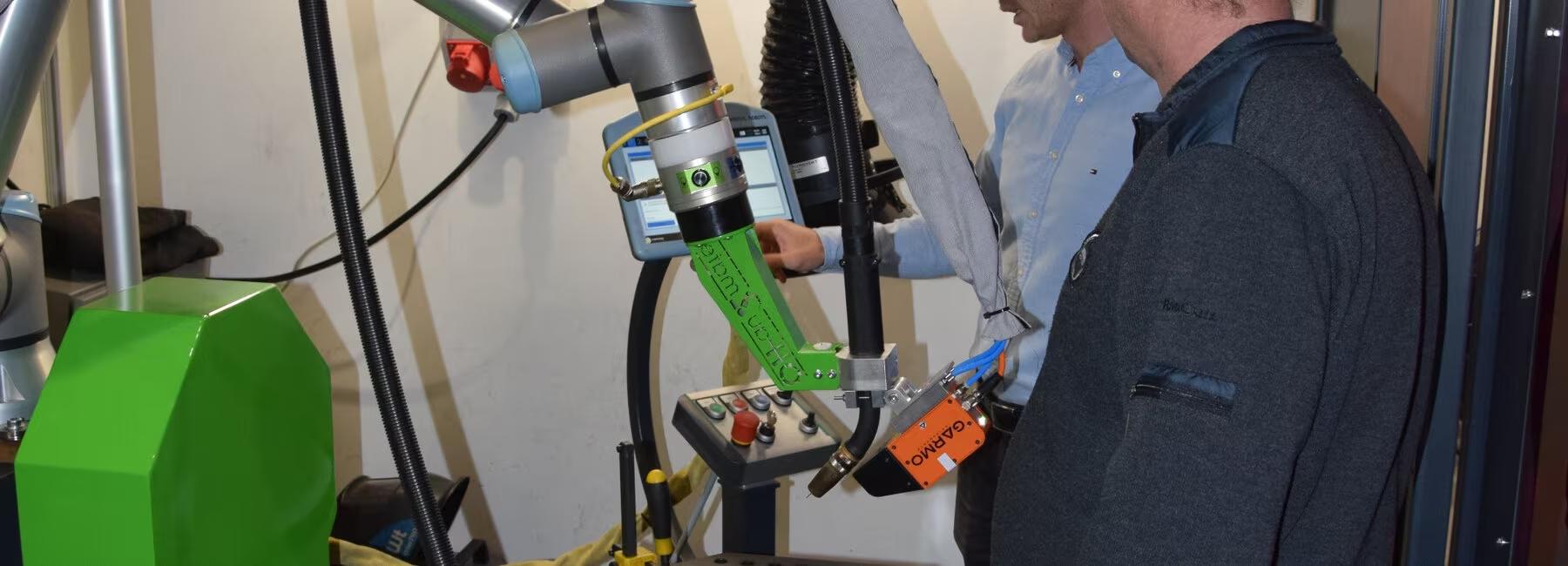
This was followed by a ‘live demonstration’ by Christian Schmidt, who showcased how to work with the welding cobot, and those interested were able to experience for themselves how easy it is to programme welding paths and how intuitive the operation is. Building on the presentations and demonstrations, a lively discussion ensued between the participants from the craft businesses and the speakers.
We would like to extend our sincere thanks to the Chemnitz Chamber of Skilled Trades for enabling us to present the topic ‘Automation of welding processes for small batches’ as part of the ‘Master meets Professor’ event series, and of course to all the speakers and participants for the lively discussion.
Text: Prof. Julia Zähr, Thomas Große
Images: Thomas Große