

This page was translated automatically using artificial intelligence (DeepL). The German version is binding. More information about automatic translation
News Intranet
This page was translated automatically using artificial intelligence (DeepL). The German version is binding. More information about automatic translation
Professor Steffen Weißmantel’s research group at the Laser Institute of Mittweida University of Applied Sciences (LHM) has had three reasons to celebrate in recent weeks, as funding commitments were secured for no fewer than three research projects.
The MMA(q)opt project (Use of micromirror arrays to produce micro-optical components for (quantum) optical data transmission) is funded by the BMBF for three years as part of the programme ‘Validation of the Technological and Societal Innovation Potential of Scientific Research – VIP+’.
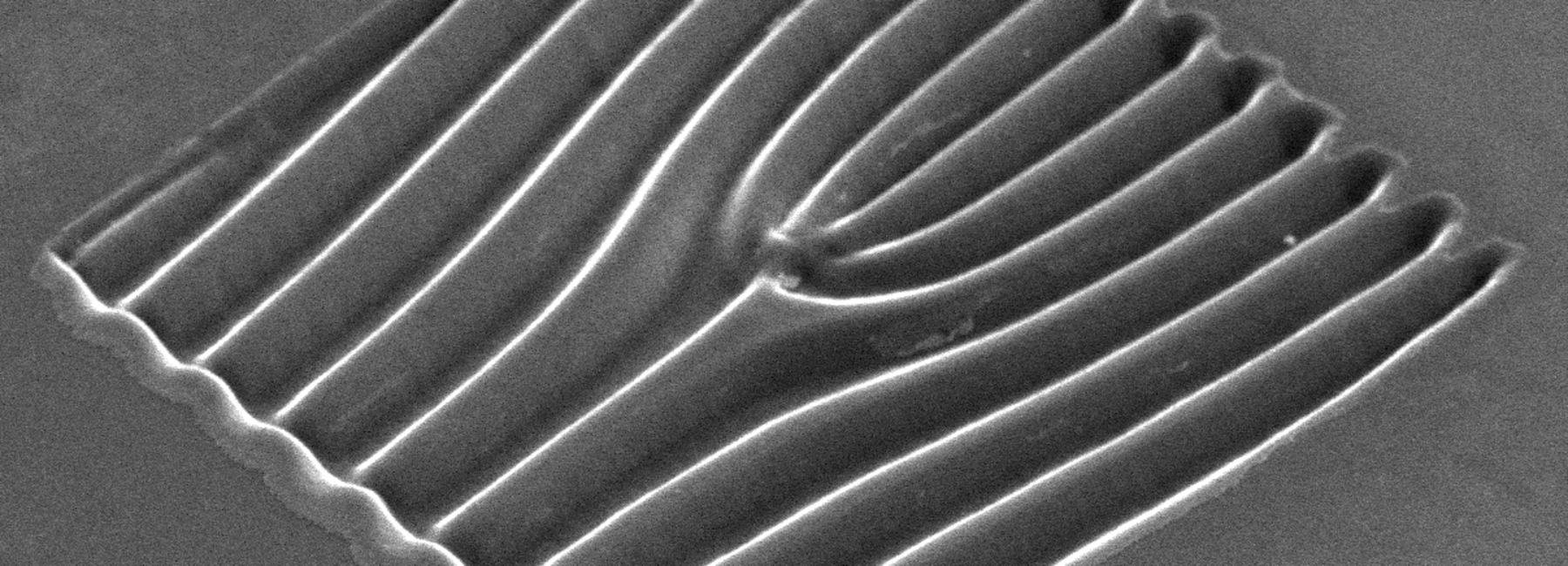
Against the backdrop of digitalisation and the development of quantum technologies, demand is growing for high-quality micro-optical components, particularly in the field of optical data transmission. To manufacture these components, highly precise, minute structures must be created using laser technology. However, current manufacturing technologies are reaching their limits in this regard. In order to be able to manufacture micro-optical components to meet increasing demands in terms of speed, quality and flexibility, the project is testing and further developing the use of a specially developed array of individually controllable micromirrors. If successful, the technology will enable the highly flexible, high-precision and rapid production of micro-optics in glass and optical crystals. The flexibility and speed of the proposed process could enable customised and scalable mass production of micro-optical components, thereby overcoming a further hurdle towards the industrial application of the process. One immediate application of the structures that can be produced in this way is a novel data transmission module, the function of which is based on the modulation of the orbital angular momentum of optical signals. In the long term, this could significantly increase the capacity of optical transmission channels and thus enormously boost the data rate in optical data networks. The process could also provide high-precision micro-optics for novel quantum-optical technologies. The project partner is the Fraunhofer Institute for Photonic Microsystems (IPMS) in Dresden. There, Dr Jan-Uwe Schmidt and Dipl. Ing. Markus Hilmes are carrying out the necessary modifications to the microspecular array and its control electronics. At the LHM, these are then integrated into a UV laser system. The further development of the process and the scientific investigations are being carried out at the LHM by Sebastian Büttner, M.Sc.
The second project to be approved concerns an innovative ignition mechanism for fireworks systems. The project is funded by the BMWK under the ZIM programme (Central Innovation Programme for SMEs).
The ‘Investigations into electrode coating and the ignition of electric arcs as a function of electrode structure, -geometry and -arrangement’ aims to develop a completely new ignition technology for professional fireworks systems – one not previously available on the market – which may, however, also find applications beyond the pyrotechnic sector. The idea is to use a so-called mini-arc (i.e. a plasma) for ignition instead of a single-use electrical igniter. To this end, investigations are planned into the required electrode geometry and arrangement, as well as the deposition of thin oxide layers with apertures, in order to achieve a reproducible, stable arc. The response time is to be less than one millisecond. In addition to their effect on the formation of the arc, the layers are intended to reduce wear on the electrodes, so that the ignition device can be used repeatedly and safely. The project will run for 25 months until 31 December 2025. The partners are Blackboxx Fireworks GmbH in Marienberg and the Private Institute for Environmental Analyses (IfU GmbH) in Ottendorf. The project team member at the LHM is Dipl.-Ing. (FH) Manuela Hartwig.
Last but not least, the project ‘Validation of an opto-acoustic measurement technique for composite materials and prefabricated components with a view to commercial application’ was approved by the SAB. The project will commence on 1 May and will run for 16 months. Funding for the project is provided from ERDF funds. The project is being carried out in collaboration with Professor Jörn Hübelt from the Technical Acoustics Group at Mittweida University of Applied Sciences.
The project team member at LHM is Dipl.-Ing. (FH) Manuel Pfeiffer. The innovation of the novel opto-acoustic measurement technology being developed in the project lies in combining research findings from two otherwise distinct fields of application. On the one hand, the project draws on fundamental principles of laser-induced shock wave excitation on solid-state surfaces from the fields of optics and Laser Technology; on the other hand, principles from engineering acoustics can be utilised with regard to the non-destructive analysis of natural frequency patterns and the determination of frequency-dependent phase velocitiesof acoustic signals to assess the internal structural integrity. Together, and incorporating the non-contact laser vibrometric detection of acoustic signals – which has been further developed in recent years – these research findings form the basis for validating a novel non-contact, non-destructive in-situ measurement technique, which is particularly suitable for use on irregular, naturally grown renewable materials, prefabricated timber components and natural fibre composites.