

This page was translated automatically using artificial intelligence (DeepL). The German version is binding. More information about automatic translation
News Intranet
This page was translated automatically using artificial intelligence (DeepL). The German version is binding. More information about automatic translation
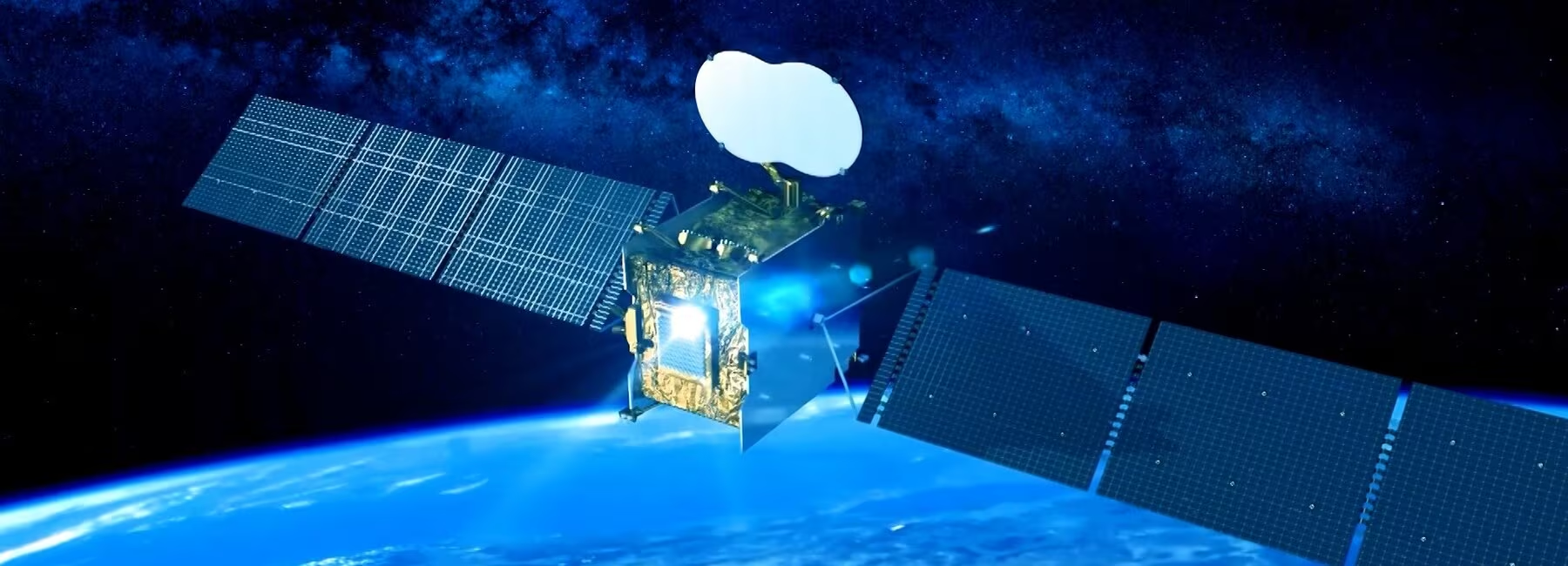
Mechanisms are essential to the success of any space mission. For example, solar panels must be deployed to supply a satellite with power, antennas must be positioned to transmit signals accurately, and mirrors must be aligned so that sharp images can be transmitted back to Earth. Mechanisms are indispensable for the operation of any satellite and must function 100 per cent reliably under the most extreme conditions, such as high temperatures, cosmic radiation, vacuum, etc.
The company beyond gravity, based in Coswig, Saxony, specialises in the development and production of high-precision satellite mechanisms. As one of the leading suppliers in this field, it supplies the European Space Agency (ESA), amongst others. The design of the moving parts presents the company with constant challenges. Currently, these mechanisms are manufactured using conventional subtractive processes, such as milling or turning. However, complex multifunctional shapes cannot be produced using these methods. For this reason, 3D Printing is a highly interesting process for beyond gravity. In the field of space travel, however, it is still in its infancy. With conventional selective laser melting (also known as SLM or L-PBF), very thin structures cannot be produced with the required resolution, if at all. Furthermore, the comparatively high surface roughness has a negative impact on the fatigue strength of the components.
This is where the micro-SLM process developed at the Laser Institute of Mittweida University of Applied Sciences (LHM) comes into play. This is a further development of the SLM process for the micro-scale. It enables 3D printing of components with higher structural resolution, lower surface roughness and greater dimensional accuracy, using very fine powders with particle sizes of less than 10 µm and a laser spot of approximately 30 µm. This makes it possible to produce precision components with structural resolutions of up to 30 µm and layer thicknesses of up to 5 µm. Compared with the conventional SLM process, this represents a four- to five-fold improvement in resolution. The surface roughness (Ra) of the untreated components is already as low as Ra = 2.5 µm. Through subsequent glass bead blasting, the roughness can be reduced to Ra = 1.0 µm and, by means of dry electropolishing, even to Ra = 0.1 µm.
Scientists in Professor Streek’s research group at the LHM have succeeded in using the micro-SLM process to manufacture a mirror mount with thin-walled, flexible swivel joints for aligning inter-satellite laser communications, which meets the required specifications. The precision component was designed by beyond gravity as a monolithic solid-state joint, meaning it is not made up of several parts but consists of a single piece. It can move flexibly in two spatial directions and always springs back to its initial position, much like a spring. The mirror holder has also been topology-optimised, meaning it was designed purely according to the flow of forces and all unnecessary material was removed. Made from a high-strength steel alloy suitable for space applications, this precision component measures 45 x 45 x 15 mm³ and weighs just 20 g. This demonstrator impressively showcases the potential of this high-precision technology, and perhaps in a few years’ time, micro-SLM components ‘made in Mittweida’ will be flying through space.
The Laser Institute at Mittweida University of Applied Sciences is a partner in the Saxony5 Co-Creation Lab for Additive Manufacturing. Saxony5 is a joint project involving the five Saxon universities of Applied Sciences, aimed at strengthening research-based knowledge and technology transfer. To support these transfer processes, the joint project is producing a series of ‘transfer films’, each of which showcases a successful transfer project. You can find the latest Saxony5 transfer film, featuring the Miko SLM component and entitled ‘Satellite Mechanisms from Coswig’, via the following link.
Text: Michael Pfeifer
Images: ESA (1), Mittweida University of Applied Sciences – Saxony5/TV11 (2)