

This page was translated automatically using artificial intelligence (DeepL). The German version is binding. More information about automatic translation
News Intranet
This page was translated automatically using artificial intelligence (DeepL). The German version is binding. More information about automatic translation
The Saxon Tax and Finance Authority and Mittweida University of Applied Sciences are to join forces on an important project: in future, they will research and develop applications of artificial intelligence and blockchain technology for the Tax and Finance Authority’s areas of responsibility.
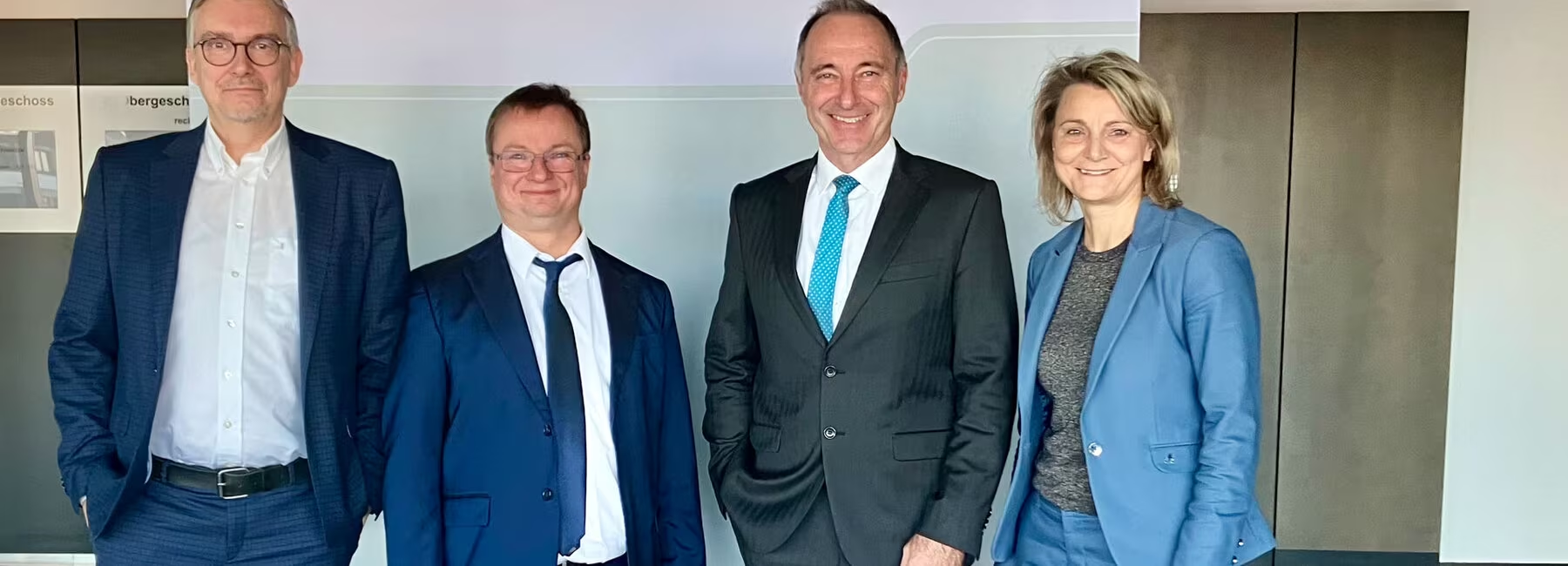
Udo Stiwi, Vice-President of the State Office for Taxation and Finance (LSF), and the Vice-Chancellor for Research at Mittweida University of Applied Sciences, Professor Uwe Mahn, signed a research cooperation agreement to this end today in Chemnitz – initially for a period of two years.
Application-oriented research into AI and blockchain
Mittweida University of Applied Sciences is a leading centre for applied research into AI and blockchain in the Free State of Saxony and beyond. The Blockchain Competence Centre Mittweida (BCCM), established back in 2017 within the Faculty Applied Computer Sciences and Biosciences, has played a decisive role in developing Mittweida and the Mittelsachsen district into a showcase region for applications of blockchain technology, the visibility of which now extends far beyond the state and federal borders.
For both areas of research, close collaboration with potential users in industry and public administration is standard practice. Similarly, the cooperation between Mittweida University of Applied Sciences and the LSF is not a one-way street, but a mutual exchange geared towards mutual benefit and the growth of knowledge. The Saxon tax authorities aim to make tax enforcement simpler and more efficient through the use of new digital technologies. This practical challenge, in turn, feeds back into research and teaching at Mittweida University of Applied Sciences. This further strengthens Mittweida’s position as a centre for application-oriented and interdisciplinary academic training of specialists in future technologies.
Stiwi on the role of AI: “It is one of the most significant key technologies, offering great opportunities, not only for the tax authorities. Today’s signing of the cooperation agreement has laid the foundation for close collaboration between academia and the administration. I am delighted about this. Together, we can succeed in further developing these technologies and translating them into tangible economic and social benefits.”
Ideally suited to the use of new technologies
The tax authorities are ideally suited to the widespread use of these technologies. This is because they offer considerable potential for application. In particular, the highly numerical and rigid nature of tax law, as well as standardised mass processing procedures, make this technological approach particularly suitable. Added to this are high requirements regarding the tamper-resistance of data. Potential areas of application include, on the one hand, interaction with taxpayers – for example, in the form of a virtual adviser such as a ‘chatbot’ or voice-based interactions to assist with the submission of applications. On the other hand, AI can also provide support in the so-called back office, i.e. in the management and use of information, as well as in the further automation of internal processes within the tax administration. Cases can thus be processed more efficiently by staff and decision-making processes accelerated, for example, where so-called ‘knowledge-based AI’ is available or where large volumes of data are analysed using AI.
Specifically, the collaboration will initially focus on developing concepts for the practical application of AI and blockchain in tax administration, based on existing research findings: Among other things, software solutions from the Blockchain Academy Mittweida project – which emerged from the Mittweida blockchain showcase region – are to be adapted to the requirements of a tax control instrument. Against the backdrop of the growing appeal of virtual currencies – particularly in anticipation of substantial capital gains – the tax authorities face the task of ensuring the equitable taxation of such income. In addition to tracking transactions on the blockchain, the identification and monitoring of taxable income in particular is a challenge that can only be met with technical (AI) support. However, the use of AI technology also offers considerable potential for streamlining the assessment of facts and the compilation of relevant legal references. Routine and research tasks are to be automated, thereby freeing up urgently needed staff capacity to enable the tax authorities to continue carrying out their core tasks in the future. The collaboration will therefore include, amongst other things, the development and testing of sector-specific ‘knowledge-based AI systems’.