

This page was translated automatically using artificial intelligence (DeepL). The German version is binding. More information about automatic translation
News Intranet
This page was translated automatically using artificial intelligence (DeepL). The German version is binding. More information about automatic translation
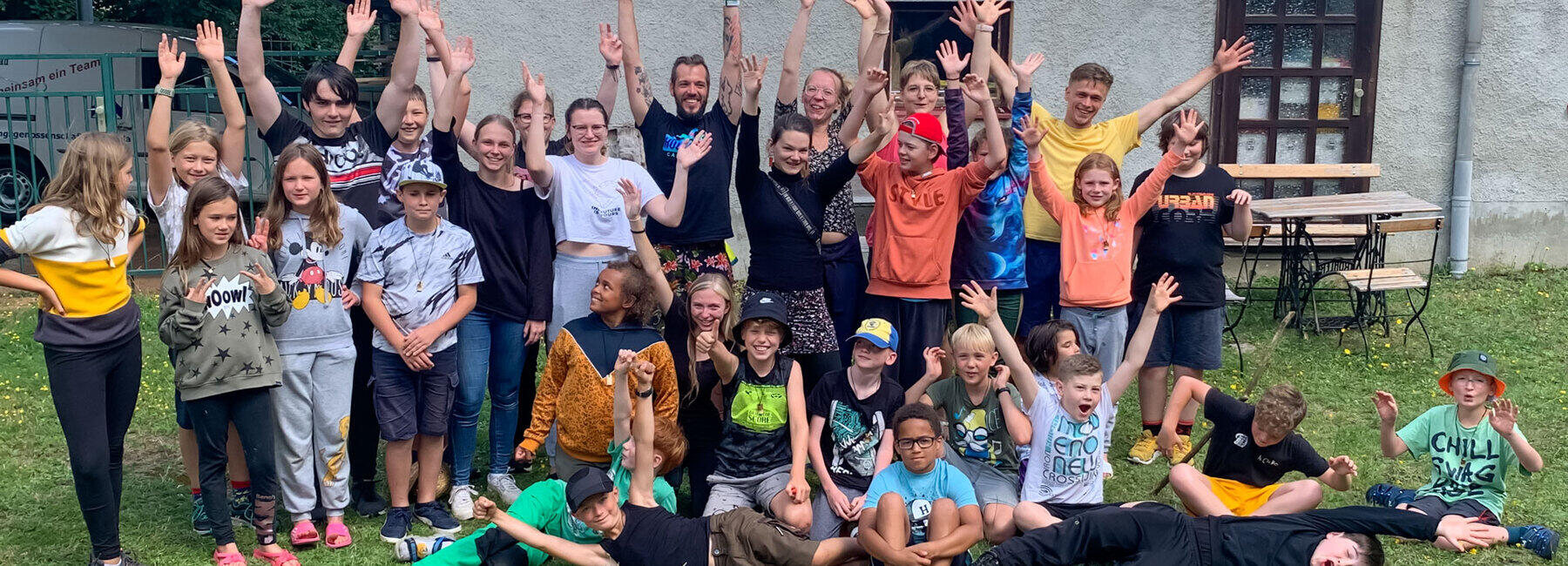
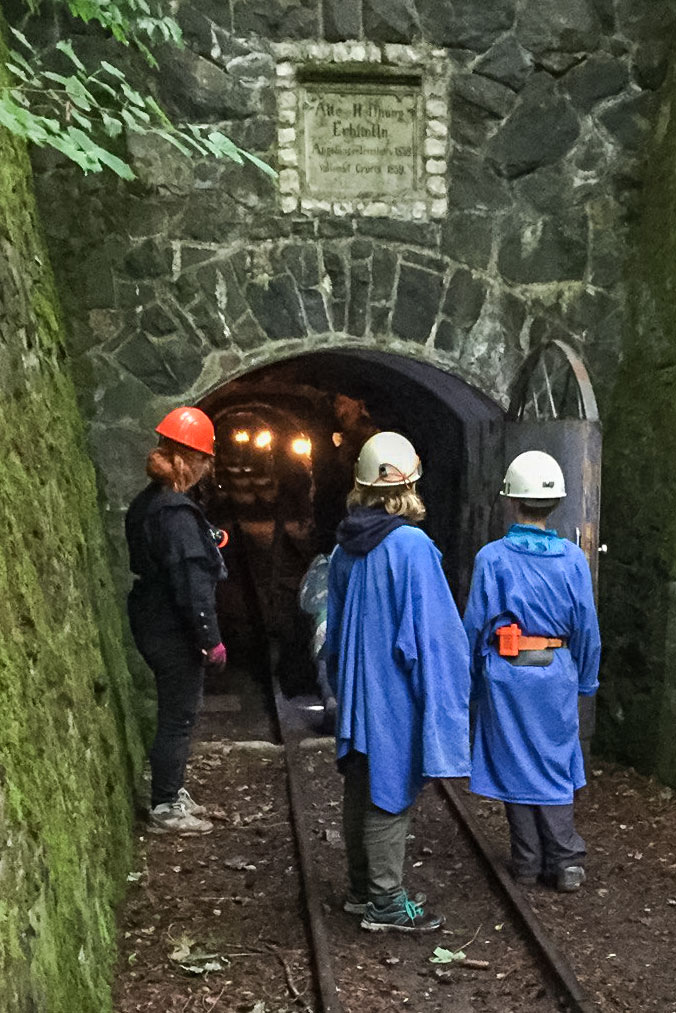
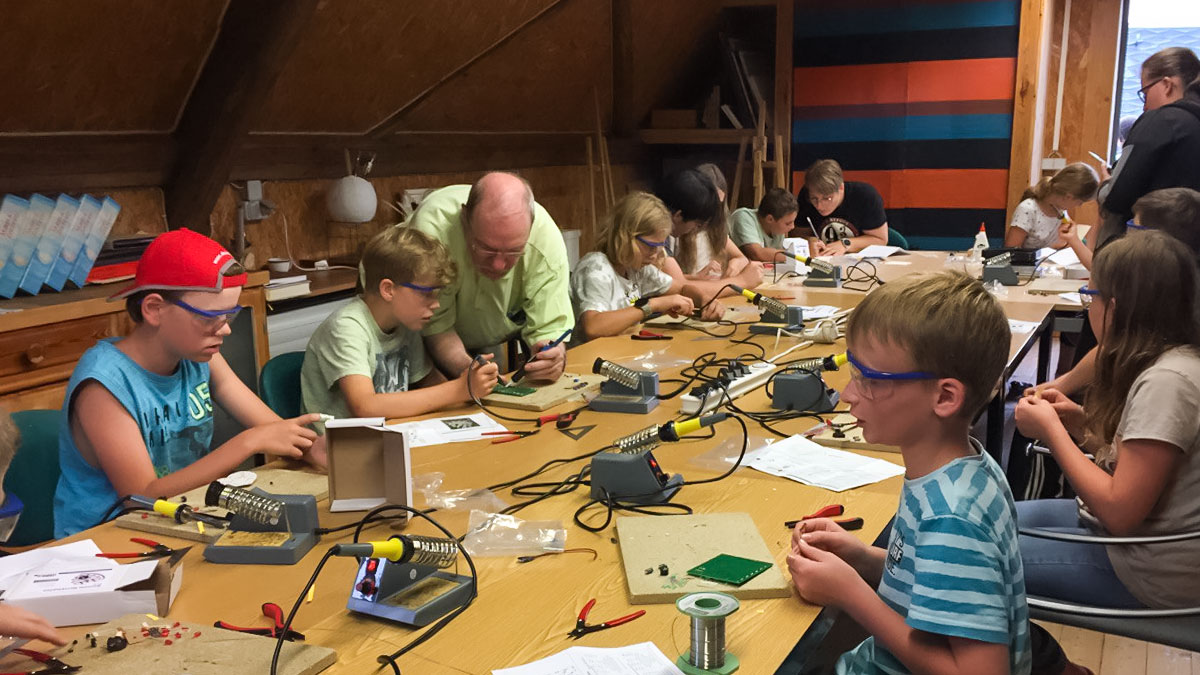
For some, it was the school holidays; for others, the semester break. What brought them all together was the Children’s and Young People’s Outdoor Technology Camp, held from 24 to 28 July at the Müllerhof socio-cultural centre in Mittweida. The camp, attended by 22 pupils aged between 8 and 12, brought people together in even more ways: technical workshops indoors, experiential learning adventures outdoors, nights under the starry sky, a trip ‘underground’, but also, for example, putting together the meal plan, going shopping and cooking together.
For seven students of Social Work at Mittweida University of Applied Sciences, the five days marked the highlight of a practical project in which they had prepared the camp and were now helping to supervise it. Indeed, the camp would not exist at all without the link to the university. Now in its third year since 2021, the organisational and experiential educational preparation for the Children’s and Young People’s Outdoor Technology Camp forms part of a course. A report featuring lots of photos can be found on the Faculty of Social Sciences’ website.
Let’s take a look behind the scenes here. Frederike Bremer, the 25-year-old Master’s student in Social Work, has been involved from the very beginning: first as a Bachelor’s student, then as a student assistant and finally as a lecturer – a typical ‘career path’ at Mittweida University of Applied Sciences, which offers its students the chance to get involved in research and take on responsible roles in projects at an early stage.

Ms Bremer: This is the third year you’ve helped organise and supervise the camp: has it become routine yet?
On the contrary: every year it feels fresh and exciting. As the groups of students and children are always changing, you have to keep adapting to everything anew. But I’m also delighted every time a few children come back, as it means we have some young, camp-savvy ‘experts’ on board who really inspire the other children taking part for the first time. So far, I’ve loved every single year. I’ve always had a lot of fun and have come away from the week feeling both inspired and full of joy.
They’re not doing this on their own. Among others, students are involved as part of a course.
Yes, the project thrives thanks to many volunteers and institutional supporters, some of whom have been involved for quite some time. But this year’s core team, comprising 12 members in total, included seven Bachelor’s students studying Social Work. They had enrolled on the accompanying course within the ‘Controversies – Participation – Shaping’ module and were then fully involved in the project from March onwards. In the true spirit of “Students as Partners”, the aim was for everyone to get involved and contribute, each according to their own strengths and skills – for example, trying out different public relations methods, finding donations and sponsors, drawing up weekly schedules, staff rosters and risk management plans, and much more.
In addition, the students naturally focused on experiential learning methods, which are, after all, a central aspect of the camp. These had first to be thought through in theory and then put into practice during the camp week as educational activities for the children. The greatest learning experience then takes place over the course of this week. The students are part of the camp team and take on responsibility for the children and specific areas of work. Each individual student creatively helps shape the day-to-day running of the camp using their own skills and abilities, thereby contributing to the success of the whole week. It is also important to note that, following the camp, they can reflect on the camp process and their methodological guidance in a reflection report. In this way, they can draw insights from their specific practical experience for their own benefit and for their future work. The report also forms a key component of the module assessment.
What insights does the camp project provide for students?
Students gain first-hand experience of Social Work topics and see a project through from start to finish. During the camp preparations and its implementation, many topics from their degree programme become relevant and are thus put to the test in practice: project management, public relations in Social Work, funding and grant structures in the social sector, social participation, experiential education, guidance, reflection, child and youth work, teamwork and much more. That is one aspect.
Just as important are individual insights and experiences. The camp certainly offers opportunities to push boundaries and step outside one’s comfort zone, which can strengthen the students’ skills in the field of Social Work. It’s hard for me to say how each individual perceives this and processes their experiences, as it is highly personal. What I can say is that many challenges have to be tackled all at once during the week, which can make the learning process very intensive. I am convinced – and speak from my own experience – that the course, with its camp week, helps students develop both personally and professionally. It allows so many topics from different modules of the degree programme to be linked – and the great thing is: they can be applied straight away.
But now we must also take another look at the objectives the camp has for the children.
Quite clearly – and I’m speaking here as a social worker – we want to empower the people in our region. We want to achieve this empowerment above all for the children. At our camp, interest-based technical workshops are combined with elements of experiential learning. So, on the one hand, we want to spark curiosity and an interest in technology and craftsmanship among young researchers. On the other hand, through the experiential learning activities, we want to offer the children a space to explore their own strengths and weaknesses and, where possible, to develop problem-solving strategies together through reflection. As this is an outdoor camp, the local natural environment plays a key role in the delivery of the exercises and games.
Our aim here is also for the children, through their constant connection with nature, to (further) develop an awareness of their environment and to recognise ways in which they can actively help shape it. Examples include the joint meal planning mentioned earlier, the necessary shopping, and the preparation of the food. Through our low participation fee, we also aim to enable children from financially disadvantaged families to access and participate in the programme, and through our activities to broaden their social sphere and strengthen their network.
Combining technology and experiential education in this way isn’t immediately obvious. How did it come about?
It certainly has to do with the ‘inventors’: five years ago, Manfred Glätzner, an engineer at the Laser Institute at Mittweida University of Applied Sciences, came up with the idea for a technology camp for children. Collaboration with the Social Work department was part of this idea from the very beginning. Markus Lohse, a PhD student at our faculty, took up the idea and, in 2019, further developed the basic concept in a research project for social work students. With the Verein zur Wahrung der Kinderinteressen e.V. (Association for the Protection of Children’s Interests) and its chairperson, Karen Schleif, the project soon found a supporter outside the university. Others followed.
Markus Lohse won me over straight away back in 2019. When Markus presented the research project to us students at the time, ideas for how to put it into practice immediately sprang to mind. The main focus was on setting up a local camp with local partners and working across faculties. That’s when he really had me. There are certainly links to my own childhood as well. I used to love going on children’s and youth camps myself, and as a child I always really enjoyed those intense days and made the most of them for my own personal development. As I’d built up a network outside the university campus whilst studying, and as strengthening our wonderful region is very close to my heart, it quickly became clear that I’d continue to help shape the project. And then I was right in the thick of it – I could have pulled out, but I didn’t want to anymore. These experiences have reinforced my desire to work in the field of experiential and early childhood education later on.
After the camp is before the camp. Have preparations for 2024 already begun? Basically, yes:
Funding applications need to be written, and arrangements made with our partners before things really kick off again in the spring. The dates for the 2024 camp have already been set: 15 to 19 July. We’re also considering setting up a second camp for older children and teenagers. That’s because some of those who’d like to come back next year will already be too old by then.
The Technology Camp is one of many examples of successful transfer between academia and practice at Mittweida University of Applied Sciences – and it even spans disciplines, bringing together Social Work and engineering.