

This page was translated automatically using artificial intelligence (DeepL). The German version is binding. More information about automatic translation
News Intranet
This page was translated automatically using artificial intelligence (DeepL). The German version is binding. More information about automatic translation

Anyone who thinks exclusively of Japan and the US when it comes to innovative computer games should add the university town of Mittweida to their list. In the so-called ‘Special Call 5’ of futureSAX’s InnoStartBonus scheme – which invited potential start-up founders across Saxony with innovative business ideas, particularly in the fields of gaming and blockchain, to apply – three teams from Mittweida University of Applied Sciences convinced the expert jury of their eligibility for funding in late summer. As a result, “Riding Turtles”, “Traveller’s Box” and “Totemware Production” secured 60 per cent of all funding available in the competition. Since November, they have been receiving monthly support of 1,050 euros per team from the Free State of Saxony for a period of one year.
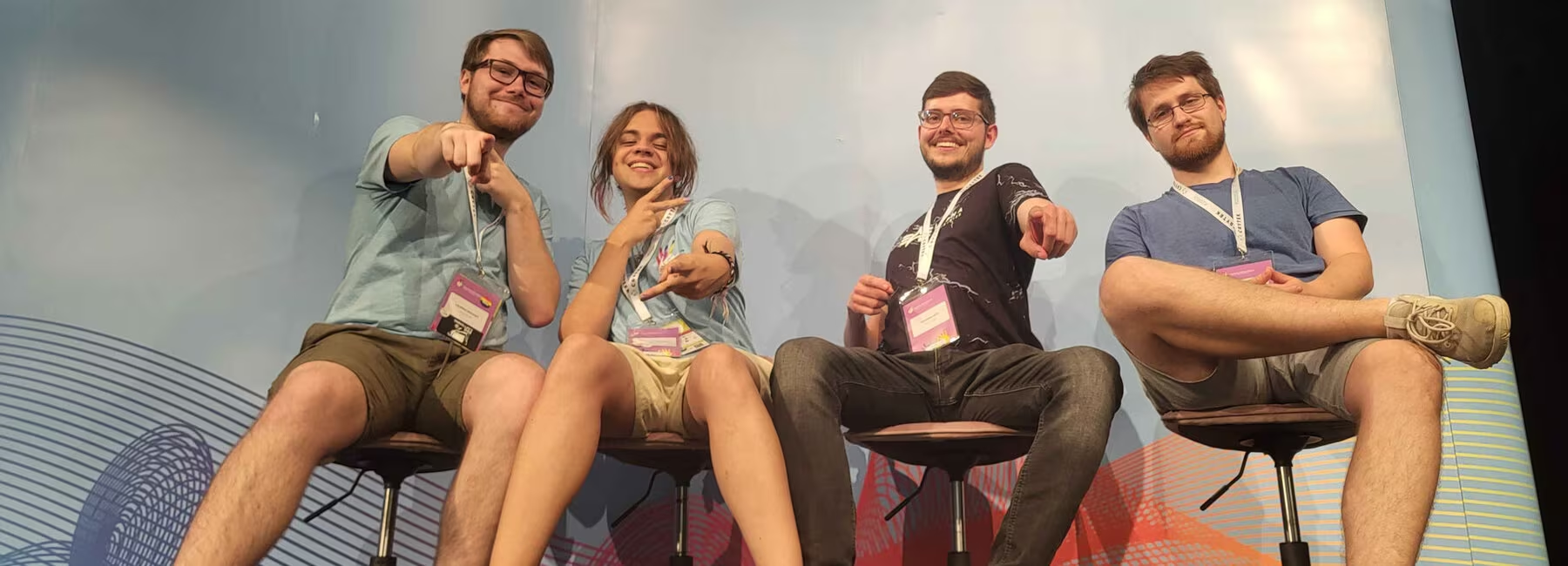
“We’re currently developing our very first video game of our own: Bot/Bot (pronounced: Bot Slash Bot),” says Laurenz Bischoff (23) from Traveller’s Box. “Our game has already attracted interest. That’s why we’re using the funding to set up our studio and acquire further development tools.” Bischoff and his three partners, Johannes Bätz (23), Raphael Müller (22) and Robin Schöppach (22), all come from the same ‘stable’: following their bachelor’s degrees, they are now also studying for a master’s in Media Informatics and Interactive Entertainment at Mittweida University of Applied Sciences. Game development forms part of the curriculum here and is put into practice, ranging from simple board games to creating their own games.
Raphael Müller looks back on the early days: “We met at Mittweida University of Applied Sciences; it gave us the space to flourish and grow together. Our professor – and now good friend – Alexander Marbach set us on the right path to turning our dreams of starting a business into reality. Then, at just the right moment, the Mittweida team from the Saxeed start-up network came on board. Without the support and feedback, particularly from Dirk Liebers, we wouldn’t have been able to pull it off so easily.”
Albina Hironymus (27) tells a very similar story – together with André Spittel (30), she forms the Riding Turtles team. Both completed their bachelor’s degrees in Media Informatics and Interactive Entertainment at Mittweida University of Applied Sciences and went on to work in the games industry, although André returned to study for a master’s degree. “We were completely overwhelmed when planning to set up our own business, but Saxeed gave us some good advice on getting started,” he says. “The funding now makes it easier to focus on our own project and work towards securing further funding from a publisher or via Kickstarter.”
With “Gestapo Files”, Albina and André are developing an innovative detective game. What’s new about it, according to Albina: “It uses a large language model – something like ChatGPT. You have to express your reasoning in your own words and present your arguments logically, otherwise you won’t get anywhere! So there’ll be no more guessing in our game!”
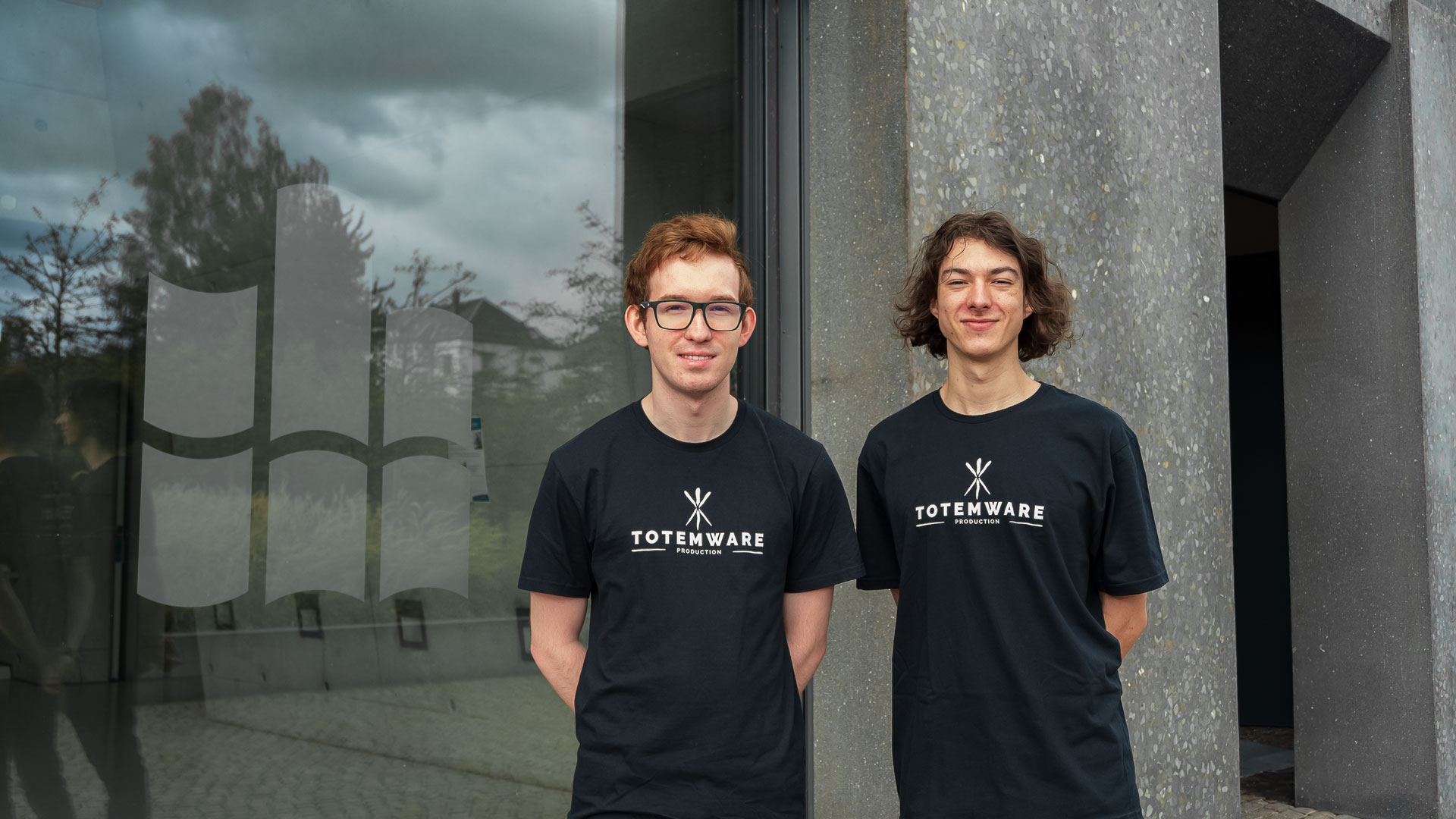
Max Kästner (21), founder of Totemware Production, sees himself more as a service provider for independent – “indies” – and medium-sized developers, offering web design, web development, trailer production and 3D modelling for the games sector. As a keen video gamer, Kästner developed an interest in the management processes behind games at an early age. So his choice of degree course comes as no surprise: “The Media Management degree programme at Mittweida University of Applied Sciences gave me the know-how I needed to plan a start-up strategically.” What he values most about the SAXEED start-up network is the network itself and events such as ‘Idea & Beer’. “SAXEED gave me the boost I needed to turn my plans into reality. I’m very grateful for that!”
The support provided by the InnoStartBonus is helping Kästner and his co-founder, Elias Hörmann (21), to cover some of their costs until their first orders come in. Incidentally, Elias is studying Media Informatics and Interactive Entertainment at the HSMW.

Success with SAXEED
SAXEED is a start-up initiative launched by the four universities in south-west Saxony, located in Chemnitz, Freiberg, Mittweida University of Applied Sciences and Zwickau. Through lectures, workshops and events, it motivates and raises awareness amongst students, graduates and university staff, encouraging them to turn the ideas and technologies developed on campus into reality – and provides individual support from the initial idea right through to setting up a business or launching their own start-up. SAXEED has also made a fresh start with the 2024 summer term. Professor Alexander Knauer from the Faculty Applied Computer Sciences and Biosciences and Professor Ulrich Buser from the Faculty Media Sciences are the new project leaders. Together with site manager Dirk Liebers, they form an interdisciplinary team aiming to facilitate more successful start-ups at Mittweida University of Applied Sciences.
Interdisciplinarity as a key to success
In order to successfully develop innovative business models, technical and sector-specific expertise must be combined with entrepreneurial skills, strategic and innovative thinking, as well as social and leadership skills – not to mention knowledge in the field of Business Administration. “I am delighted that we have been able to achieve these successes as a cross-faculty team. This demonstrates not only the great potential of Mittweida University of Applied Sciences, but also just how much we can achieve through collaboration,” says Buser.
Intensive support: a key to success
The three teams of game developers from Mittweida are examples of just how successful start-up support initiatives can be when everyone pulls together. Following the call for entries for the InnoStartBonus, SAXEED site manager Liebers approached Alexander Marbach. He teaches Creative Content Design and digital games at the Faculty Media Sciences at HSMW – and knows his students’ projects inside out. Marbach suggested several teams to Liebers who were currently working on innovative game ideas. Liebers prepared them specifically for the InnoStartBonus. As well as helping with the application and drawing up the business plan, the programme included intensive pitch training to win over the jury.
“Not all students are business whizzes. Nor do they need to be, because that’s what we at Saxeed are here for,” says Liebers. “It’s the people who matter. Ideas need to be constantly developed further to be successful. We help people with their ideas by supporting them in every aspect of the start-up process and, ultimately, by connecting them with the right people who will support their successful growth once the business has been launched.”
About the InnoStartBonus
Through the InnoStartBonus, the Free State of Saxony supports Saxon start-up founders with innovative business ideas in the run-up to and at the start of their innovative business ventures. The aim is to support selected innovators, through a competitive selection process, with a start-up grant of 1,050 euros per month for twelve months, whilst providing them with personalised support and networking opportunities.
Upcoming events in Mittweida: the Business in a Box Challenge: MakerHub Werkbank32 meets SAXEED on 19 November, the Storytelling and Brandtelling workshop on 22 November, the Social Impact Weekend in Mittweida on 22 and 23 November, and the Start-up Forum on 3 December.