

This page was translated automatically using artificial intelligence (DeepL). The German version is binding. More information about automatic translation
News Intranet
This page was translated automatically using artificial intelligence (DeepL). The German version is binding. More information about automatic translation
The fundamental objectives of the Federal Participation Act (BTHG), which was passed in 2016, are to strengthen self-determination and promote greater participation for people with disabilities. However, the BTHG has not yet been fully implemented. The overhaul of the existing integration support scheme, which is proceeding along different paths in the 16 federal states, is a complex process and is taking longer than anticipated. Nevertheless – and precisely for this reason – it is worthwhile, even at this early stage, to take an academic look at the reality of implementation, according to the organiser and moderator, Professor Sebastian Noll from Mittweida University of Applied Sciences.
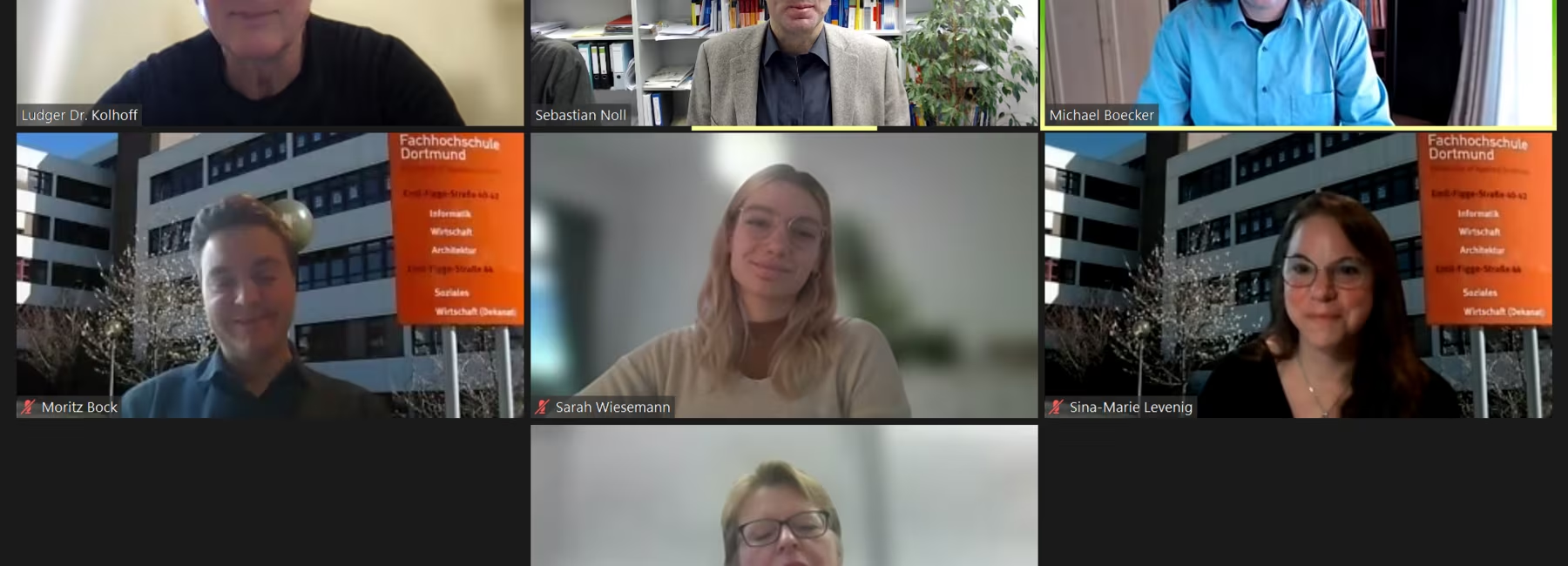
Four research teams presented the findings of their projects at the online symposium on 17 November 2023. The event was organised by the Bundesarbeitsgemeinschaft Sozialmanagement / Sozialwirtschaft e.V. (Federal Working Group on Social Management / Social Economy), an association of lecturers and researchers, and the Faculty of Social Sciences at Mittweida University of Applied Sciences. Around 60 participants accepted the invitation to the Zoom conference and not only listened but also contributed extensively with questions and comments.
After the Dean, Professor Isolde Heintze, had welcomed the participants, Professor Ute Kahle from SRH in Dresden began her presentation by providing an overview. She described the development of integration support in Germany over recent decades. She linked the conceptual considerations of the social space and lifeworld approaches with new instruments such as inclusive workplaces or the Supplementary Independent Participation Advice (EUTB), in which, following the peer counselling model, people with disabilities advise other people with disabilities seeking guidance. In doing so, she kept a close eye on the tension between participation and cost-effectiveness.
The second presentation came from Professor Michael Boecker (Dortmund University of Applied Sciences) and his research team. Here, the focus was on participation in working life, particularly on the conditions for success and the barriers involved. Starting with a qualitative pilot study, a questionnaire was developed and a nationwide quantitative survey was carried out. Initial preliminary results showed that people with disabilities lack, amongst other things, the necessary support to make the transition to the open labour market. Key conditions for success included autonomy, consideration and accessible workplaces.
Professor Ludger Kolhoff (Ostfalia – Braunschweig / Wolfenbüttel University of Applied Sciences) took a regional perspective and presented projects under the title ‘Implementation of the BTHG in South-East Lower Saxony’. A primary analysis involving managers and staff from service providers and management organisations in Wolfsburg and Salzgitter had shown that public service providers face the dilemma of striking a balance between economic rationality and the provision of services in line with the person-centred approach of the BTHG. Private service providers are increasingly having to take on administrative tasks rather than supporting people, with the result that the actual needs of people with disabilities are not given sufficient attention.
Professor Sebastian Noll and Sarah Wiesemann from Mittweida University of Applied Sciences looked beyond the national horizon. Their project compared the implementation of greater participation and self-determination for people with intellectual disabilities in communal living arrangements in Germany and the Netherlands. Selected findings suggested that Dutch service providers cooperate more closely with other organisations within the local community, thereby enabling people with disabilities to access a wide range of services. Differences between the two countries were also suggested by the survey results on leadership practices within the organisations: Whilst in Germany the focus is on centralised standards and management tools, Dutch organisational representatives emphasised a decentralised and autonomous approach; more self-directed teamwork is intended to foster self-determination among clients.
The concluding discussion, chaired by Professor Andrea Tabatt-Hirschfeldt (Ostfalia – Suderburg University of Applied Sciences), focused on the issue of cooperation between organisations, which is perceived as underdeveloped in Germany. Whilst some voices call for greater creativity and commitment from the institutions themselves, others view structural problems such as bureaucratic hurdles and inadequate funding as obstacles. It was emphasised that academia must continue to critically monitor the long road to implementation.
Photo: Christian Kästner
Text: Prof. Sebastian Noll