

This page was translated automatically using artificial intelligence (DeepL). The German version is binding. More information about automatic translation
News Intranet
This page was translated automatically using artificial intelligence (DeepL). The German version is binding. More information about automatic translation
Whilst more and more students across Germany are flocking to the major cities, the number of applications is rising in parallel at Mittweida University of Applied Sciences in Central Saxony, of all places. Most recently, the ‘DPA’ reported on the growing popularity of the General and Digital Forensic Science degree programme. However, that is only part of the story. In engineering in particular, the situation in Mittweida diverges completely from the German trend. Already, exactly twice as many first-year students have enrolled on a technical bachelor’s degree programme in Mittweida as at the same time last year.
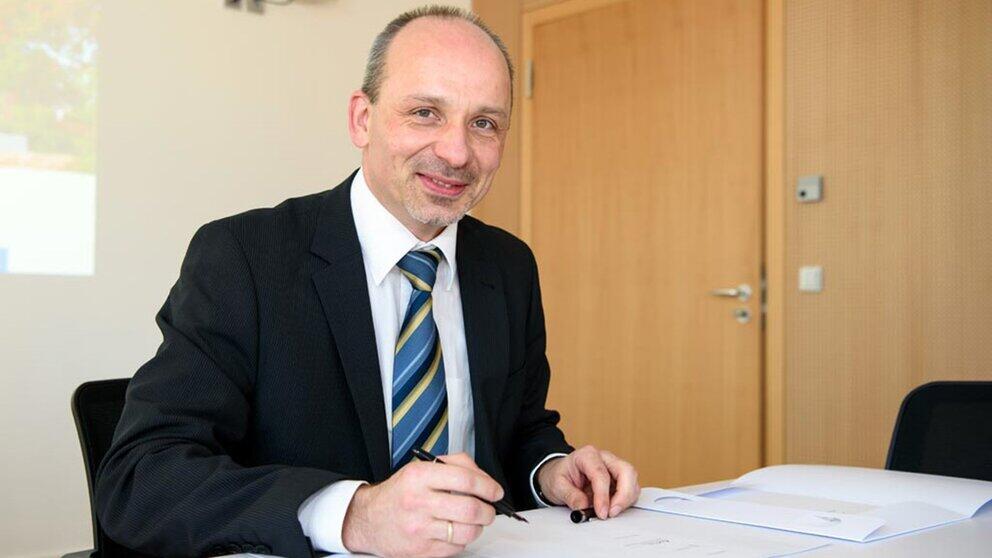
“It’s not just us who are delighted about this; it’s a positive sign for Saxony’s industrial sector, which offers engineers exciting job opportunities,” says Professor Jörg Matthes, who, as Dean, heads the Faculty Engineering Sciences at Mittweida University of Applied Sciences. In recent years, Mittweida’s engineering staff have fundamentally reformed their range of degree programmes; since 2017, 17 new professors have joined the faculty, bringing with them their industry expertise. “Our degree programmes focus precisely on the areas where industry in Germany is desperately seeking staff, and which are therefore particularly attractive,” says Matthes.
Not all Mechanical Engineering is the same
Where the degree programmes in Mittweida are titled ‘Mechanical Engineering’, ‘Electrical Engineering’ or ‘Physical Engineering’, they actually cover cutting-edge topics such as robotics, micromobility, Digital Product Development and connected mobility. The latter focuses on the conditions required to ensure that automated vehicles and passengers can use public roads safely, without putting people at risk.
The fact that there are as yet no set solutions for such technological applications of the future – and that students will be the ones to develop them once they enter the world of work – is what makes studying at Mittweida so special. “There’s no one-size-fits-all approach. We need new, innovative solutions. That’s why engineers from Mittweida stand out from the rest,” says Matthes. “Those who study here bring creativity to the table to develop new approaches and solutions – to try out new ideas, to question what appears to be tried and tested, and simply to experiment in order to find the best possible solution to a problem.”
Additional university places available in Mittweida
To ensure that even those who decide at the last minute still have the opportunity to begin their studies in the winter term, additional places have been created. For example, in Engineering pedagogy, a degree programme that offers the option of working as a teacher of a technical subject at a vocational college in the future. Or in Responsible Consumption and Production, which combines a degree in robotics with international experience at one of the EURECA-PRO universities and is of particular interest to those with an interest in technology who can envisage working for multinational companies or going abroad themselves.
Even outside the fields of forensics and engineering, Mittweida University of Applied Sciences is currently on a growth trajectory, despite demographic trends. Enrolment figures at the Faculty of Applied Computer Sciences and Biosciences and the Faculty Media Sciences are also higher than last year’s.
Those interested in starting their studies in the winter semester can currently still enrol on a wide range of degree programmes at Mittweida University of Applied Sciences. In addition to engineering programmes, this applies, for example, to computer science programmes such as forensics, Software Development and IT security; management-oriented programmes in Business Administration, Business Engineering and Sustainable real estate management; and the programme in Media Informatics and Interactive Entertainment.