

This page was translated automatically using artificial intelligence (DeepL). The German version is binding. More information about automatic translation
News Intranet
This page was translated automatically using artificial intelligence (DeepL). The German version is binding. More information about automatic translation

Dementia affects many people. Across Germany, dementia affects more than 1.8 million people living with the condition. It therefore also affects their relatives, their social circles, and the many full-time and voluntary support workers, carers and nursing staff. It affects politics, academia and research – and society as a whole. Nevertheless, there are still many steps to be taken on the path towards a dementia-sensitive society.
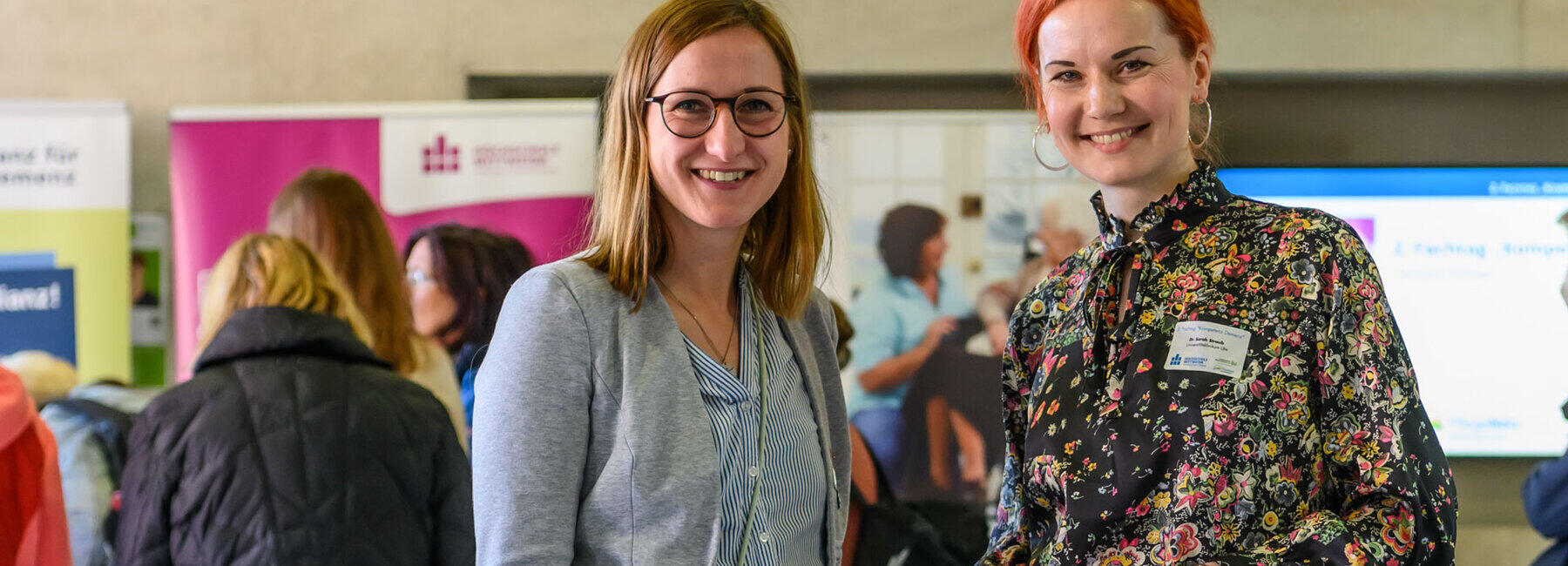
Mittweida University of Applied Sciences took one such step on 3 May 2023 with the event ‘Kompetenz Demenz’. The Faculty of Social Sciences and its partners – Landesinitiative Demenz Sachsen e.V., the Alzheimer’s Society and PflegeNetz Mittelsachsen – organised the event to raise awareness, provide information, foster networking and build capacity. Around 150 participants and exhibitors attended this event – the second of its kind since 2021 – which focused on dementia and was aimed at a broad audience.

Professor Barbara Wedler and her colleague Bianka Hammer organised the symposium: Wedler: “As a significant proportion of the care provided to people with dementia is carried out by family carers, our symposium is aimed not only at professionals in the fields of medicine and nursing, as well as students, but also, and in particular, at family carers and volunteers. For all of them, the event offers a wide range of lectures and workshops.”

Bavaria as a role model: a regional dementia strategy
Klaus Holetschek, Bavarian Minister of State for Health, joined the event via video link to deliver the keynote address. The Free State of Bavaria is currently one of only four federal states to have a state-specific dementia strategy. This is important given the varying conditions (population density and average age, infrastructure and care provision) across Germany. Under the heading ‘Dementia as a societal challenge – quo vadis?’, the Minister presented the ten areas of action in the Bavarian strategy, including two that were of particular importance to the participants at the Mittweida symposium: living in supported shared accommodation and care homes, and home support and respite care for family carers.

Care: Every person with dementia is different
In doing so, the Minister also addressed a matter close to the heart of the second speaker that morning: Klaus Wudmaska, founder and leader of the Plauen-Vogtland Alzheimer’s Family Support Group. The 82-year-old Wudmaska shared his many years of experience in caring for people with dementia, first in a professional capacity, then within his own family and as a volunteer: his talk, ‘Your dementia – my life. Relatives caught between care and overload’ was peppered with anecdotes from everyday life, some light-hearted, some touching, encouraging and honest.

From a medical perspective, too: not all cases of dementia are the same
Psychologist Dr Sarah Straub was also invited to Mittweida to speak about a cause close to her heart – and her main area of research at the University of Ulm – namely one of the many forms of dementia and the second most common form affecting people under the age of 65: frontotemporal dementia (FTD). Like Alzheimer’s disease, it is a progressive form of dementia. The American actor Bruce Willis is a high-profile sufferer.
Patients experience personality changes, develop speech disorders and lose their sense of social behaviour and of right and wrong – and thus present with extremely non-specific symptoms that are difficult to attribute to the condition. The impact on their professional and private lives is significant, particularly as part of the clinical picture is that patients lack awareness of these changes.

Music: Everyone has their own taste
The morning drew to a close on a musical note. In her talk entitled ‘Personalised Music Listening – Favourite Music for People with Dementia’, Doreen Rother from Friedrich Schiller University in Jena discussed the effects of listening to personalised playlists on people with dementia. She and her colleagues in Jena are investigating this as part of a study. Favourite pieces of music are an important part of a person’s life story and of their life before developing dementia.
Positive experiences and feelings are associated with this music. Reactions whilst listening to personalised music are said to be very varied and individual. Some people began to sing, others moved rhythmically, whilst others simply listened in a relaxed manner. The advantages of this method are that it is cost-effective, non-pharmacological, language-independent and can be easily integrated into both inpatient and home care.


Practical Session in the Afternoon
Doreen Rother (Personalised Music) shared her experiences, as did Sarah Straub (Nutrition and Dementia), during one of the eight workshops held on the afternoon of the symposium. “Dementia Partner Course”, “An Appreciative Approach to Working with People with Dementia”, ‘Biographical Work in the Care Process’, ‘End-of-Life Care for People with Dementia’ and ‘Kraft-Copilot – The Self-Care Platform for Young Family Carers’ were among the other workshops on offer.

Support for carers
The programme of lectures and workshops was accompanied by a ‘Market of Opportunities’ at the Centre for Media and Social Work at Mittweida University of Applied Sciences: 21 organisations showcased a wide range of care options for people with dementia. Among other things, visitors had the opportunity to experience the limitations of old age for themselves using an age simulation suit, whilst the dementia obstacle course – led by students – simulated the changes associated with dementia.

A Blooming Epilogue
A few days later, the organisers, together with the gardening group from the Seifersbach social therapy residential home run by the Mittweida Association for Supported Living, planted the 90 petunias that had adorned the conference rooms into a flowerbed. These colourful harbingers of summer will be followed in September by a training course on ‘Dementia and Disability’ for care staff.