

This page was translated automatically using artificial intelligence (DeepL). The German version is binding. More information about automatic translation
News Intranet

This page was translated automatically using artificial intelligence (DeepL). The German version is binding. More information about automatic translation
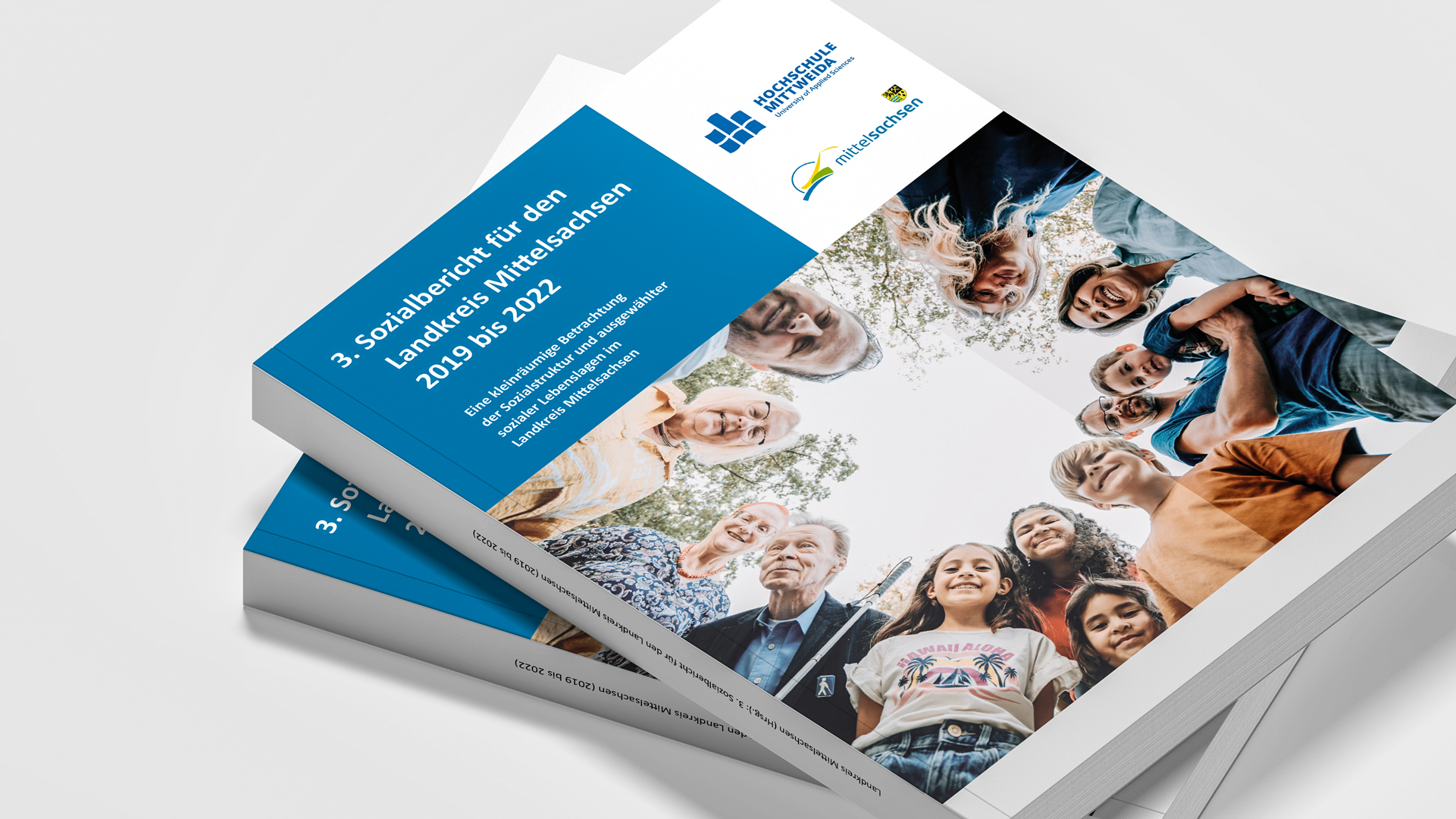
The Mittelsachsen district published its third social report this week. Researchers Tabea Esche and Friederike Haubold have been compiling the report since March 2024 under the leadership of Dr Isolde Heintze. Heintze is a professor of social policy at the Faculty of Social Sciences at Mittweida University of Applied Sciences and has been working with the Mittelsachsen district administration since 2014.
On 11 December 2024, the professor presented the social report to the district council in Freiberg. She said: “All good things come in threes. The consistent implementation of social reporting in the Mittelsachsen district is unrivalled in the Free State of Saxony. Thanks to this continuous social reporting, it is now possible to provide a detailed and localised picture of the living conditions of the population of Mittelsachsen spanning twelve years.”
The third social report, running to almost four hundred pages, examines developments in living conditions in the district over the period from 2019 to 2022: How is demographic change affecting the population of Central Saxony? What influence do global events, such as the COVID-19 pandemic, have on the living conditions of young and old? Who voted for which party in the 2021 federal election? How are educational qualifications distributed in Central Saxony? Where are people most in need of social support? What opportunities and challenges does immigration present? The report, now available, provides answers to these questions.
Jörg Höllmüller, Second Deputy District Administrator of the Mittelsachsen district and responsible for health and social affairs, emphasises: “In turbulent times such as these, it is particularly important to have sound insights into the social structures and developments in our region.”

New topics added
In the social report, the authors provide a nuanced account of the diverse life circumstances and situations faced by the residents of Central Saxony across the 52 local authorities within the district. In terms of content, the report builds on previous reporting and therefore continues to examine the four key areas of focus: demography, finances and income, intangible life circumstances, and social participation.
Furthermore, the report is enriched by new topics such as the side note ‘Between challenges and opportunities – prospects for people of foreign origin in the Mittelsachsen district’, an ‘expansion of the indicators for socially vulnerable living conditions of children and their families’, and an examination of the topic of ‘care’. Furthermore, initial findings from the 2022 Census population survey are presented.
By linking the data-driven findings to the ‘areas of social policy action’, the importance of local-level social reporting for municipal social policy is once again made clear and tangible. The authors set out specific recommendations for action aimed at developing a socially inclusive and participatory society in the Mittelsachsen district.
Sylvia Kempe, Coordinator for Integrated Social Planning in the Mittelsachsen district, emphasises: “With this third social report, we once again have access to a sound data foundation that supports forward-looking planning and decision-making processes for all stakeholders involved in social services.”
The established collaboration between the university and the district will continue in the coming years – and in four’s time, it will be ‘Four Wins’.
Gain an insight and have your say
Residents of the district are also invited to use the report to gain an insight into the diversity of people’s life circumstances, to engage in discussion about these issues, and to continue helping to shape the future of the district.
The platform mittelsachsen-sozial.de offers comprehensive and clearly presented information on social policy issues in the district.
The 3rd Social Report of the Mittelsachsen district and a version in plain language are also available for download there.