

This page was translated automatically using artificial intelligence (DeepL). The German version is binding. More information about automatic translation
News Intranet
This page was translated automatically using artificial intelligence (DeepL). The German version is binding. More information about automatic translation
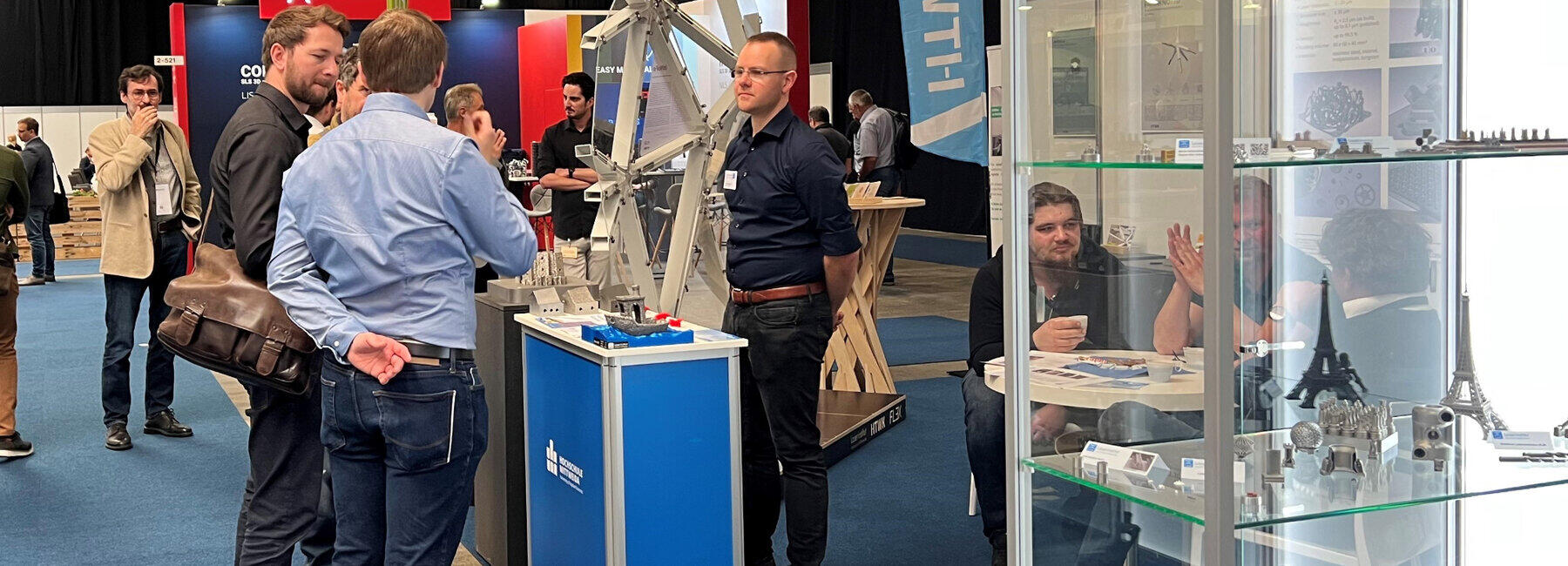
The sub-project ‘Laser-based Manufacturing in Architecture and Construction’ was represented here by Mittweida University of Applied Sciences and the Leipzig University of Applied Sciences, which had combined their stands to form a joint stand. They presented their entire portfolio in the field of laser-based additive manufacturing using metals and ceramics, as well as the application of 3D Printing in architecture and construction, to more than 2,700 visitors to the exhibition.
The attention of visitors to the trade fair was once again drawn to the section of a free-form façade with customised connection nodes on the stand, which was making its second appearance at the event. This time, however, there was a new development: The nodes are no longer all manufactured from aluminium using conventional selective laser melting (SLM); instead, the first stainless steel nodes were on display, produced using macro-SLM, a newly developed process by the Laser Institute at Mittweida University of Applied Sciences (LHM). The process enables 3D Printing of large-volume components. It uses a coarse powder (particle size: > 200 µm), which is fused using high-power laser energy. In the future, it will enable 3D Printing of large parts (in the cubic metre range).
The collaboration between the two exhibiting partners within the Saxony5 technology transfer network aims to establish additive manufacturing in the construction industry. The FLEX research group at HTWK Leipzig is conducting research into resource-efficient, smart and efficient load-bearing structures, such as optimised façade and roof structures. This requires custom-made joints, which only makes economic sense through additive manufacturing. As conventional 3D Printing processes are too costly, LHM has developed the new Macro-SLM process. This enables the cost-effective custom production of these joints. Furthermore, the process also offers great potential for the additive manufacturing of significantly larger components. Interest at the stand was correspondingly high.
In addition to the stand, Martin Erler from the Laser Institute at Mittweida University of Applied Sciences gave a presentation at the 3D Printing Conference, during which he revealed further details about the new process and also outlined other areas of research in the field of laser-based additive manufacturing at the LHM. He also discussed the micro-SLM process, which addresses the completely opposite range of sizes and enables the manufacture of the smallest parts made of metal and ceramics.
Text: Michael Pfeifer, Images: Mittweida University of Applied Sciences